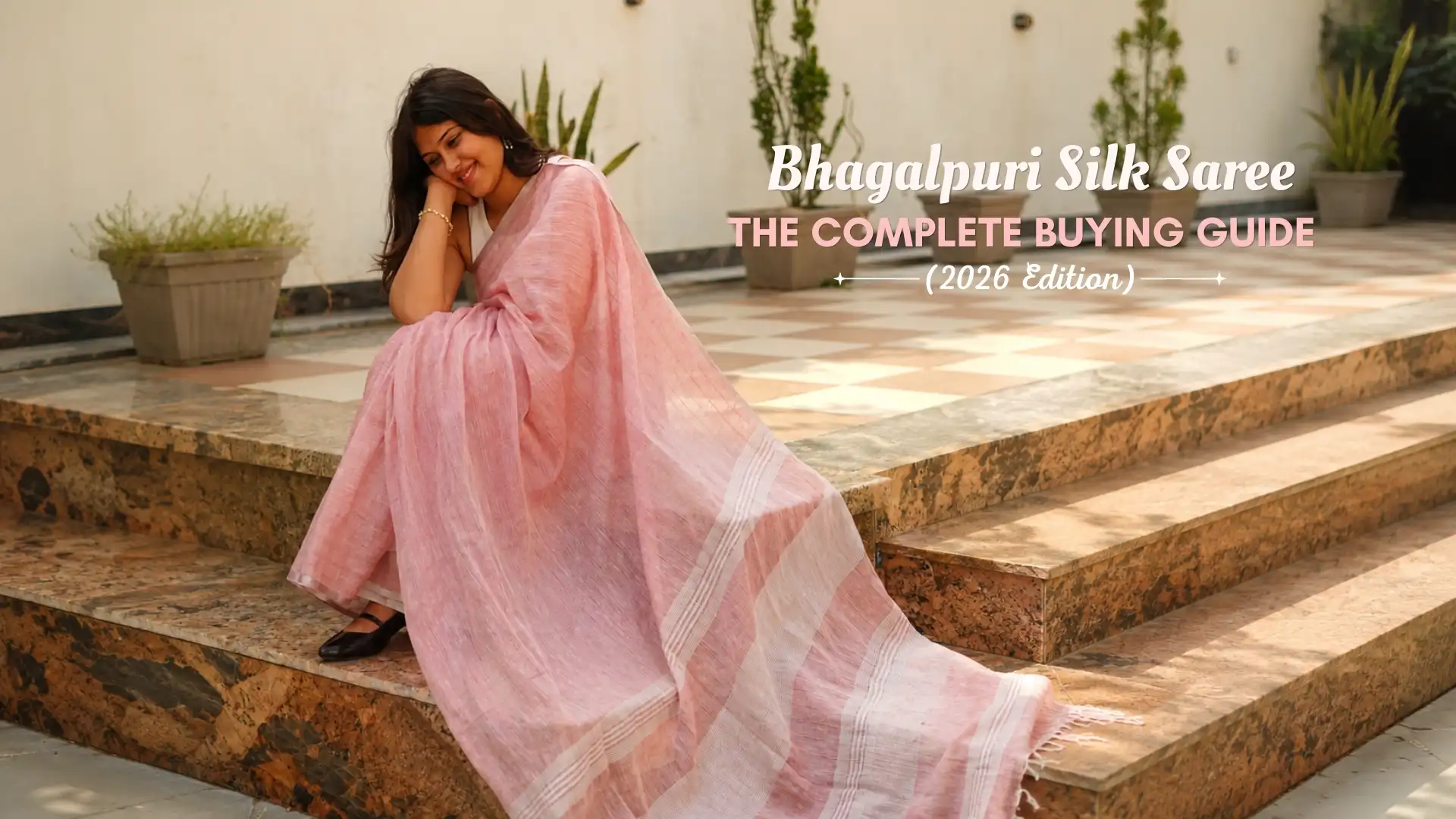
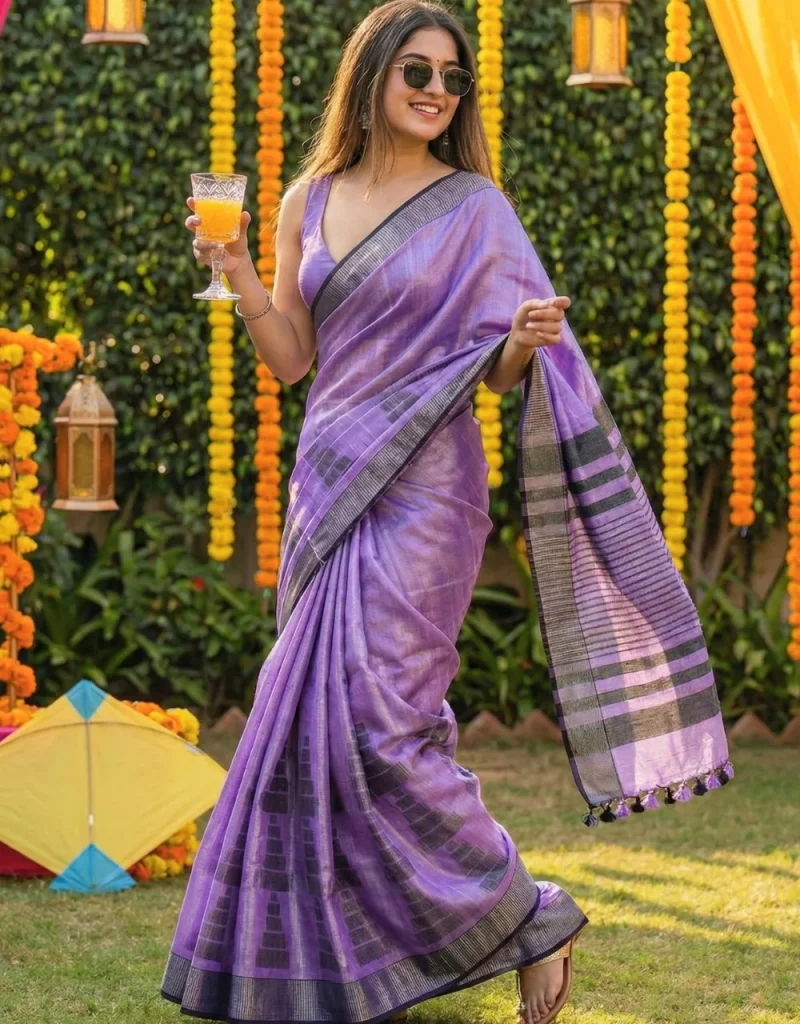
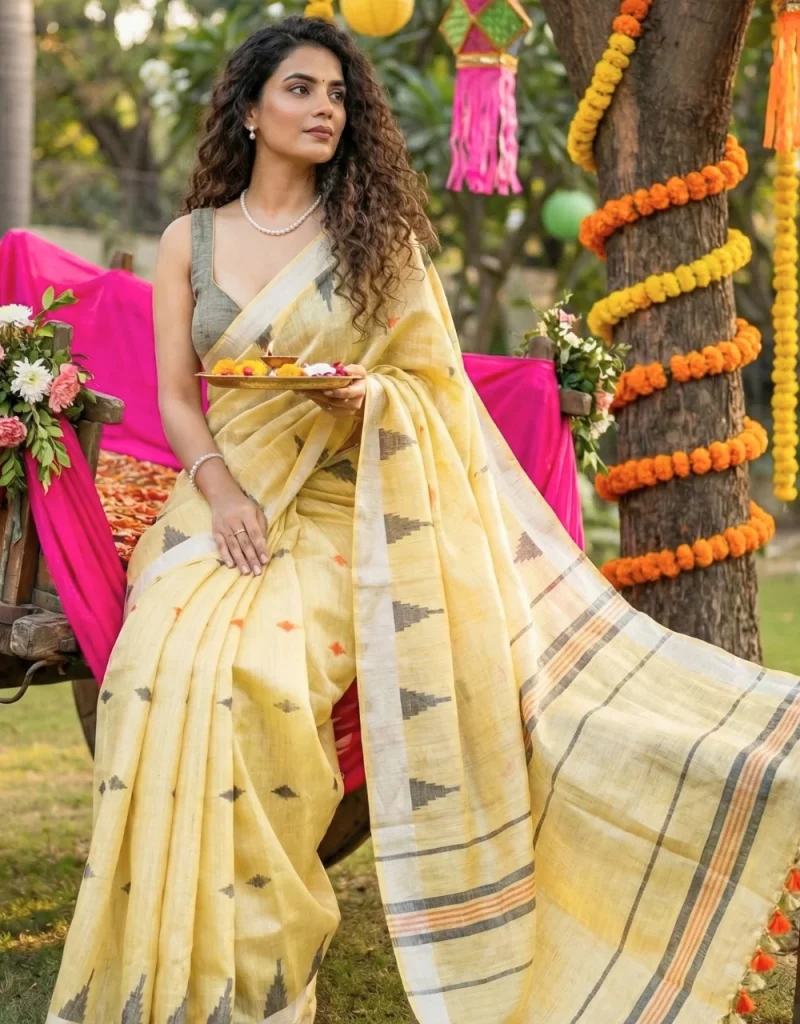
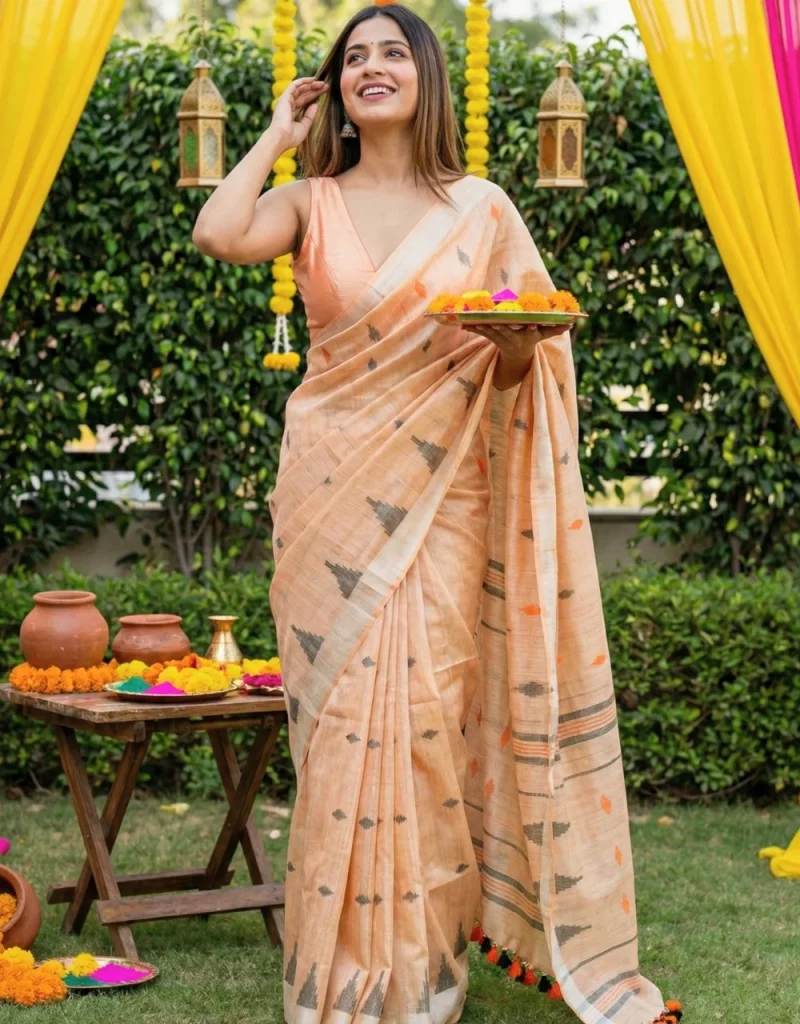
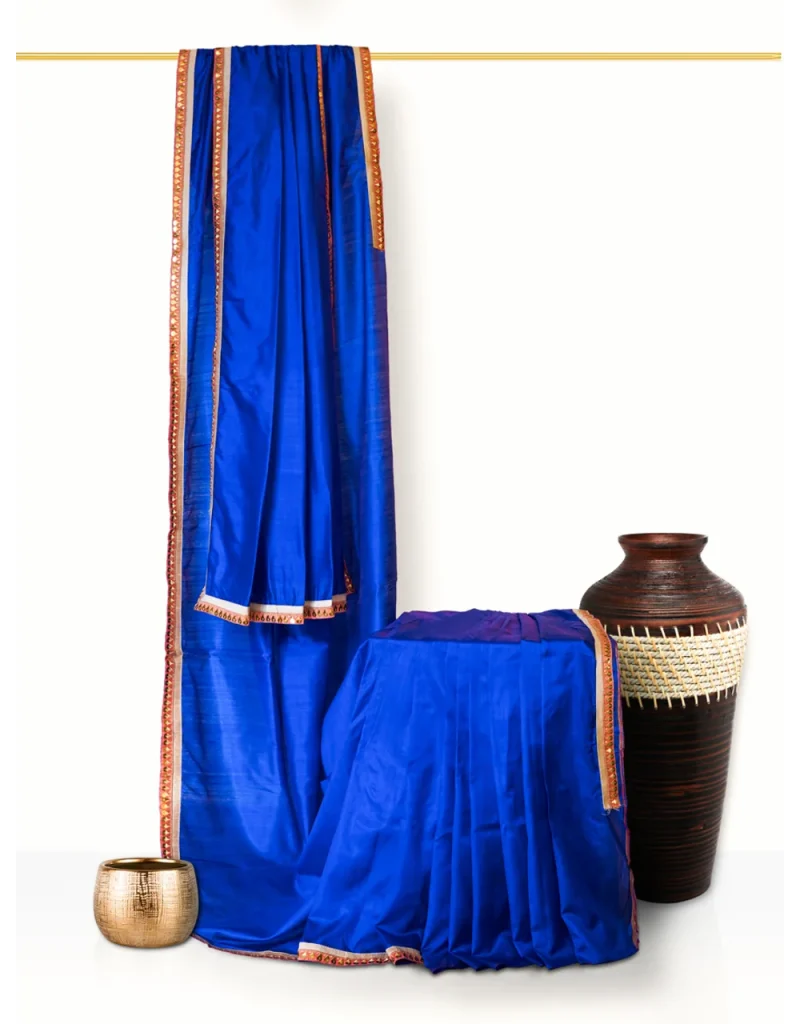
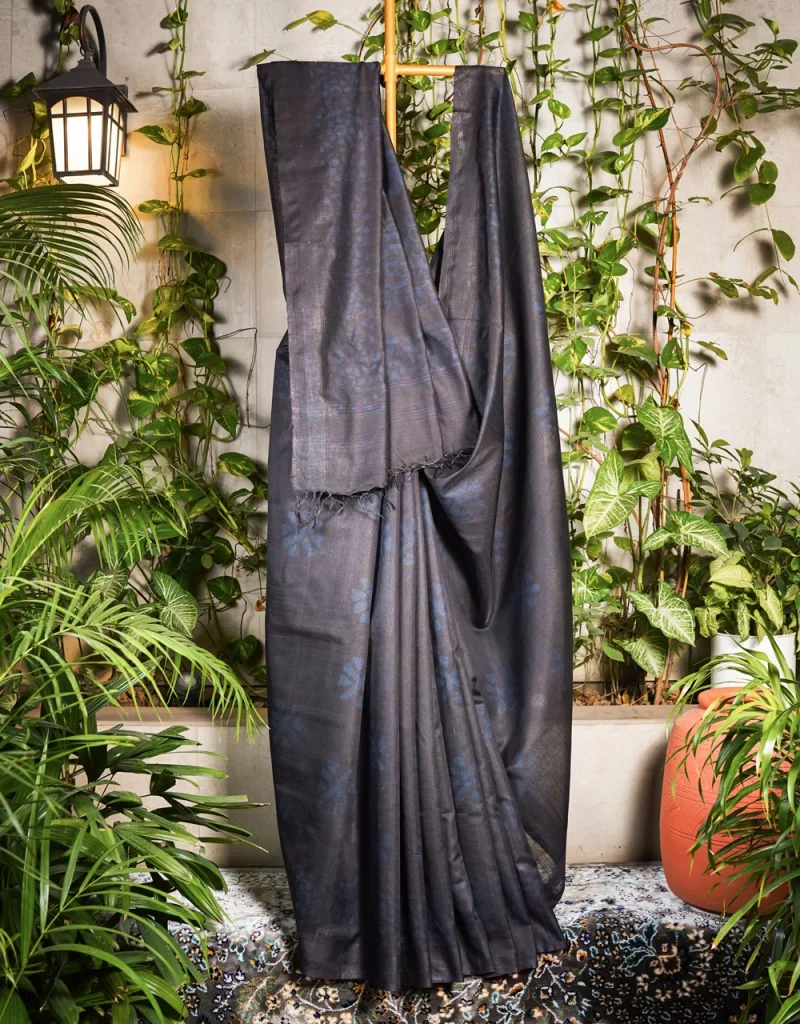
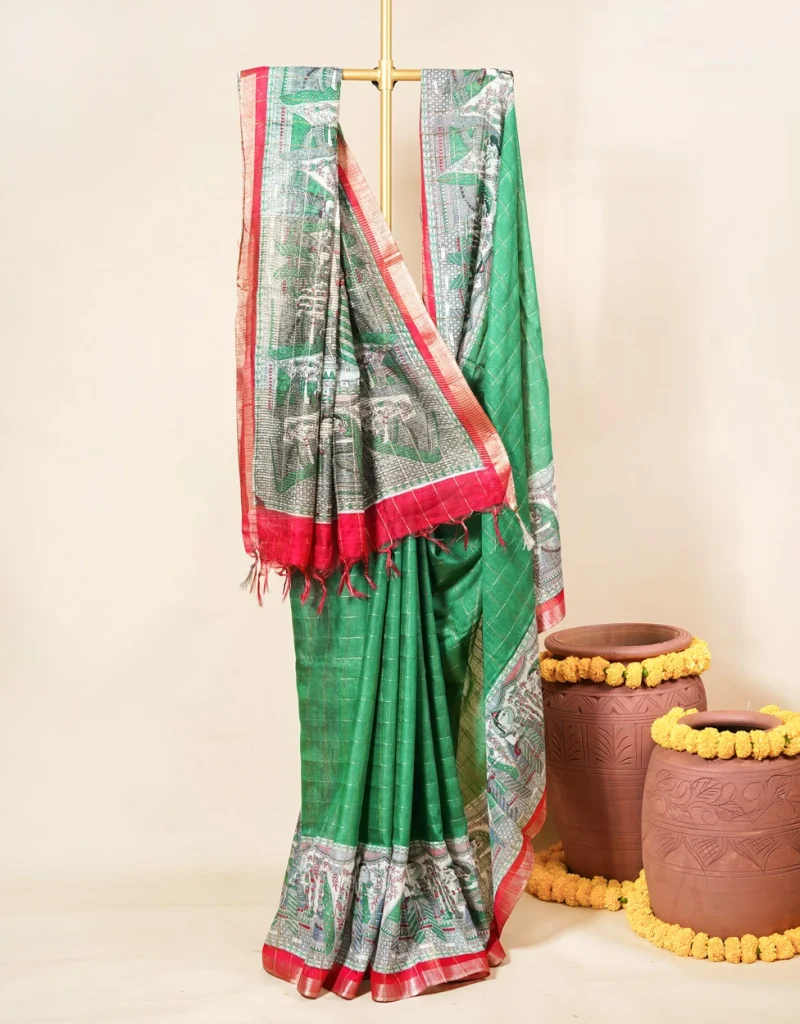
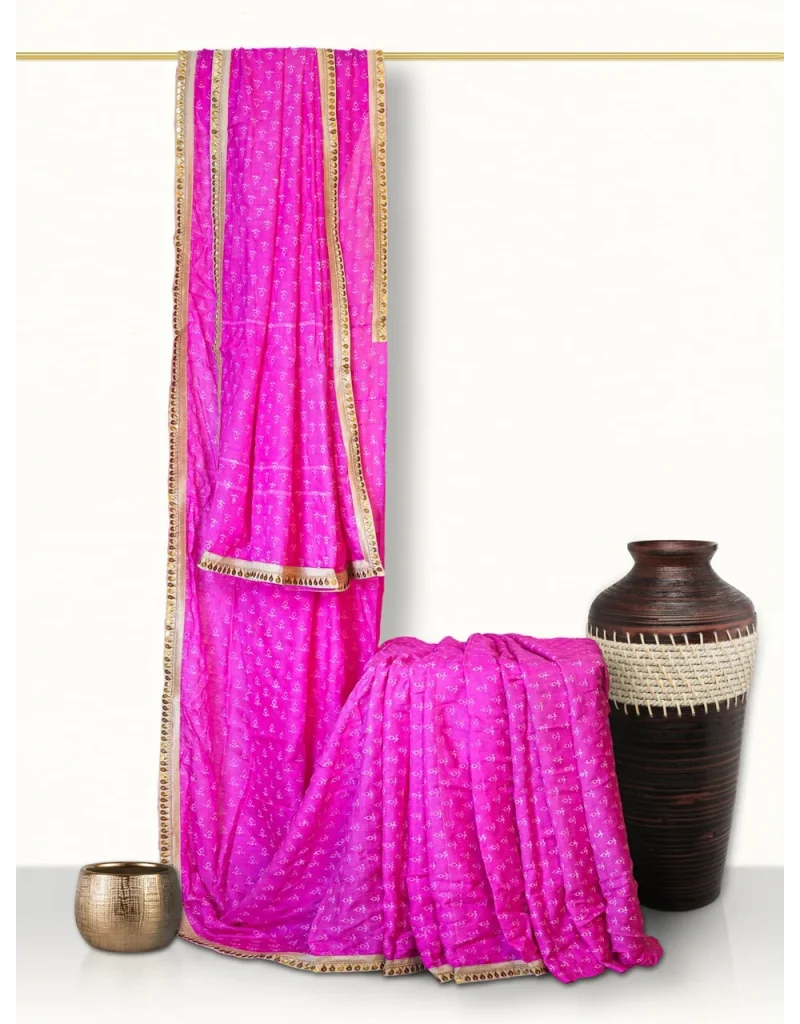
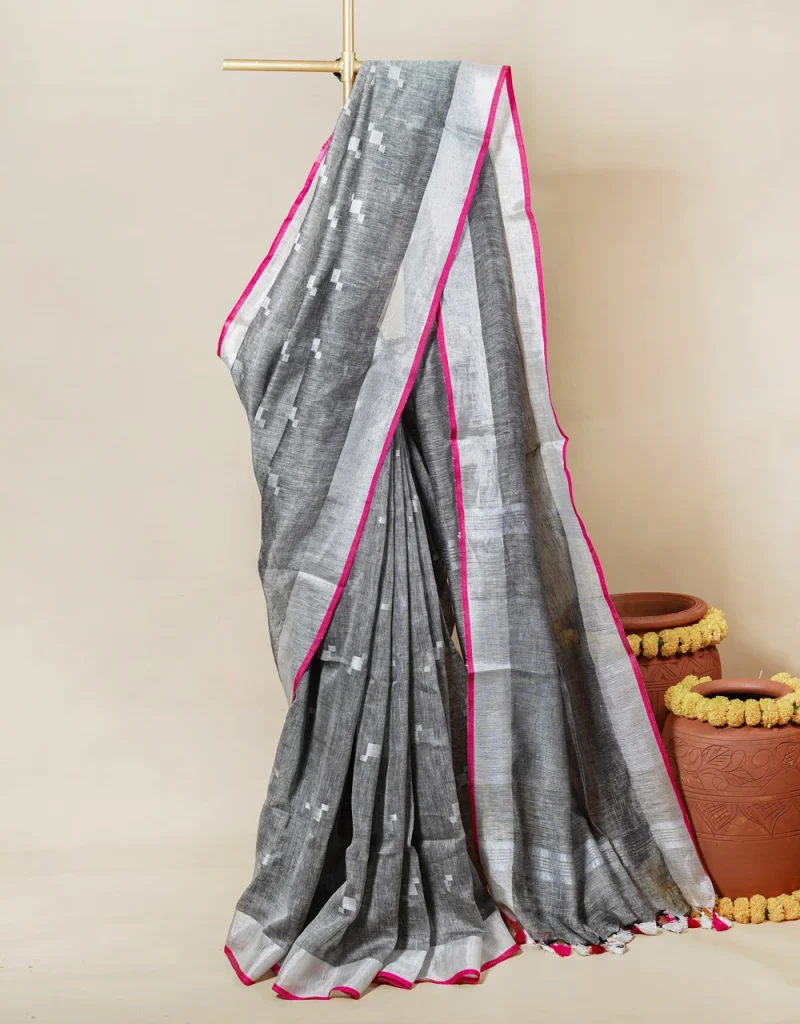
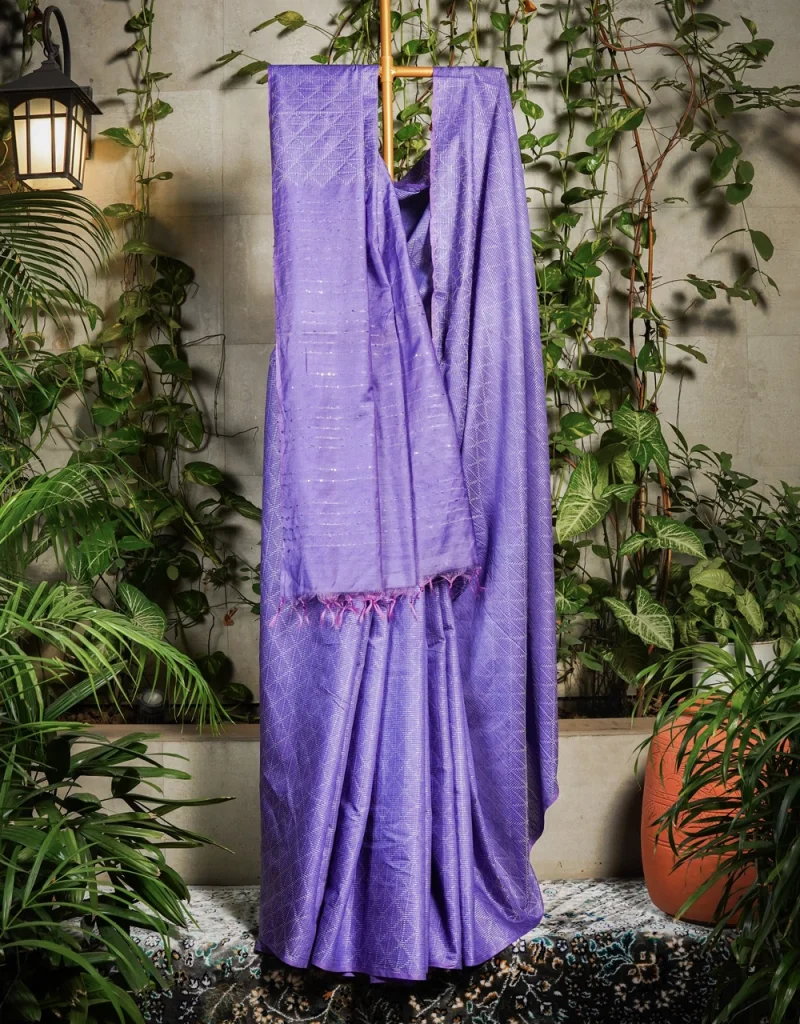
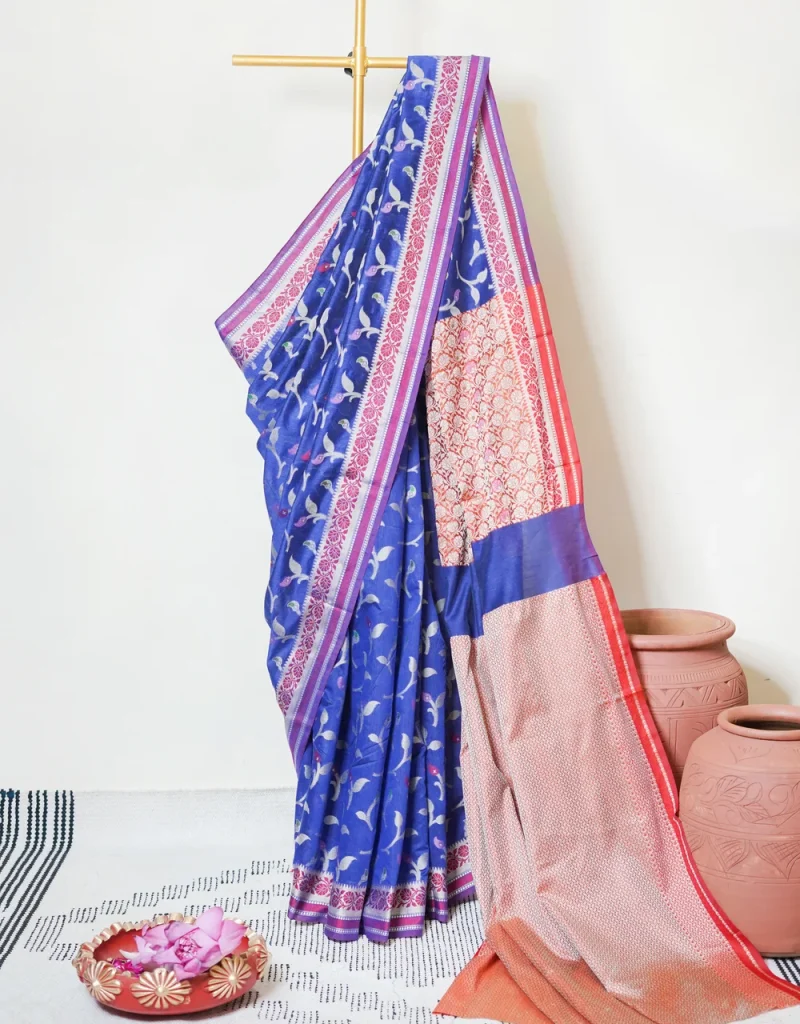
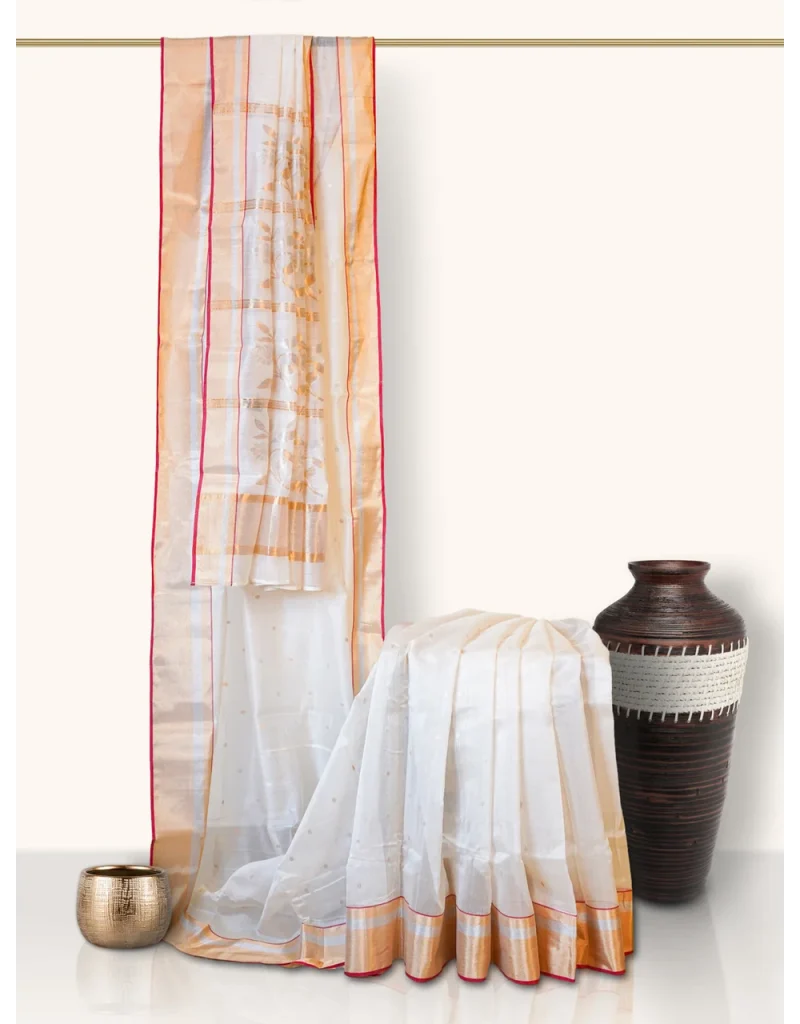
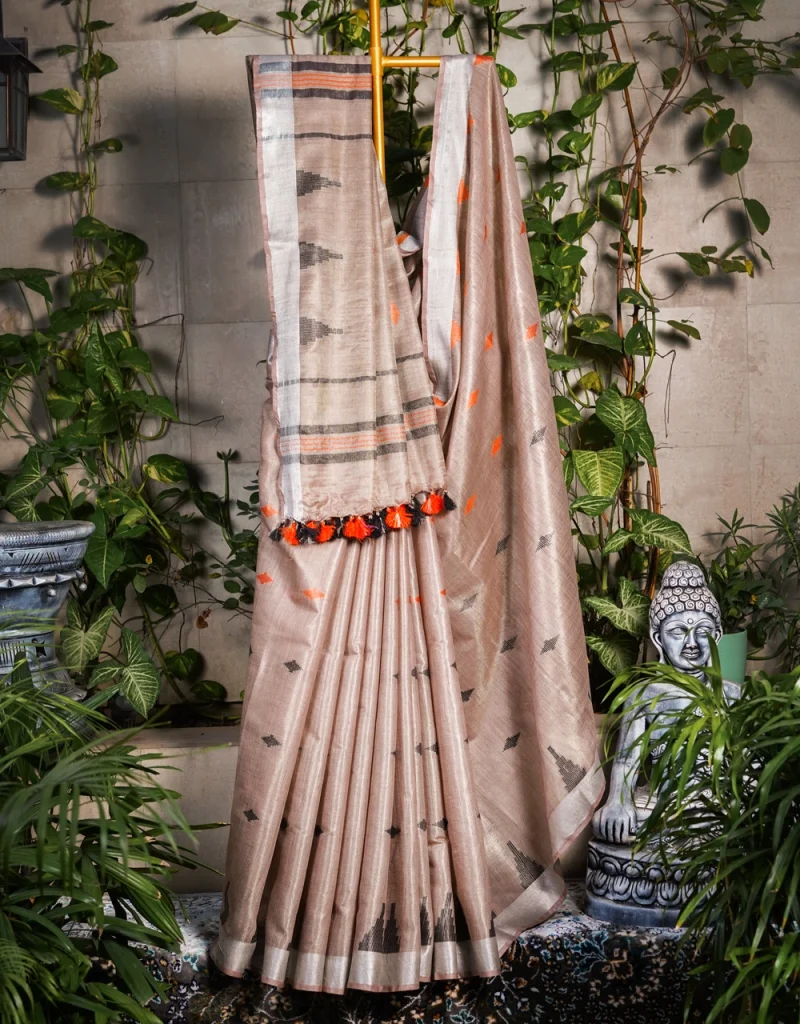
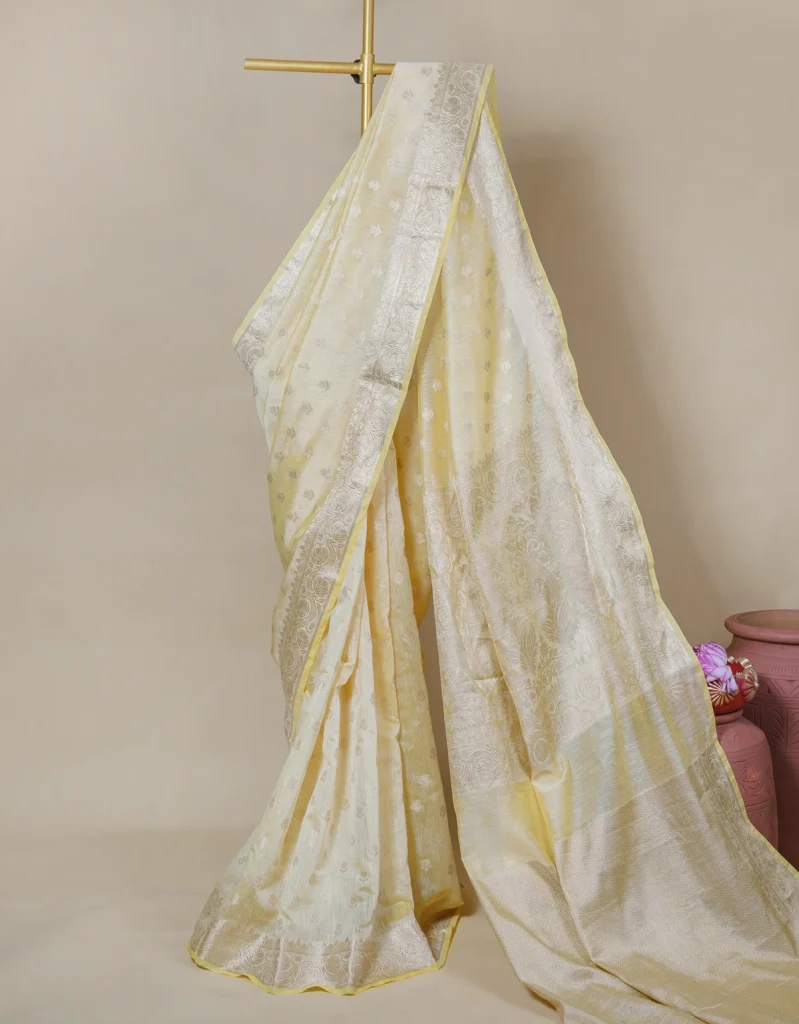
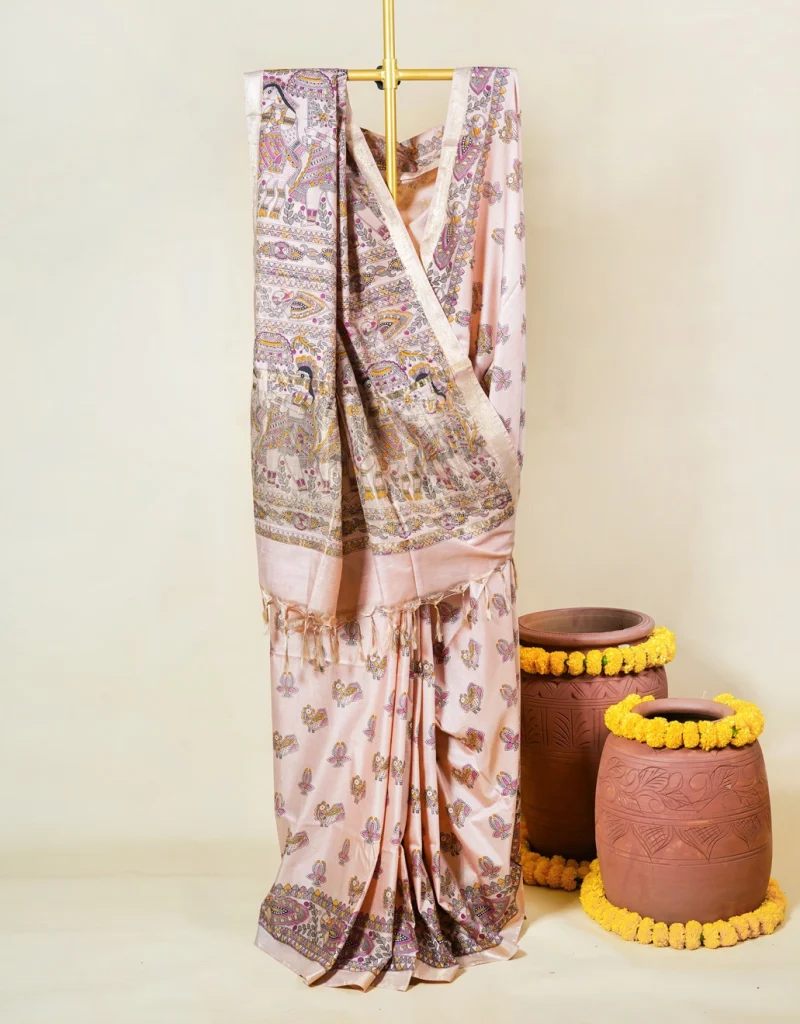
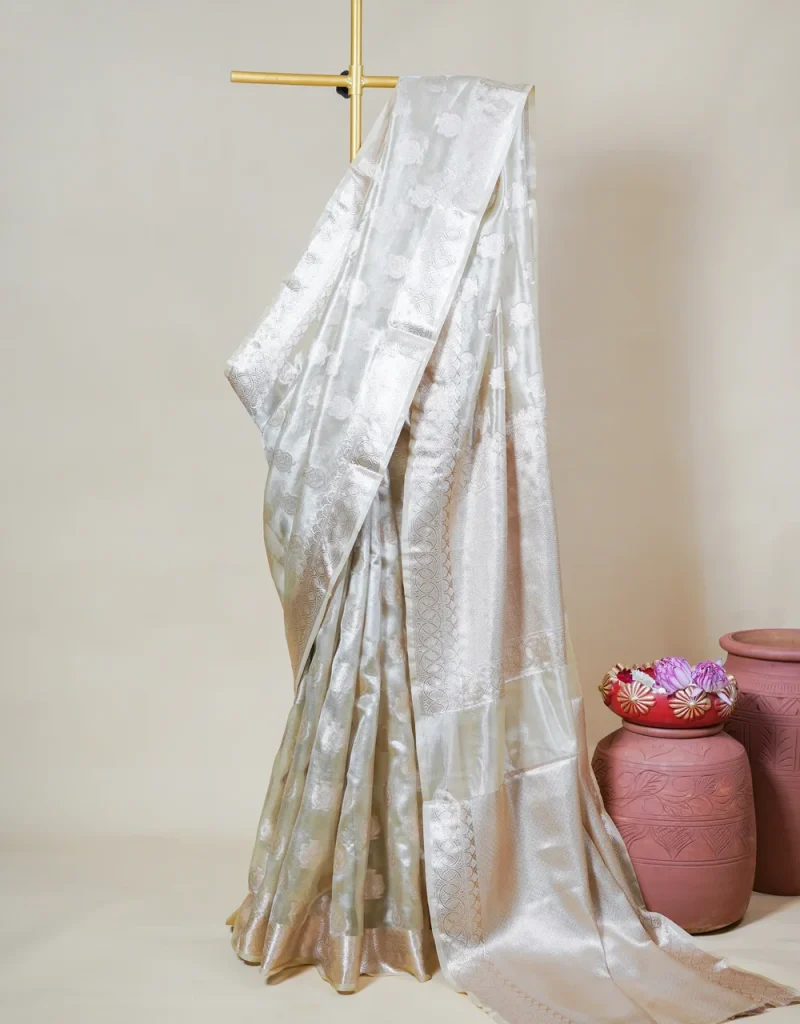
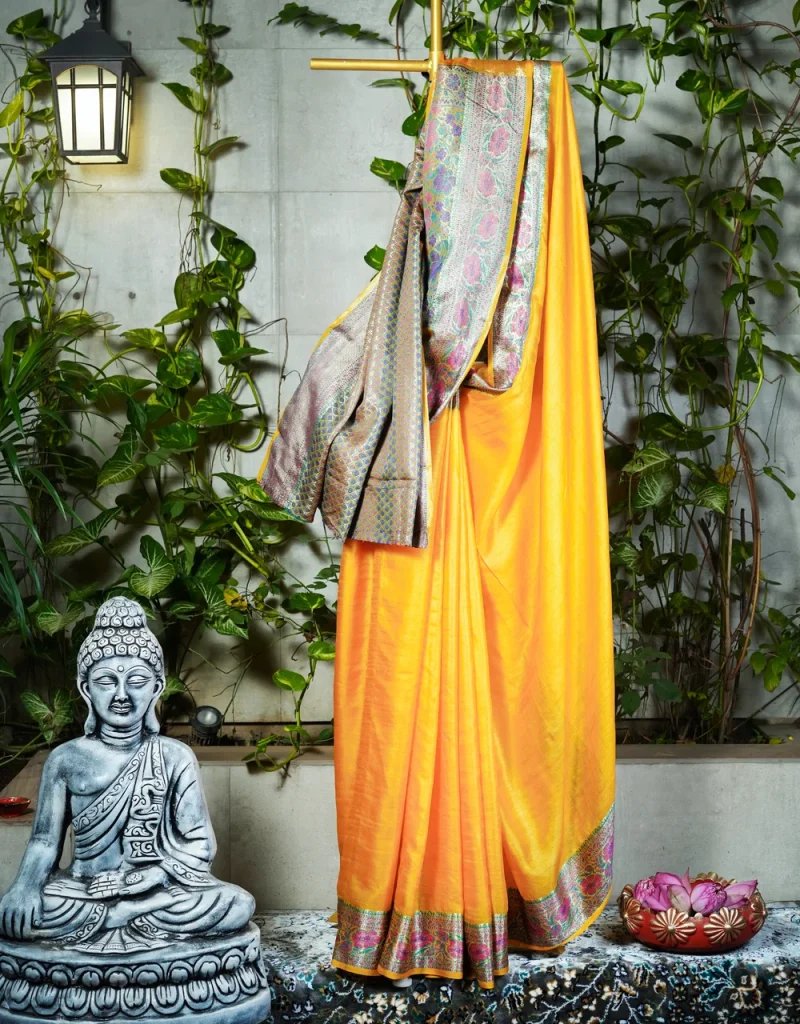
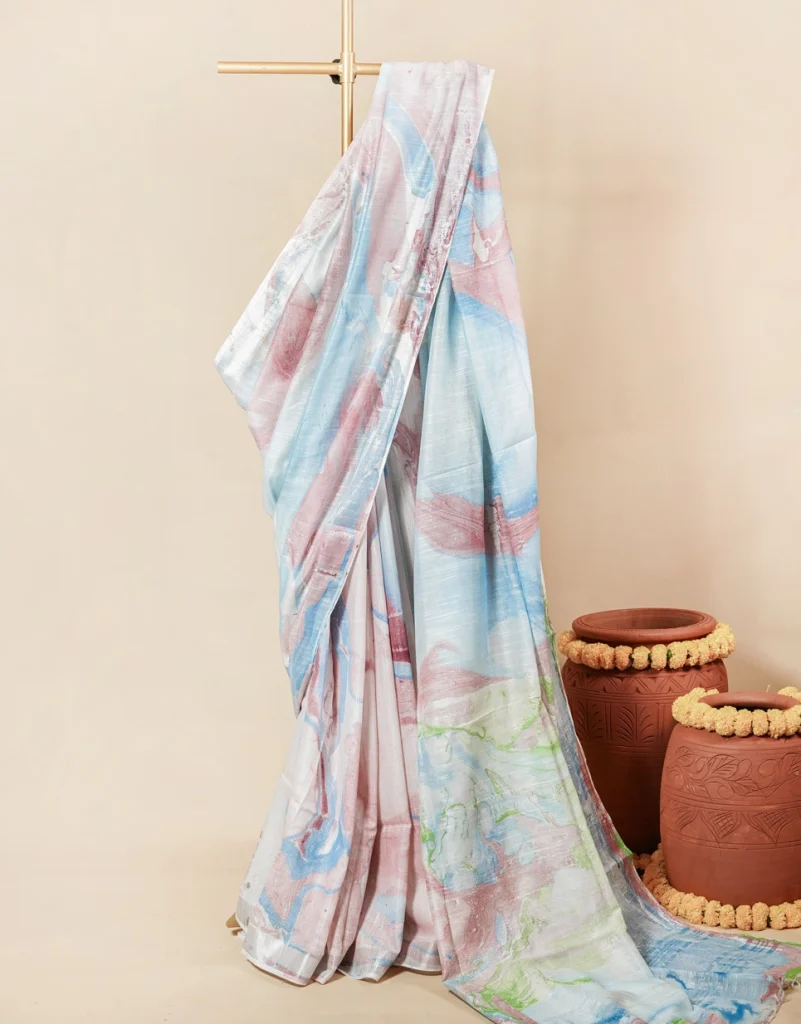
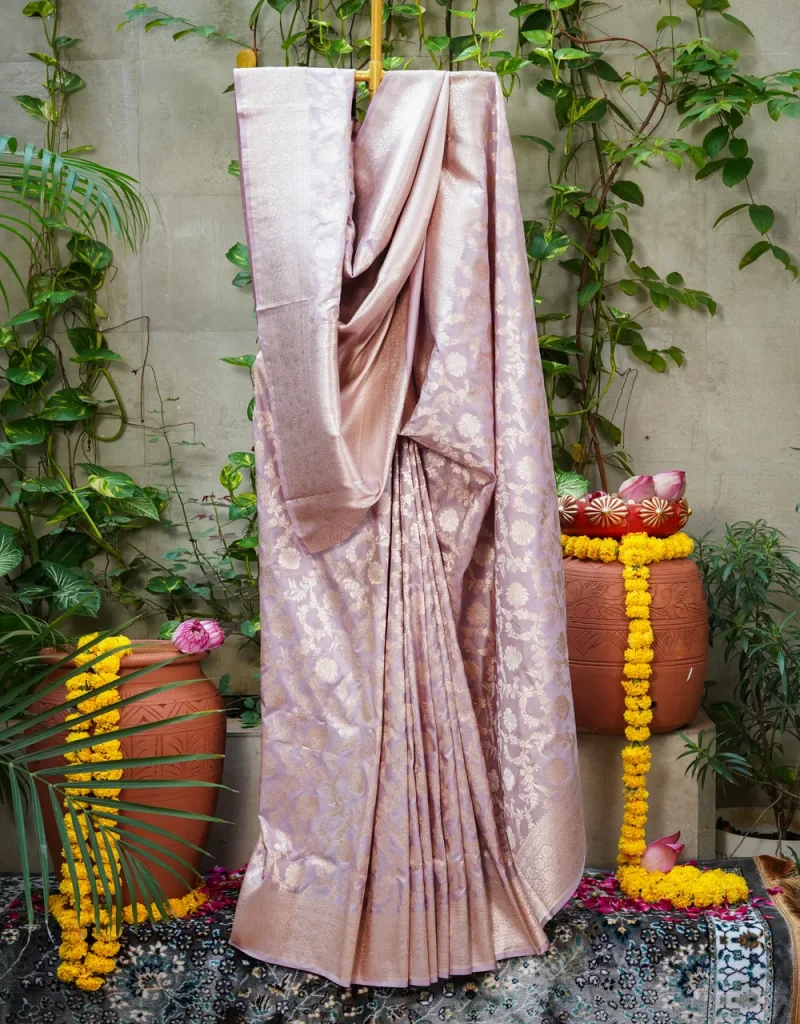
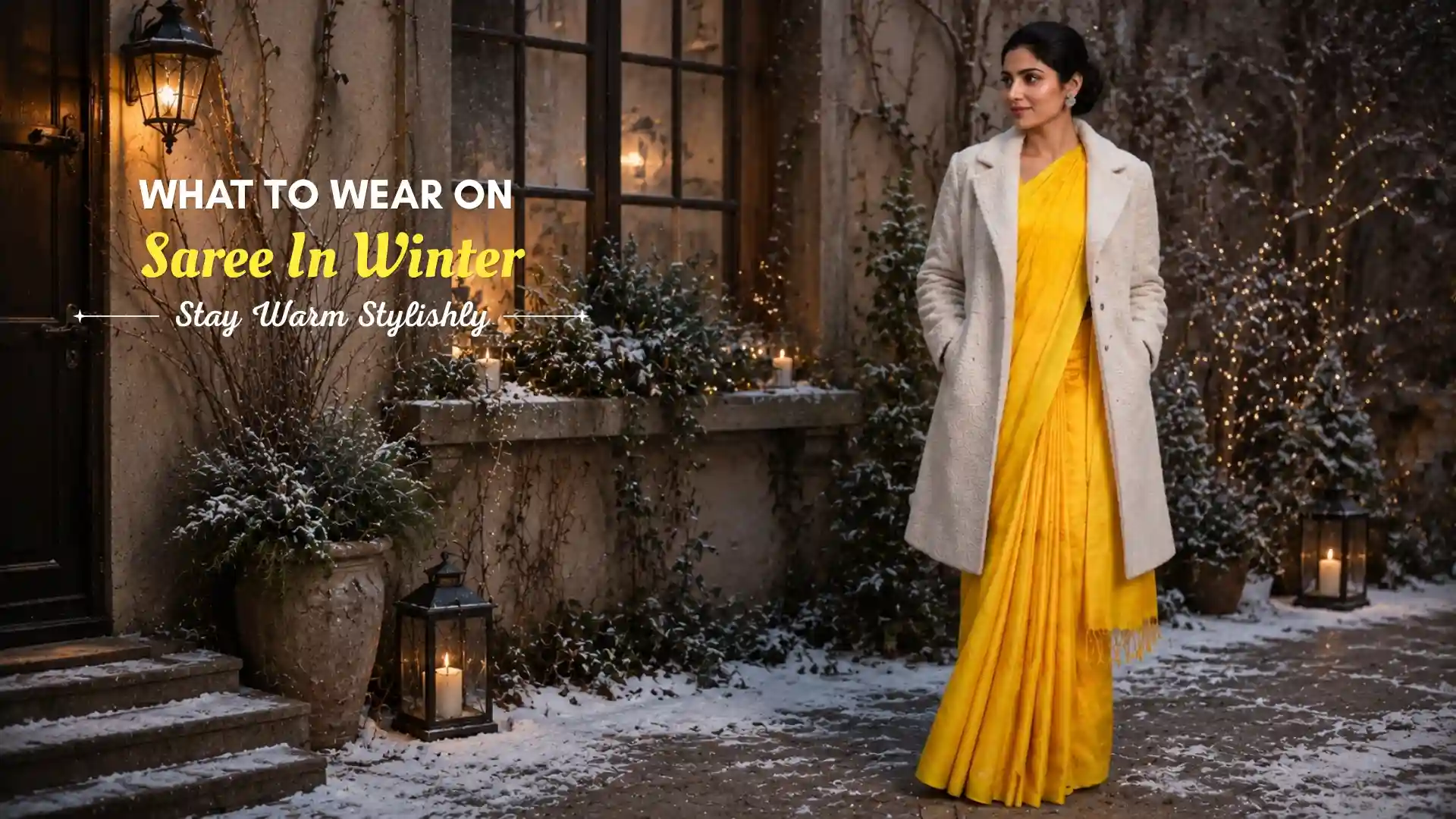
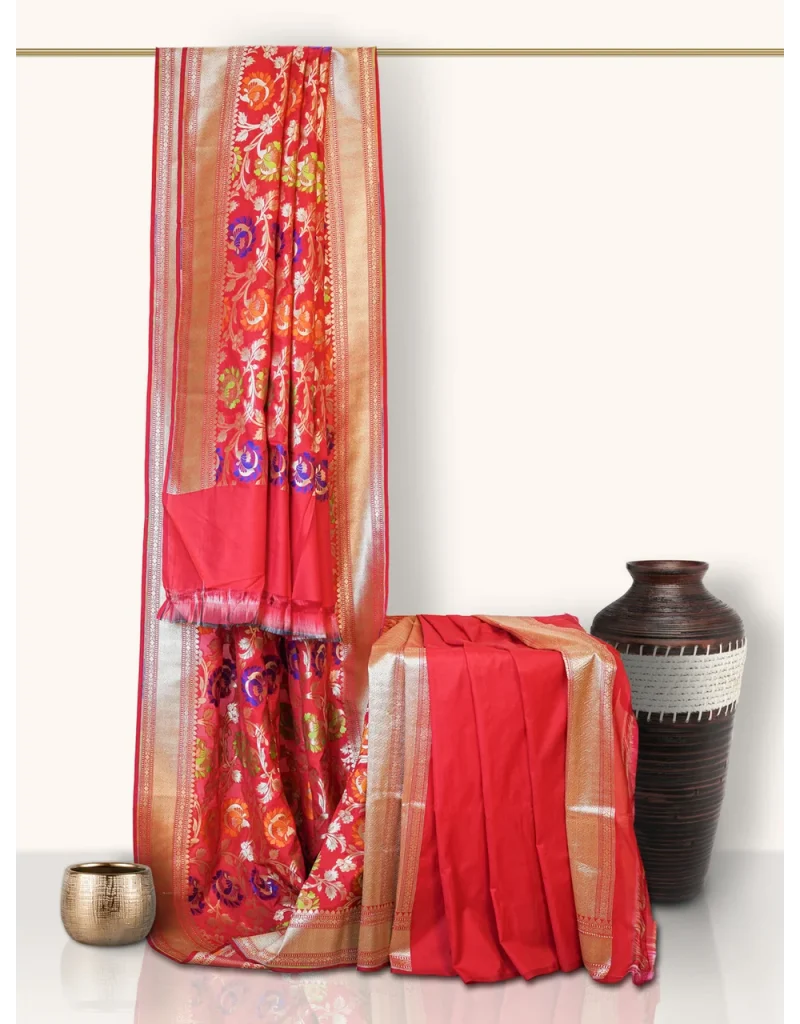
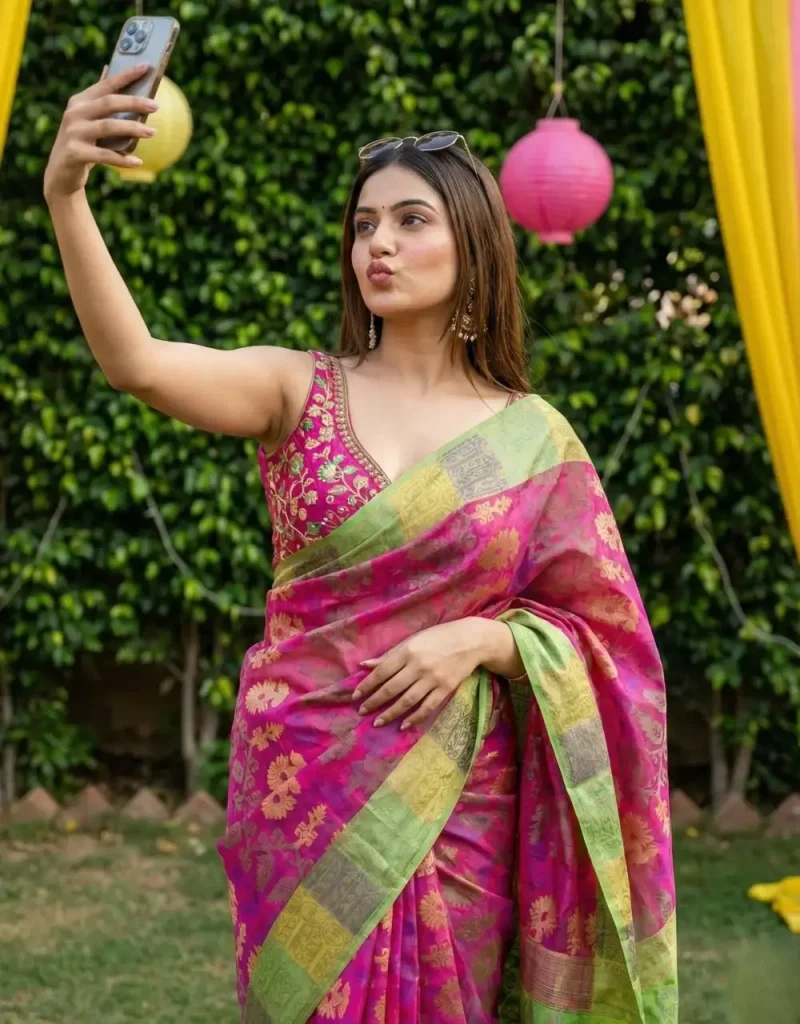
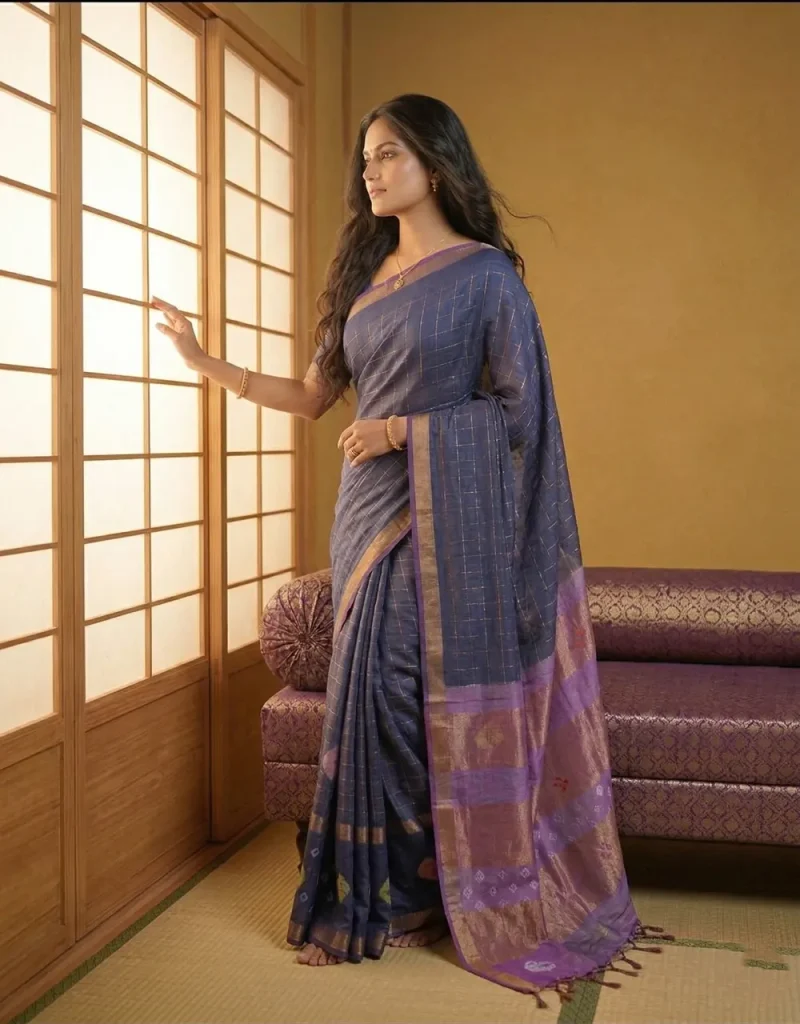
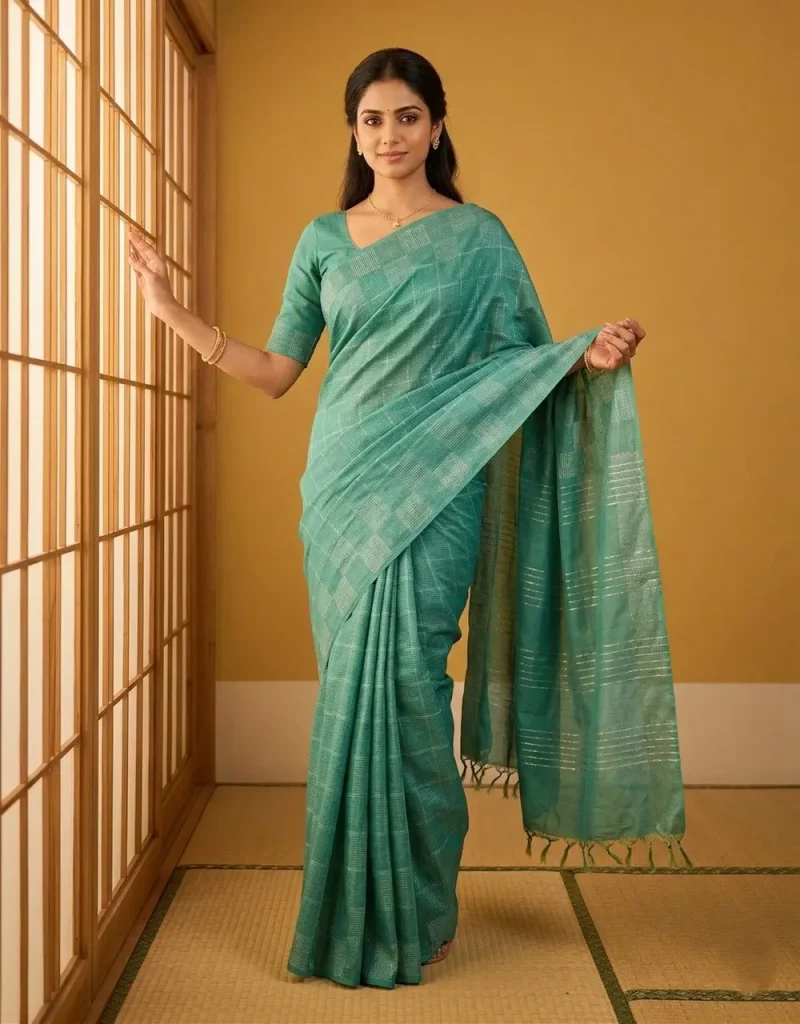
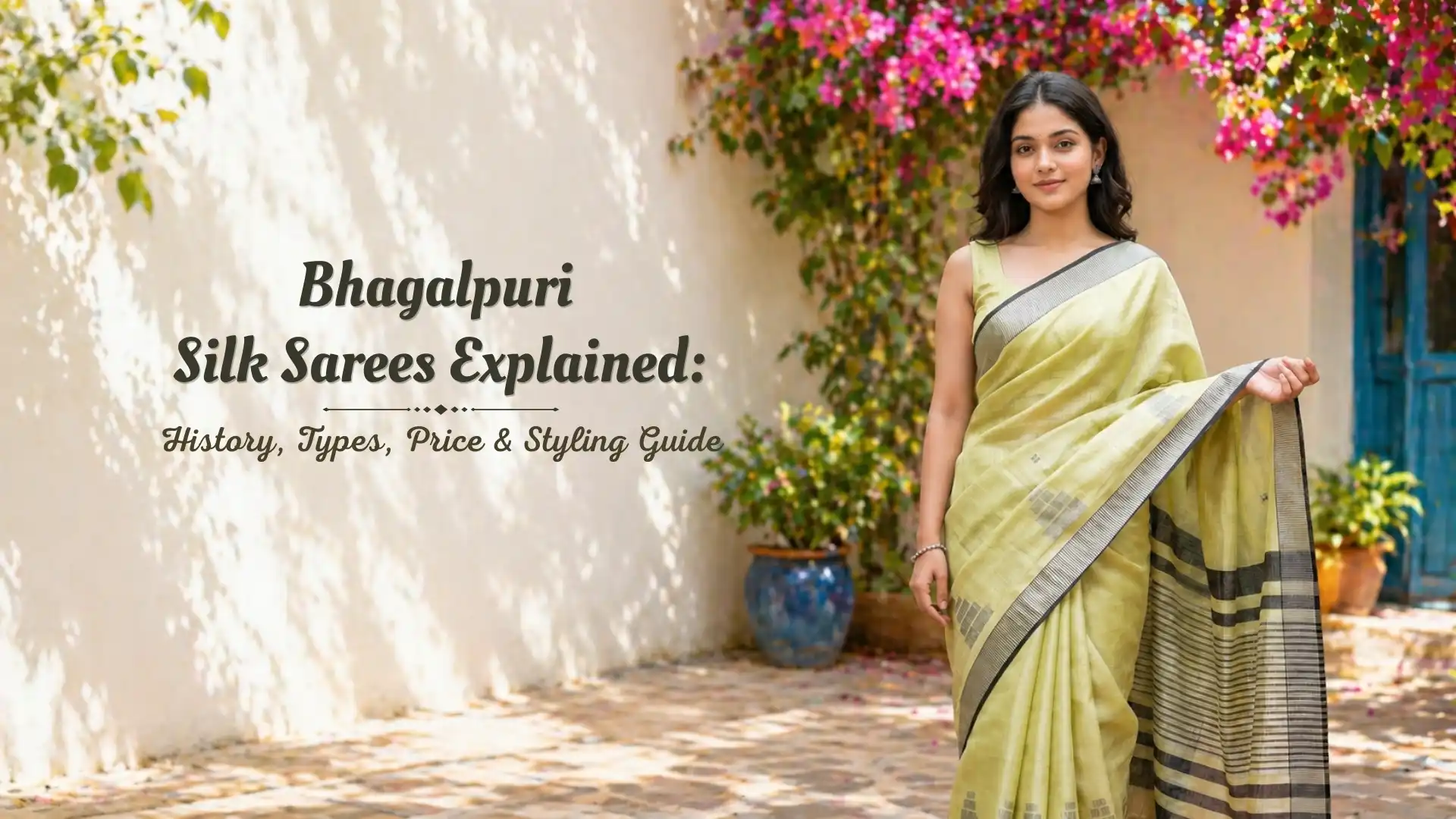
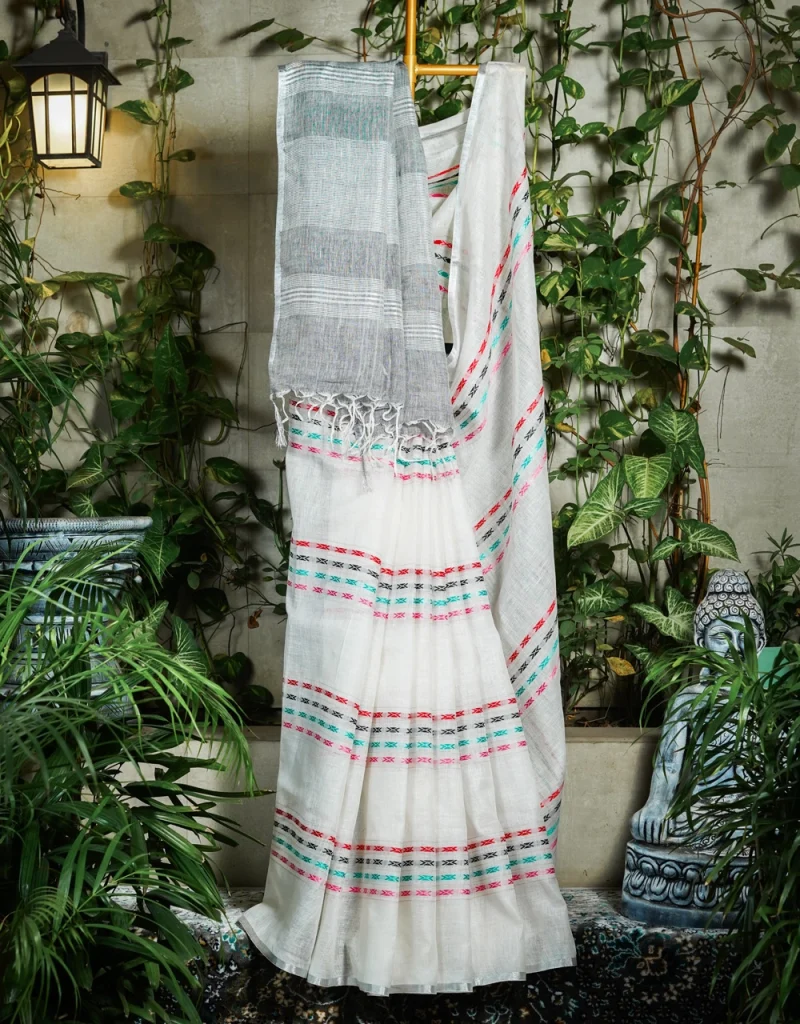
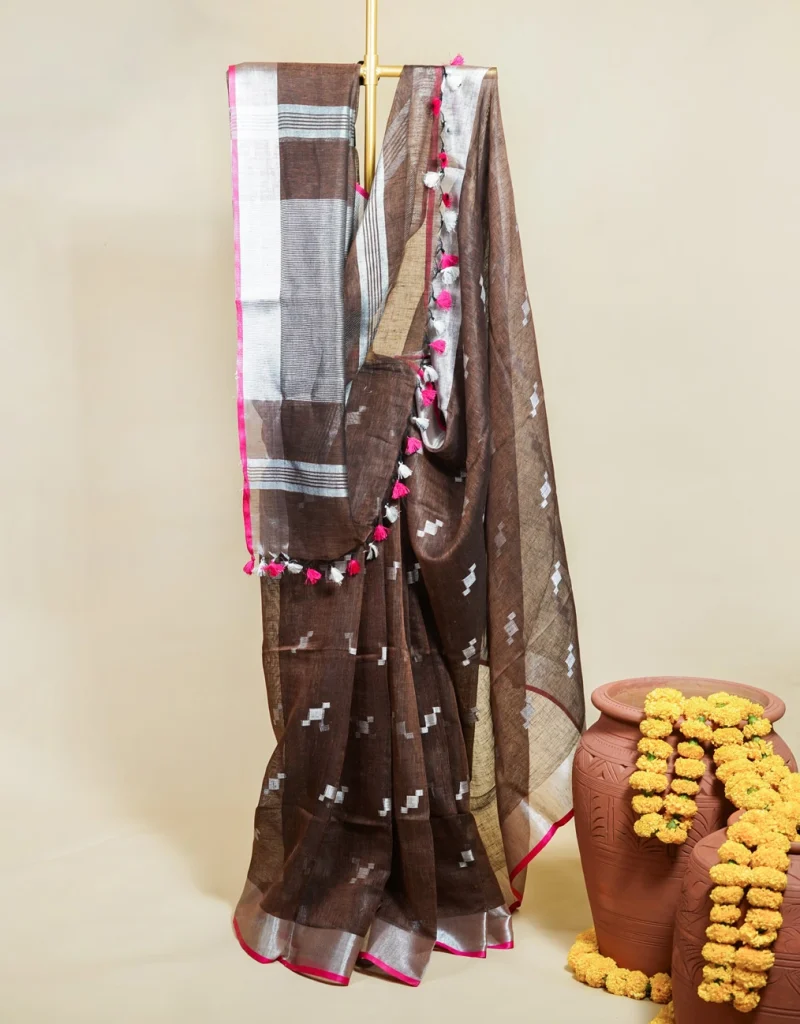
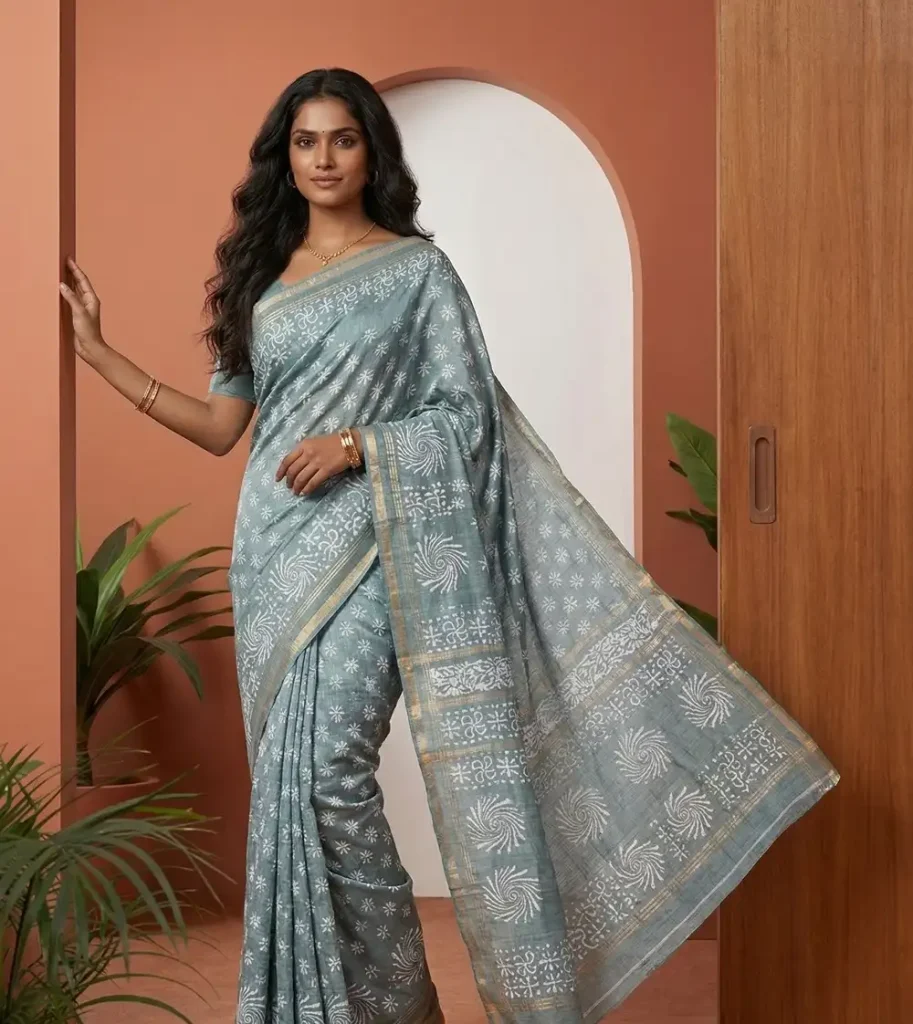
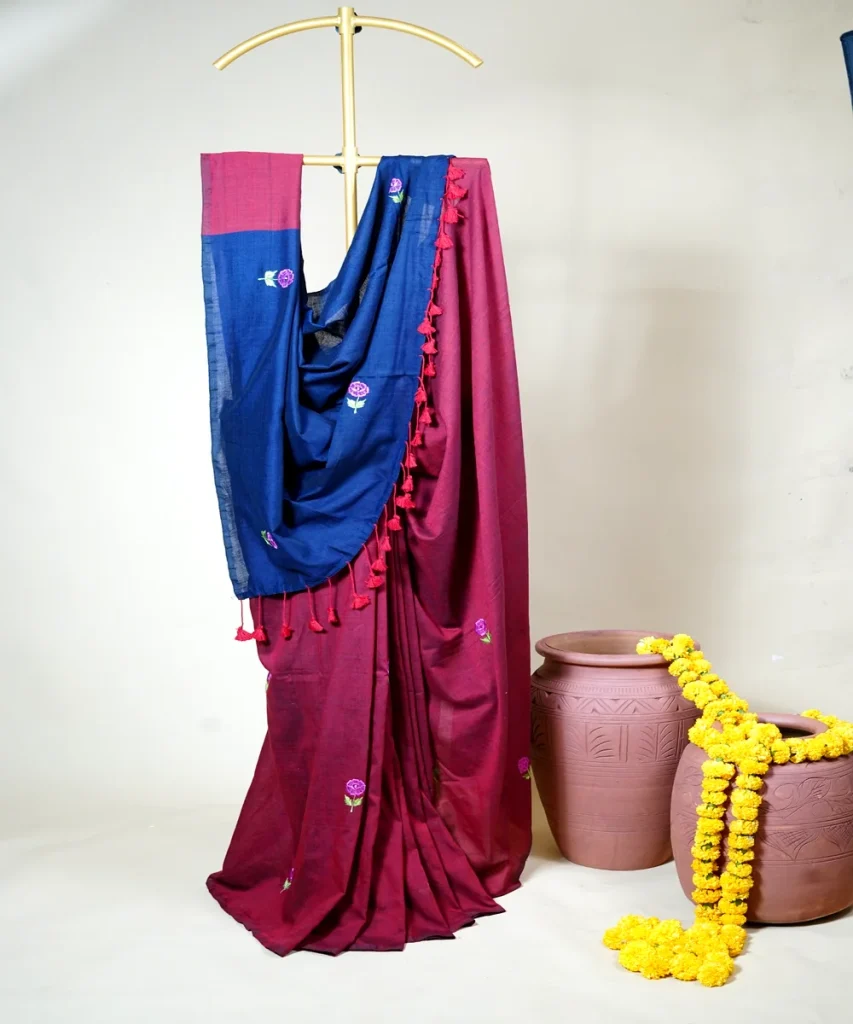
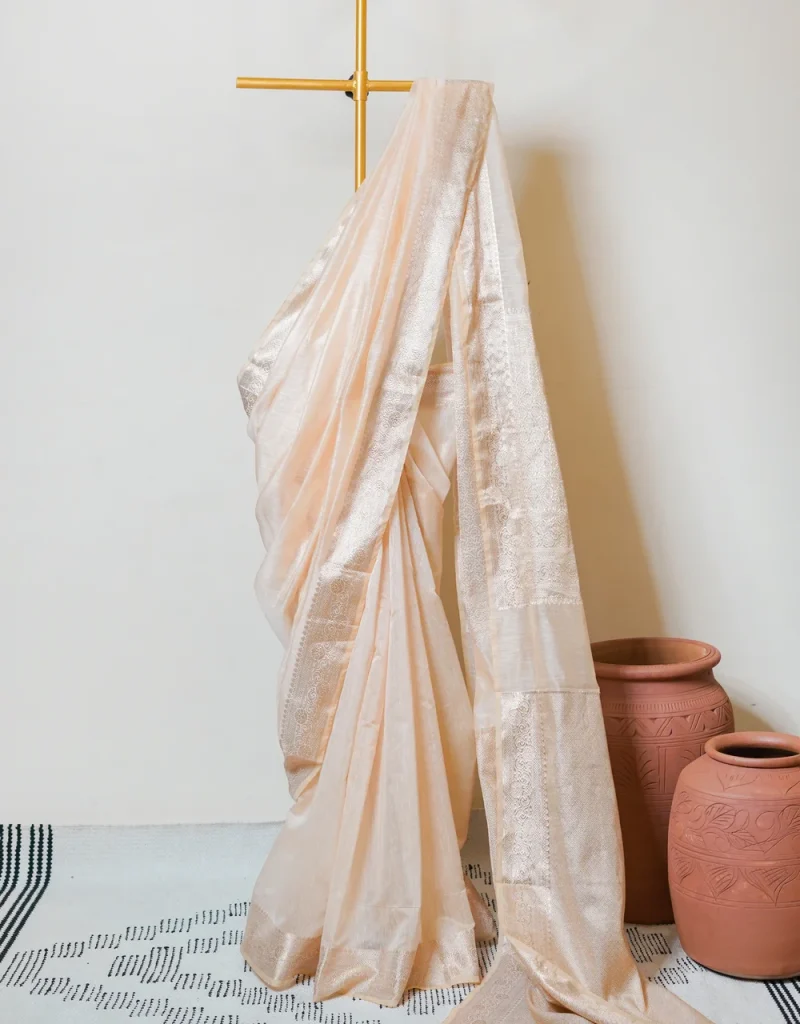
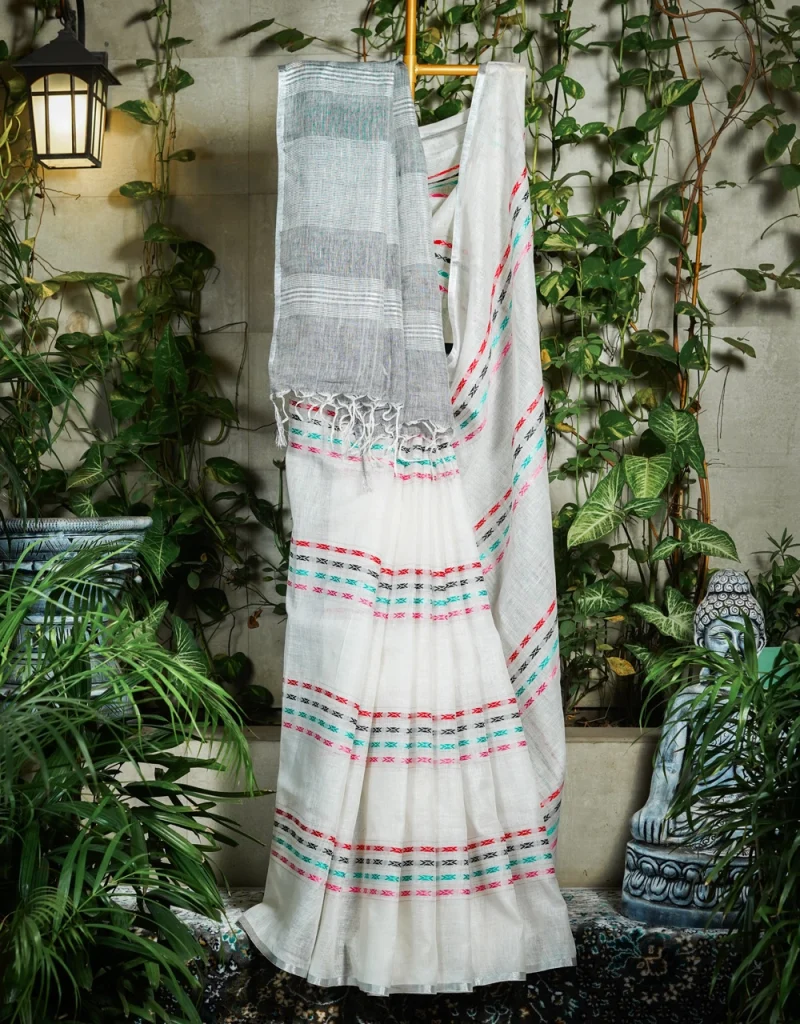
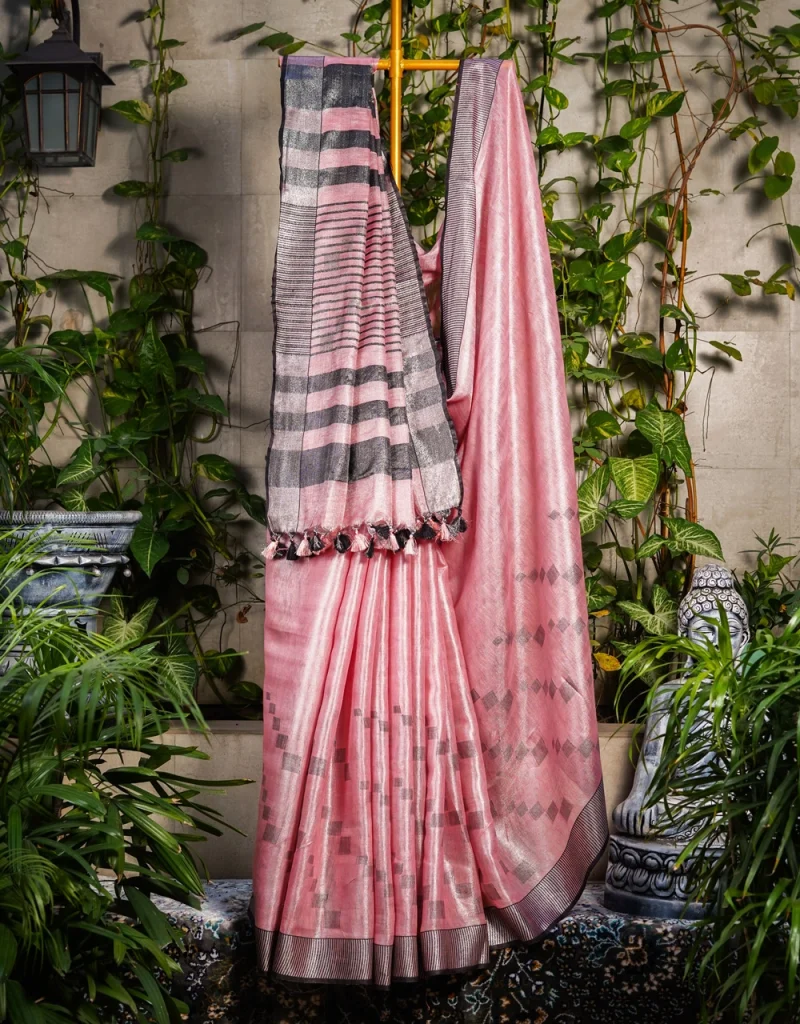
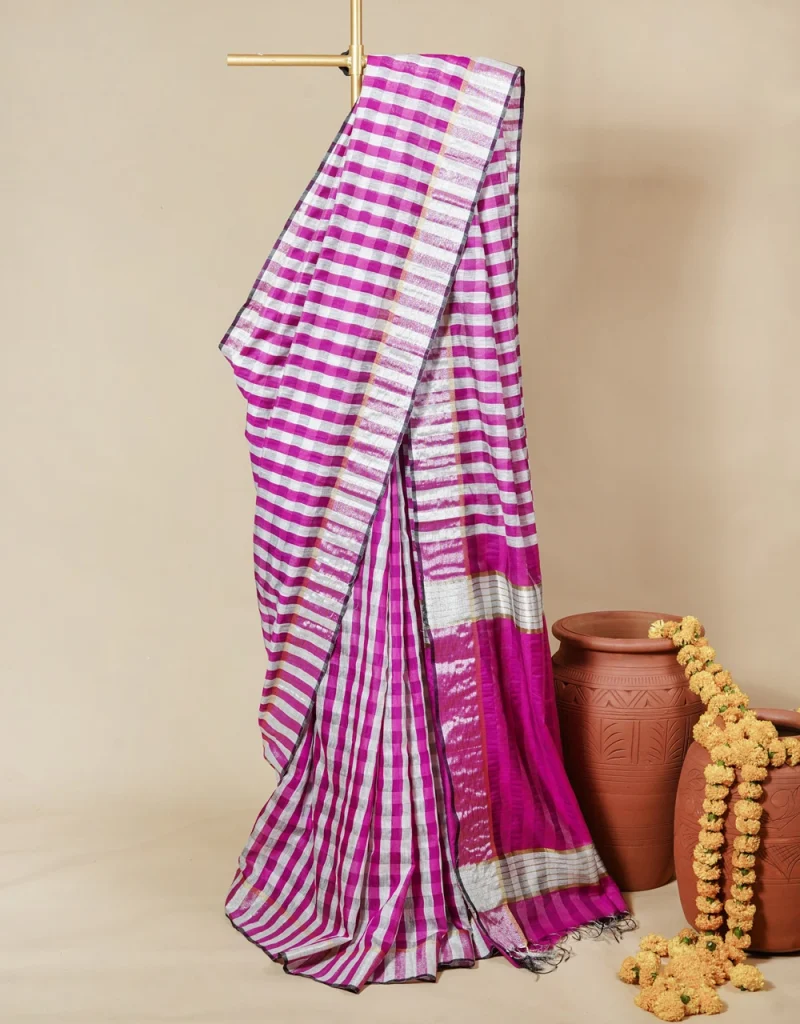
Every Bhagalpuri silk saree begins its life in Bhagalpur, a city on the banks of the Ganga that has earned the title Silk City of India.
The region holds a Geographical Indication tag, which means only textiles woven here can legally carry the Bhagalpur silk name, a distinction that protects both buyers and weavers.
Thirty thousand weaver families and twenty five thousand looms keep this Bhagalpuri silk saree tradition alive today, passing the craft from one generation to the next.
The Silk City Roots of a Bhagalpuri Silk Saree
Bhagalpur’s weaving history predates the Mughals, and old trade records show its cloth travelling along Silk Route caravans to Persia and beyond.
A Bhagalpuri silk saree from this cluster is still woven the same patient way, row by row, on pit looms called khatkal.
Much of the raw material behind a Bhagalpuri silk saree is Tussar silk, drawn from wild silkworms that feed on Arjun, Sal, and Oak leaves in Bihar’s forests.
Because the moths are allowed to complete their natural cycle before the cocoons are collected, this is often called peace silk or Ahimsa silk, and it is a story worth knowing before you buy.
The heritage and weaving process behind this cloth is well documented, and it explains why a Bhagalpuri silk saree feels so different from mill-made silk.
Types of Bhagalpuri Silk Sarees You Can Buy
Not every Bhagalpuri silk saree is built the same way, and knowing the variations helps you choose the right one for your wardrobe.
The fabric family ranges from pure Tussar weaves to cotton blends, linen versions, and tissue finishes, each suited to a different occasion.
Tussar Bhagalpuri Silk Saree
The classic Bhagalpuri silk saree is woven in raw Tussar, prized for its golden undertone and slightly textured surface.
If you want to buy tussar silk saree pieces in this weave, look for the natural slubs that mark genuine handloom work.
A lighter Bhagalpuri silk saree often blends cotton into the weft, giving it a crisper drape suited to daytime wear.
Many buyers also look to buy linen saree options from Bhagalpur for their breathable feel in warmer months, and a linen blend saree adds just enough structure without losing that softness.
Buying a Bhagalpuri silk saree online means you cannot always touch the fabric first, so learning a few reliable checks matters.
Start with paperwork and certification before moving to the physical tests you can do at home.
GI Tag and Silk Mark on a Bhagalpuri Silk Saree
A genuine Bhagalpuri silk saree should come with a Geographical Indication reference from the seller, along with an HSN code of 5007 on the invoice.
The Silk Mark certification is issued by a government-backed body, and checking for it before you buy silk saree pieces adds real assurance to a Bhagalpuri silk saree purchase.
Touch, Weave, and Burn Tests for a Bhagalpuri Silk Saree
Run your fingers across a Bhagalpuri silk saree and you should feel a faint natural warmth, never the cool, slippery hand of polyester.
Look closely at the weave, since a handloom Bhagalpuri silk saree carries small irregularities that a power loom copy simply cannot fake.
A burn test on a loose thread is the final proof, as a genuine Bhagalpuri silk saree chars into crushable ash while synthetic fibre melts into a hard, plastic bead.
Red Flags on a Bhagalpuri Silk Saree Listing
Be wary of any Bhagalpuri silk saree priced far below the going rate for handwoven Tussar, since authentic weaving takes real time and skilled hands.
Sellers who cannot answer basic questions about the sourcing of a Bhagalpuri silk saree or its loom type are rarely worth the risk for a piece you plan to keep for years.
Understanding cost helps you judge whether a Bhagalpuri silk saree is fairly priced or simply marked up on reputation.
What Affects a Bhagalpuri Silk Saree’s Price
The price of a Bhagalpuri silk saree depends on the weave, the dye process, and how intricate the pallu design is.
Hand-dyed pieces using natural pigments like indigo, turmeric, or madder root cost more than chemically dyed alternatives, but the depth of colour in a Bhagalpuri silk saree is unmatched.
A saree that pairs pure Tussar with a cotton silk saree blend usually sits at a friendlier price point for everyday wear.
Budget to Premium Bhagalpuri Silk Saree Ranges
An everyday Bhagalpuri silk saree in simple Tussar can start modestly, while heavily embellished festive or bridal pieces climb well past that.
Whatever your budget, treat a low price on a claimed pure Bhagalpuri silk saree as a signal to ask more questions, not fewer.
Where to Buy an Authentic Bhagalpuri Silk Saree
Once you know what to look for, the next decision is choosing where to actually buy your Bhagalpuri silk saree from.
Online Versus Offline Bhagalpuri Silk Saree Shopping
Buying a Bhagalpuri silk saree online from trusted brands like Siakari offers authentic designs, verified quality, and convenient doorstep delivery. Visiting Bhagalpur lets you buy directly from weavers, but online shopping makes genuine Bhagalpuri silk accessible from anywhere.
Questions to Ask Before You Buy a Bhagalpuri Silk Saree
Ask any seller whether their Bhagalpuri silk saree is handwoven or power loom made, since both are sold under the same name.
A seller who can name the weaver cluster behind your Bhagalpuri silk saree is usually one you can trust with a bigger purchase later.
How to Style a Bhagalpuri Silk Saree
Part of the joy of owning a Bhagalpuri silk saree is discovering how many occasions it quietly suits.
For office wear, a muted Bhagalpuri silk saree in a solid shade with a slim border keeps the look polished without feeling heavy.
For festive days, choose a Bhagalpuri silk saree with a tissue pallu or temple border, and save your lighter linen weaves for the more casual family gatherings around it.
Jewellery and Blouse Pairing with a Bhagalpuri Silk Saree
Because the fabric already has natural texture, a Bhagalpuri silk saree pairs beautifully with oxidised silver or antique gold jewellery rather than anything overly polished.
A contrast silk blouse in a solid colour lets the subtle sheen of your Bhagalpuri silk saree stay the centre of attention.
Caring for Your Bhagalpuri Silk Saree
A little discipline in care keeps a Bhagalpuri silk saree looking new for decades rather than years.
Washing and Storage for a Bhagalpuri Silk Saree
Always dry clean your Bhagalpuri silk saree, since home washing can strip the natural dyes and weaken the delicate weft threads.
Store it wrapped in muslin cloth with a silica sachet nearby, and let your Bhagalpuri silk saree breathe in fresh air every few months rather than staying folded in plastic.
Long-Term Preservation of a Bhagalpuri Silk Saree
Avoid direct sunlight for long stretches, since UV exposure fades the natural dyes that make a Bhagalpuri silk saree so distinctive.
Rotate the fold lines occasionally so no single crease weakens the fabric of your Bhagalpuri silk saree over time.
Everyday Handling and Quick Fixes for a Bhagalpuri Silk Saree
Iron your Bhagalpuri silk saree on the reverse side using a low, silk-safe setting, and always place a thin cotton cloth between the iron and the fabric to protect the sheen.
Never spray water directly onto the silk while ironing, since water spots can leave permanent marks on the delicate weave.
If a small stain appears, blot it gently with a dry cloth right away rather than rubbing, and leave any real stain removal to a professional dry cleaner who understands silk.
Keep your Bhagalpuri silk saree away from perfume and deodorant sprays while dressing, since alcohol-based products can discolour the natural dyes over time.
Humidity is another quiet threat, so during monsoon months, air your silk pieces out more often and add an extra silica packet to the storage cloth.
Whether you already own a few or are looking to buy sarees online in India, building these small habits into your routine keeps every Bhagalpuri silk saree looking freshly woven for years.
Final Thoughts on Buying a Bhagalpuri Silk Saree
A Bhagalpuri silk saree is never just fabric, it is a thousand years of Bihar’s weaving heritage folded into six yards.
Whether you choose a classic Tussar weave or a lighter linen version, buying a genuine Bhagalpuri silk saree means supporting the weavers who keep this craft alive.
Explore Siakari’s curated collection to find a Bhagalpuri silk saree that fits your occasion, your budget, and your story.
Silk saree trends in 2026 focus on lightweight fabrics, pastel shades, handwoven craftsmanship, and contemporary designs. Floral motifs, minimal zari work, digital prints, and contrast borders are especially popular. Traditional weaves like Banarasi, Kanchipuram, Bhagalpuri, and Tussar silk continue to be in demand with modern styling. Sustainable, artisan-made silk sarees are also gaining attention as shoppers increasingly prefer eco-friendly fashion that combines timeless elegance with everyday comfort and versatility.
How to identify Bhagalpuri saree?
A genuine Bhagalpuri silk saree is known for its natural texture, soft finish, and lightweight feel. It often has a slightly uneven weave, reflecting authentic handloom craftsmanship. The fabric has a subtle sheen rather than a glossy shine and becomes softer with every wash. Original Bhagalpuri sarees are usually woven from Tussar or Ghicha silk and may carry a Silk Mark certification, ensuring authenticity and quality. Always buy from trusted sellers.
Which silk is the highest quality silk?
Mulberry silk is considered the highest-quality silk because of its exceptional softness, smooth texture, natural shine, and long, strong fibres. It is produced by silkworms that feed exclusively on mulberry leaves, resulting in premium-quality silk. Mulberry silk is widely used for luxurious sarees, garments, and home textiles due to its durability and elegant appearance. Other premium silks, such as Kanchipuram and Banarasi, are also highly valued for their weaving craftsmanship and heritage.
In which state is Bhagalpuri silk famous?
Bhagalpuri silk is famous in the state of Bihar, particularly in the city of Bhagalpur, which is widely known as the “Silk City of India.” The region has a rich silk-weaving tradition that dates back centuries. Bhagalpur is renowned for producing high-quality Tussar, Ghicha, and Mulberry silk fabrics and sarees. Skilled artisans use traditional weaving techniques to create elegant, durable, and lightweight silk products that are appreciated across India and internationally.
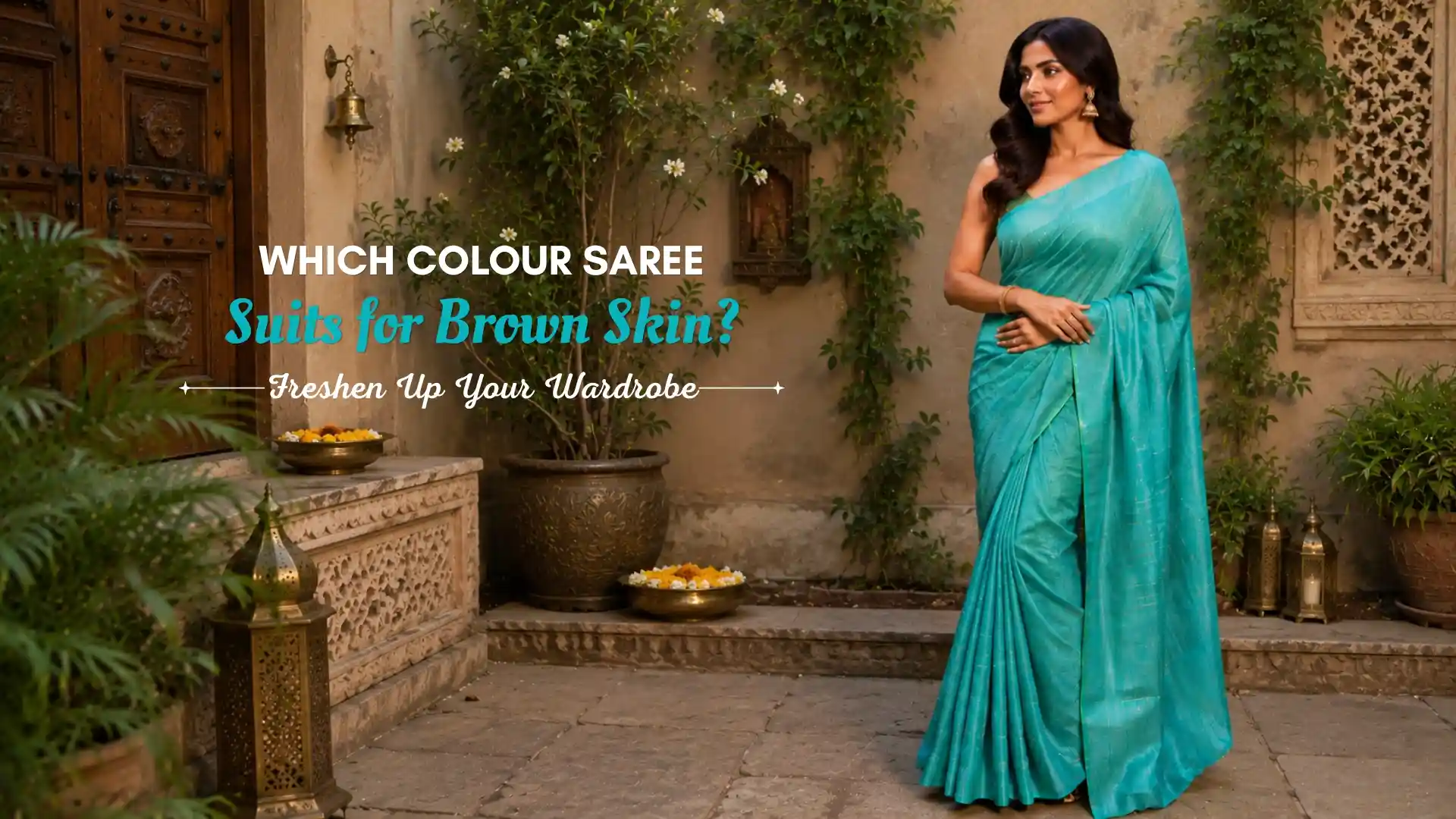
Finding the perfect ethnic attire often starts with a single, crucial question: which colour saree suits for brown skin to make your natural complexion radiate? Brown skin is a stunning, rich, and incredibly versatile canvas that carries warmth and depth, allowing for an expansive palette of colors that can elevate any look. When you look to buy sarees online in India, understanding how different shades interact with your specific melanin levels is the first step toward a timeless fashion statement.
Establishing the Foundation: Identifying Which Colour Saree Suits for Brown Skin and Your Undertone
Before you dive into shopping, you must understand the science behind which colour saree suits for brown skin by distinguishing between surface skin tone and hidden undertones. While surface tones categorized in India as wheatish, dusky, or dark can change with sun exposure, your undertone remains constant. Knowing if you have a warm, cool, or neutral undertone is critical for determining which colour saree suits for brown skin because it ensures harmony between the fabric’s pigment and your skin’s reflection.
Practical Tests to Determine Which Colour Saree Suits for Brown Skin for You
Experts suggest several easy methods to pinpoint your undertone, which ultimately helps you decide which colour saree suits for brown skin. The “Vein Test” is a reliable indicator: look at your inner wrist in natural light; green veins suggest a warm undertone, blue or purple veins indicate a cool undertone, and a mix suggests you are neutral. This simple observation is a cornerstone in refining your choice of which colour saree suits for brown skin.
The Jewelry and White Paper Tests: More Tips on Which Colour Saree Suits for Brown Skin
Another effective method to find which colour saree suits for brown skin is the “Jewelry Test,” where you hold gold and silver against your face; gold typically highlights warm undertones, while silver complements cool tones. Additionally, the “White Paper Test” holding a pure white sheet next to your face in natural light reveals if your skin looks yellowish (warm) or pinkish (cool), further guiding you on which colour saree suits for brown skin. These diagnostic steps are essential before you decide to buy tussar silk saree or any other high-end garment.
Radiant Jewel Tones: Exploring Which Colour Saree Suits for Brown Skin for Festive Glow
Jewel tones are universally celebrated when discussing which colour saree suits for brown skin because they mirror the natural richness of the complexion. Shades like emerald green, royal blue, deep purple, and ruby red create a sophisticated contrast that avoids washing out the skin, making them top answers for which colour saree suits for brown skin. These high-intensity colors are particularly effective for weddings and evening celebrations where lighting plays a role in how you determine which colour saree suits for brown skin.
The Magic of Cobalt and Royal Blue: Which Colour Saree Suits for Brown Skin for Evening Events?
Cobalt blue and electric blue are standout options for anyone asking which colour saree suits for brown skin, as they “pop” vibrantly against deeper tones. Because these are “clean” blues, they work for various undertones from neutral to deep cocoa providing a vivid, eye-catching effect that answers the query of which colour saree suits for brown skin with authority. When browsing georgette sarees, these blue hues offer a fluid, modern grace that perfectly complements brown skin.
Deep Reds and Maroons: Traditional Answers to Which Colour Saree Suits for Brown Skin
Rich maroons and deep wines are timeless choices for which colour saree suits for brown skin, providing a striking contrast that adds a healthy, sophisticated glow. These jewel tones are seen as elegant and luxurious, often preventing the skin from appearing too “yellow” or pale, thus serving as a safe and stylish option for which colour saree suits for brown skin. For those looking to make a heritage statement, silk sarees in these shades are the ultimate investment.
Earthy and Heritage Hues: Choosing Which Colour Saree Suits for Brown Skin for Daytime Elegance
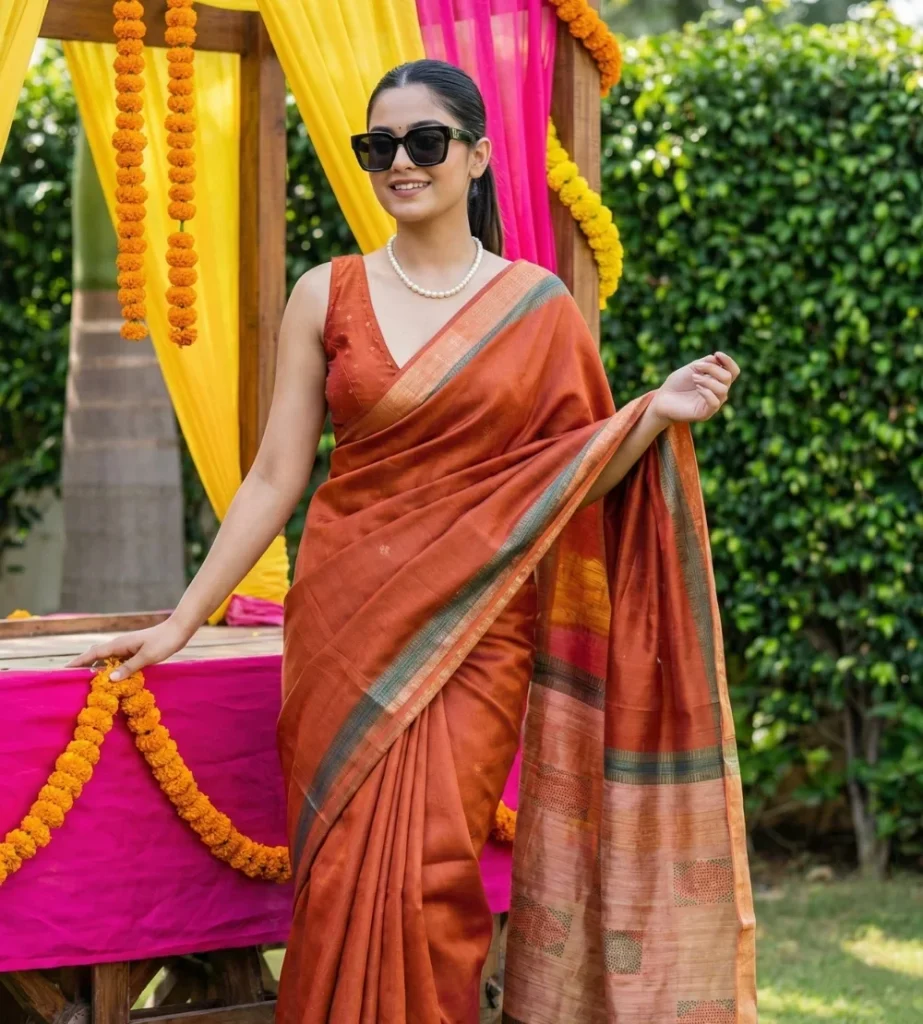
Earthy shades like rust, mustard, terracotta, and burnt orange are naturally grounded and elegant when considering which colour saree suits for brown skin. These colors harmonize with the natural warmth of the skin rather than competing with it, making them ideal for those wondering which colour saree suits for brown skin for pujas or daytime gatherings. Exploring tussar sarees in these muted, organic tones can provide an understated yet powerful look that defines which colour saree suits for brown skin beautifully.
The Sophistication of Olive and Forest Green: Which Colour Saree Suits for Brown Skin?
Olive green and forest green offer a deep contrast that prevents a washed-out appearance, which is vital when deciding which colour saree suits for brown skin. These colors balance the warmth of wheatish and dusky skin, providing a harmonious and glowing aesthetic that answers which colour saree suits for brown skin with a touch of luxury. For a professional yet ethnic look, a cotton-saree in these green variations is a fantastic choice.
Mustard and Golden Yellow: Sunny Options for Which Colour Saree Suits for Brown Skin
Mustard yellow is a bold, sunny shade that creates a “halo” effect, making brown skin stand out vibrantly when you are choosing which colour saree suits for brown skin. Unlike pale yellows that might wash out a medium complexion, these rich yellows enhance golden and olive undertones, solidifying their place in the guide of which colour saree suits for brown skin. You might even pair these with a contrasting pink saree blouse for a lively, festive twist on which colour saree suits for brown skin.
Metallic Hues and Neutrals: Modern Approaches to Which Colour Saree Suits for Brown Skin
Metallic tones like antique gold, bronze, and copper reflect light in a way that adds dimension and luminosity, making them exceptional for which colour saree suits for brown skin. These shimmering shades enhance the skin naturally and are perfect for ceremonial events where you want to know which colour saree suits for brown skin to achieve a regal look. If you want to glow at a reception, you should definitely buy tissue silk saree varieties that feature these metallic finishes.
The Boldness of Black and White: Which Colour Saree Suits for Brown Skin for Contrast?
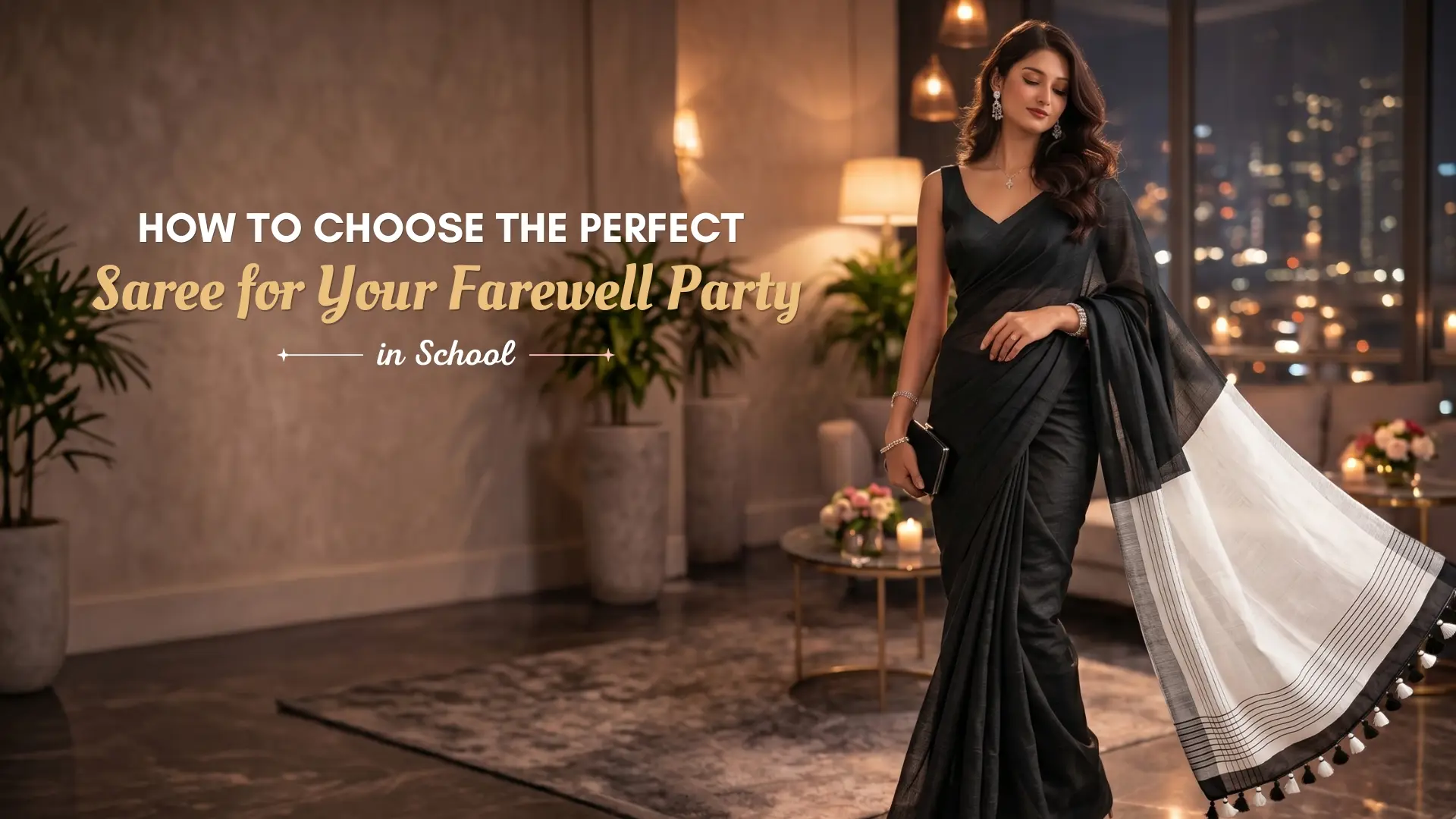
Many are surprised to learn that a crisp black saree or a bright white drape are power moves when asking which colour saree suits for brown skin. Black provides a sharp frame for the features, while bright white or off-white creates a striking, clean contrast that highlights the skin’s warmth, proving that simplicity is key to which colour saree suits for brown skin. These neutrals are classic staples that work for almost every event, depending on how you perceive which colour saree suits for brown skin.
Pastels with Depth: A Nuanced Take on Which Colour Saree Suits for Brown Skin
Pastels can be tricky, but warm variations like dusty rose, peach, or lavender with depth look stunning when you understand which colour saree suits for brown skin. The secret is to avoid “chalky” or extremely pale shades that lack contrast, instead opting for pastels that have a hint of warmth to answer the question of which colour saree suits for brown skin. For a summer wedding, you might buy linen saree options in these soft, breathable hues for a fresh look at which colour saree suits for brown skin.
Fabric Encyclopedia: How Texture Affects Which Colour Saree Suits for Brown Skin
The material of your garment is just as important as its hue when determining which colour saree suits for brown skin. Natural fibers like silk and high-quality cotton interact with light differently, which can either enhance or dull your complexion, a vital consideration for which colour saree suits for brown skin. When you search for cotton silk sarees, you are finding a balance between comfort and the natural sheen that answers which colour saree suits for brown skin effectively.
The Regal Appeal of Silks: Which Colour Saree Suits for Brown Skin for Weddings?
Silk fabrics have a natural radiance that reflects light onto your face, which is a major factor in which colour saree suits for brown skin. From the rich gold brocade of banarasi sarees to the temple-inspired borders of Kanjeevarams, these fabrics add a luxurious dimension to your skin tone, making them the ultimate choice for which colour saree suits for brown skin. The weight and drape of pure silk can also help you look taller and more structured, which influences which colour saree suits for brown skin.
Breathable Cottons and Linens: Daily Wear and Which Colour Saree Suits for Brown Skin
For everyday wear, the matte finish of cotton and the organic texture of linen offer a soft, natural appearance that defines which colour saree suits for brown skin for the office. These fabrics absorb light and provide a grounded elegance that is perfect for those who want to know which colour saree suits for brown skin for long hours of comfort. A high-quality linen blend saree can be a versatile addition to your wardrobe, effortlessly bridging the gap between casual and formal when considering which colour saree suits for brown skin.
Advanced Styling and Draping: Enhancing Which Colour Saree Suits for Brown Skin
The way you drape your six yards can highlight specific parts of the fabric and how its color interacts with your skin, a key element of which colour saree suits for brown skin. Whether you choose the classic Nivi style or the front-pallu Gujarati drape, the visibility of the embroidery or border can change your perspective on which colour saree suits for brown skin. Mastering these drapes is just as important as the initial choice of which colour saree suits for brown skin.
Modern Draping for a Fusion Look: Which Colour Saree Suits for Brown Skin?
Modern styles like the pant-style drape or the belted saree are trending for their ability to add structure and a high-fashion touch to which colour saree suits for brown skin. These contemporary silhouettes often highlight the skin beautifully when paired with the right vibrant hue, offering a bold new way to interpret which colour saree suits for brown skin. For a party, a sequined drape can provide the “shimmer and glam” that makes you the center of attention, perfectly answering which colour saree suits for brown skin for evening wear.
Blouse and Accessory Coordination: Finishing Touches on Which Colour Saree Suits for Brown Skin
Your blouse and jewelry are the final components that complete the puzzle of which colour saree suits for brown skin. Contrasting blouse colors like a navy blue saree with a gold blouse add visual interest and can change the entire look of which colour saree suits for brown skin. Additionally, coordinating your makeup with warm-toned foundations and rich lip colors like berry or terracotta will ensure you look your absolute best, regardless of which colour saree suits for brown skin you chose.
Conclusion: Embodying Confidence and Choosing Which Colour Saree Suits for Brown Skin
Ultimately, the most important rule for which colour saree suits for brown skin is your own confidence and comfort. While guides can provide a map for which colour saree suits for brown skin, experimenting with bold florals, geometric prints, and different textures will help you find your personal signature. For more fashion inspiration, you can always check the latest updates from Vogue India, Femina, or India Today to see how modern style icons are redefining which colour saree suits for brown skin on the global stage.
Rich, vibrant shades look stunning on brown skin. Jewel tones like emerald green, royal blue, deep purple, and ruby red enhance natural warmth beautifully. Warm earthy colors such as mustard yellow, rust, and burnt orange also complement undertones well. Metallics like gold and bronze add glow, especially for festive wear. Even bright hues like fuchsia or turquoise can pop elegantly. The key is contrast colors that stand out against your skin tone will always look more flattering and lively.
What colors to avoid with brown skin?
No color is strictly “off-limits,” but some shades may dull brown skin if not styled well. Extremely close-to-skin tones like muddy browns or beige can create a washed-out look without contrast. Very pale pastels like light grey or dusty lavender may also appear flat unless paired with brighter accents. Neon shades can sometimes overpower natural warmth. Instead of avoiding completely, balance these colors with bold borders, prints, or accessories to keep the overall look vibrant and flattering.
Should dark skin tones avoid light sarees?
Dark skin tones do not need to avoid light sarees at all. In fact, light shades like ivory, powder blue, mint green, and blush pink can create a beautiful contrast and look very elegant. The trick is choosing the right undertone and adding definition through borders, embroidery, or statement blouses. Fabrics with subtle sheen or texture also enhance the look. When styled well, light sarees can make dark skin tones appear radiant, fresh, and effortlessly graceful.
Is brown skin attractive?
Yes, brown skin is naturally attractive and admired worldwide for its warmth and richness. It has a beautiful ability to complement a wide range of colors, from deep jewel tones to soft neutrals. The natural glow and depth of brown skin often stand out in both traditional and modern fashion. Beauty is not defined by one shade it’s about confidence, styling, and self-expression. When you wear what suits you and feel comfortable, your natural skin tone becomes your strongest asset.
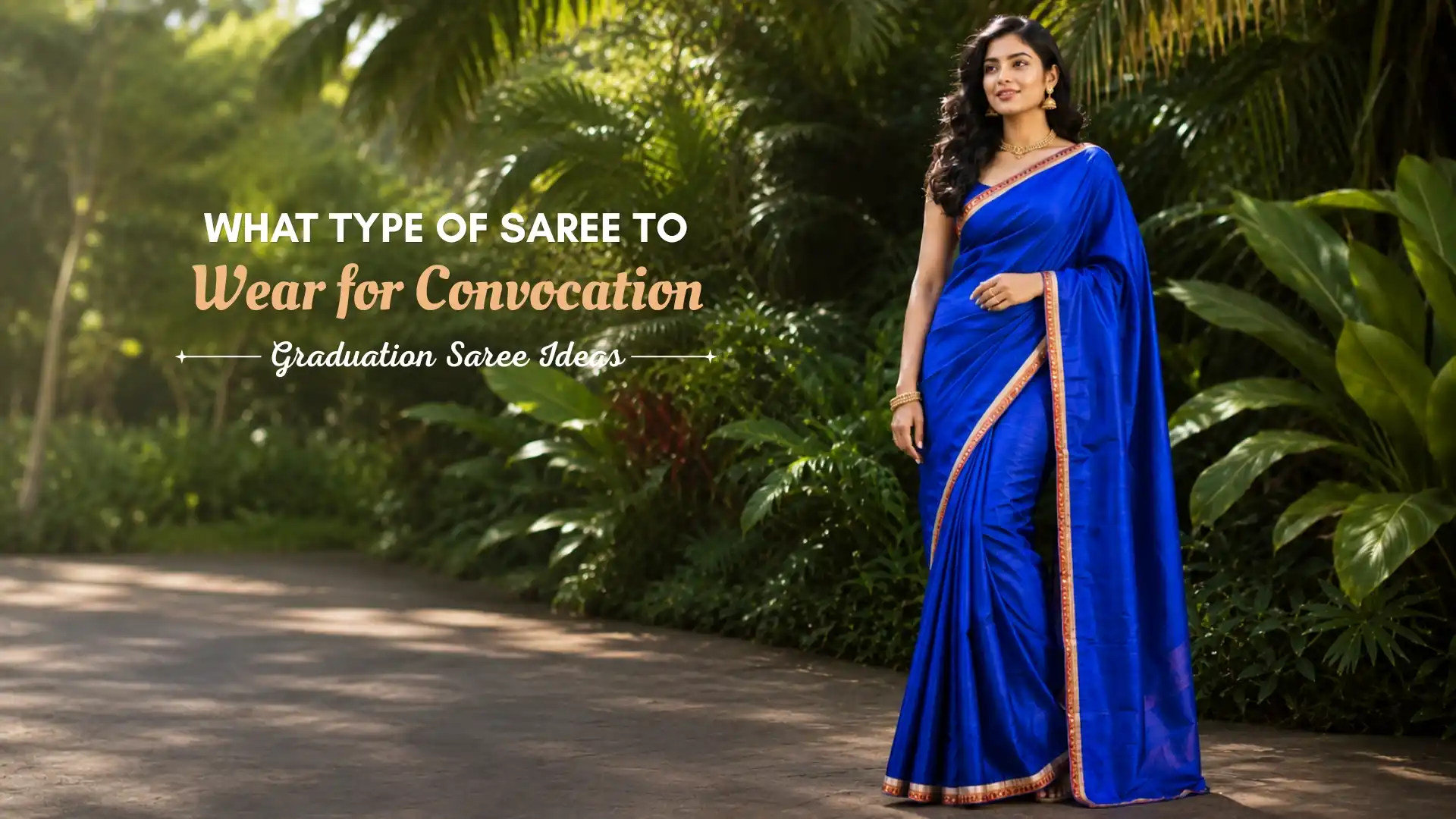
Wondering what type of saree to wear for convocation? The answer depends on three things the fabric, the colour, and how confidently you can carry it.
A silk saree signals occasion-dressing done right. A linen or cotton silk saree keeps you comfortable through a long ceremony. A tussar or tissue silk saree turns every photo into a moment.
This guide walks you through every option, season by season, so you walk across that stage looking exactly the way you’ve imagined. Siakari has curated a collection of handwoven sarees built for exactly this kind of day and this guide will help you find your perfect match.
What Type of Saree to Wear for Convocation: Why Saree Is Still the Best Choice
When you think about what type of saree to wear for convocation, the first question is actually simpler why a saree at all?
In a room full of gowns, mortarboards, and formal Indo-western looks, a well-chosen saree stands apart in a way nothing else can. It photographs beautifully, drapes with natural elegance, and carries a sense of occasion that feels earned on a graduation day.
The Cultural Shift Toward Handloom at Convocations
There is a quiet but powerful shift happening across Indian universities that makes the question of what type of saree to wear for convocation even more meaningful.
The UGC (University Grants Commission) has been actively encouraging students to choose handloom Indian attire at convocation ceremonies instead of colonial gowns a push that universities like Delhi University and JNU have already embraced.
Choosing a handwoven saree for your convocation is not just a style statement; it connects your milestone to something larger. As Vogue India has noted in its coverage of Indian fashion’s handloom revival, handloom textiles carry the stories of the weavers who made them wearing one on a day that marks your own story feels exactly right.
Why a Saree Outperforms Every Other Option
Other outfits kurta sets, shararas, anarkalis are beautiful, but when you ask what type of saree to wear for convocation versus whether to wear a saree at all, the saree still wins.
It drapes over any body shape without sizing anxiety. It transitions from ceremony to family lunch to evening celebration without a costume change.
And six yards of handwoven fabric in a convocation photograph is something your children will look at decades from now and understand immediately why you chose it. If you want to buy sarees online India with the kind of weave that lasts, Siakari’s collection is a strong place to start.
What Type of Saree to Wear for Convocation: Choosing by Fabric
Understanding fabric is the most important step when deciding what type of saree to wear for convocation. The same colour in two different fabrics can feel completely different across a three-hour ceremony.
Silk Sarees for Convocation: When You Want Maximum Impact
Silk sarees are the classic answer to what type of saree to wear for convocation. The weight of silk gives the drape a structure that holds through movement walking, sitting for long stretches, standing for photographs.
A buy silk saree for convocation in Kanjivaram, Banarasi, or a lighter Mysore silk gives you rich colour, subtle sheen, and the kind of dignified formality that the occasion deserves.
Pair a silk saree with a simple contrast blouse a deep jewel tone against ivory silk, or gold zari against cobalt and you have a look that needs no other effort.
Silk absorbs colour deeply, which means every shade looks richer on it than on any other fabric.
Cobalt blue is one of the most striking choices bold enough to stand out against dark auditorium backdrops, formal enough to feel appropriate for an academic ceremony.
Beige and cream in silk have a quiet authority to them. Paired with a gold zari border, ivory silk reads traditional without being heavy.
Deep Red and plum photographs exceptionally well under both flash and natural light, and they complement a wide range of Indian skin tones.
Emerald green in Kanjivaram or Banarasi silk is a consistently popular convocation choice rich, celebratory, and deeply photogenic.
Tussar Silk Sarees for Convocation: Texture That Photographs Beautifully
If you are weighing what type of saree to wear for convocation and pure silk feels too formal or too warm, tussar silk is the answer.
Tussar has a natural slub texture slightly matte, earthy, and deeply sophisticated. It drapes softly and doesn’t feel stiff against the skin.
When you buy tussar silk saree in a muted ivory, honey, or sage, you get something that photographs in a completely different register than synthetics real depth, real warmth, real texture. Tussar also sits beautifully under natural light, which matters for the outdoor photo sessions that follow most convocation ceremonies.
Tussar’s matte texture makes it especially suited to earthy, natural tones that would look flat in synthetic fabrics.
Ivory and off-white in tussar are the single most popular convocation combination on social media right now warm, timeless, and effortlessly elegant with gold jewellery.
Honey and amber tones sit beautifully against the natural slub of tussar and photograph with a warmth that jewel tones cannot replicate.
Sage green and dusty olive are the modern choices understated, fresh, and increasingly popular among graduates who want to look contemporary without abandoning tradition.
Soft terracotta in tussar is a Rajasthani-inflected choice that works beautifully for daytime ceremonies in natural light.
Cotton Silk Sarees for Convocation: For Warm-Weather Ceremonies
Convocations in April, May, and June call for a different fabric calculation entirely. A cotton silk saree gives you the elegance of silk with the breathability of cotton it does not trap heat, does not wrinkle badly, and holds a clean drape through the humidity of a packed auditorium.
Cotton silk in soft pastels or muted prints is an increasingly popular answer to what type of saree to wear for convocation in summer.
Cotton silk takes colour in a softer, slightly diffused way compared to pure silk which makes it ideal for the pastel and muted palette that suits daytime ceremonies.
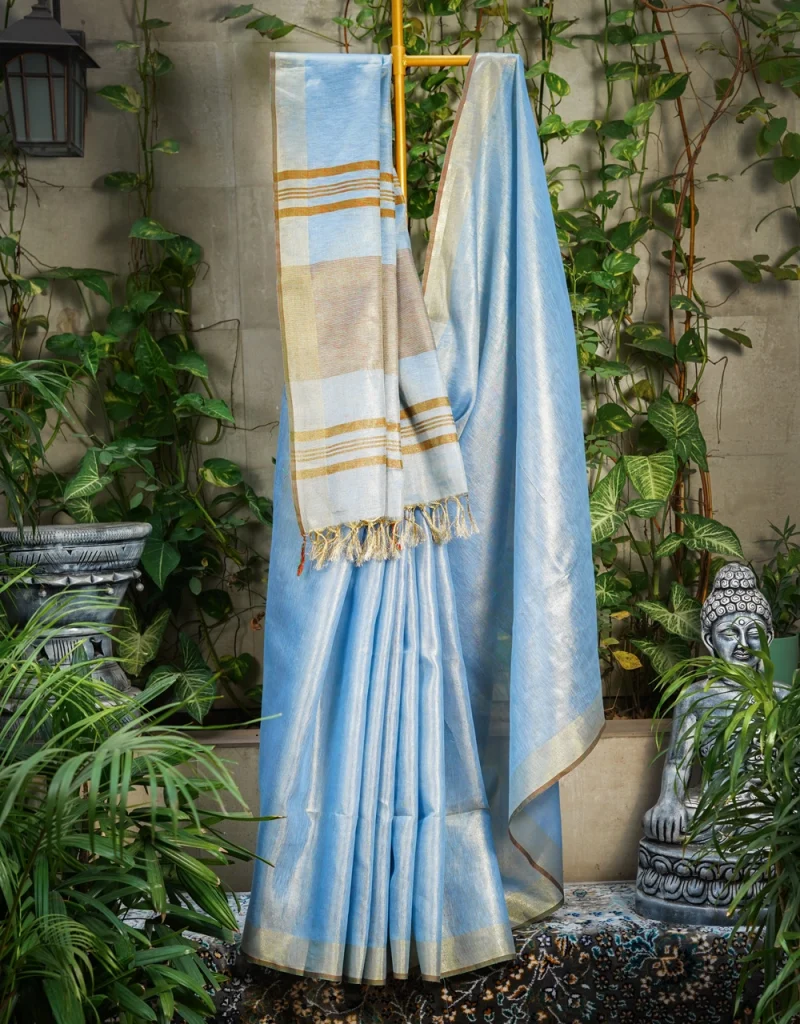
Powder blue in cotton silk is one of the most universally flattering convocation colours soft enough for natural light, structured enough to feel formal.
Blush pink reads feminine and celebratory without being bridal, which makes it a strong choice for a graduation ceremony.
Mint green and soft lavender are the summer-convocation colours that keep gaining ground fresh, light, and very photogenic in outdoor settings.
White with a coloured border in cotton silk is a classic that never looks outdated, especially paired with a contrast blouse in the border colour.
Tissue Silk Sarees for Convocation: The Festive Choice
For those thinking about what type of saree to wear for convocation and wanting to stand out in every photograph, a buy tissue silk saree is for the graduate who wants to be noticed.
Tissue silk has an almost luminous quality it catches light from every angle, which makes it exceptional in photographs. Keep the blouse simple and the jewellery minimal when wearing tissue; the fabric does the talking.
Tissue sarees in gold, rose, or silver are among the most popular convocation choices on Instagram right now, and for good reason.
Tissue silk is at its most powerful in metallic and luminous tones colours that interact with light rather than simply reflecting it.
Gold tissue is the most photographed convocation saree colour in this fabric – it glows under both flash and natural light and pairs beautifully with a deep contrast blouse in maroon or navy.
Silver and champagne in tissue silk are the understated alternatives – shimmery but refined, and very effective in auditorium lighting.
Rose gold is the modern festive choice – warm, glowing, and distinctly contemporary without departing from traditional occasion dressing.
Linen Sarees for Convocation: The Understated Modern Choice
Linen has had a quiet revolution in Indian fashion over the last five years, and for anyone asking what type of saree to wear for convocation with a modern, unfussy aesthetic, convocations are where that revolution shows up most naturally.
A buy linen saree for convocation in ivory, slate blue, or terracotta reads effortlessly modern not trying too hard, not underdressed. Linen drapes in a relaxed, slightly structured way that suits women who prefer clean lines over elaborate embellishment.
A linen blend saree with a cotton or silk component is even more versatile, it holds a sharper drape while staying breathable.
Linen’s natural texture means it reads best in colours that complement its earthy, slightly raw character.
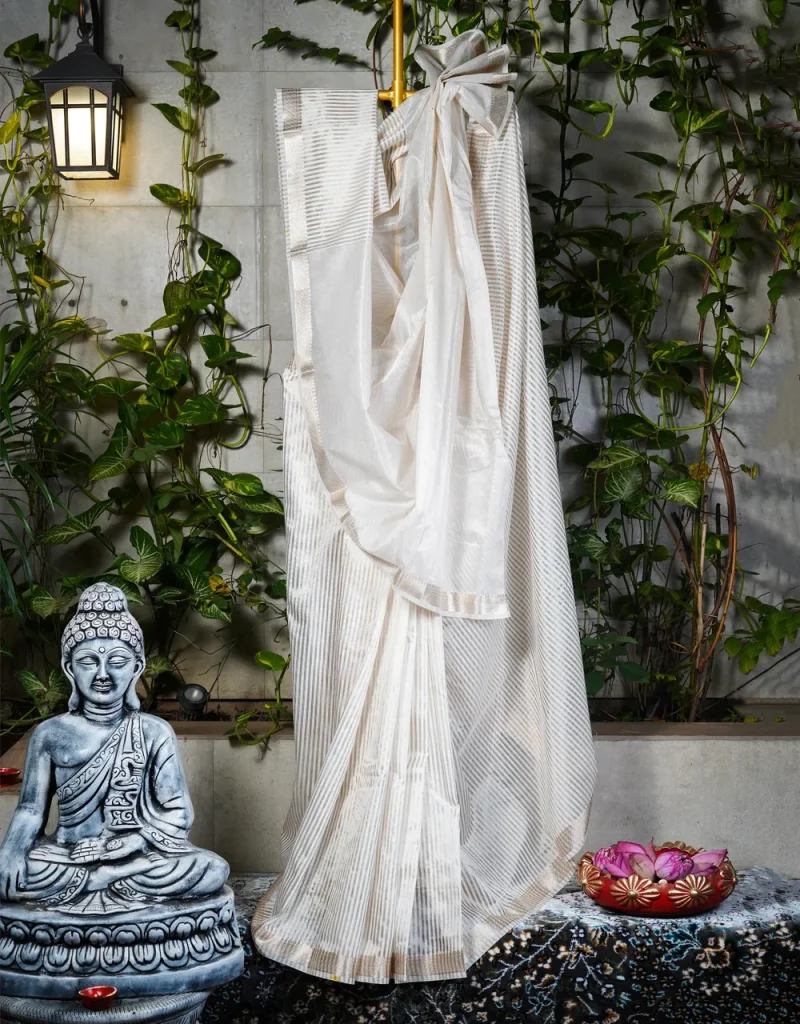
Ivory and natural white in linen are the definitive modern-convocation choice clean, elegant, and distinctly contemporary.
Slate blue and indigo in linen carry an intellectual, artisanal quality that feels particularly appropriate for an academic milestone.
Terracotta and rust are the warmth-palette choices grounded, crafted-feeling, and very striking in natural outdoor light.
Mustard in linen is a bold but balanced choice warm enough to feel festive, structured enough to feel formal.
What Type of Saree to Wear for Convocation: Colour Guide
Once you understand fabric, colour is the next layer of the what type of saree to wear for convocation decision. The right colour does more than look good it works with your skin tone, the light in the venue, and the photographs you’ll carry for years.
Pastels: For Outdoor Ceremonies and Natural Light
Soft pinks, powder blue, sage green, lilac, and ivory are the most consistently flattering choices for convocation sarees.
What type of saree to wear for convocation in pastels? A cotton silk or tussar in blush or powder blue these tones glow rather than overpower in natural light, and they complement most skin tones beautifully.
Jewel Tones: For Indoor Ceremonies and Bold Impact
Emerald, cobalt, burgundy, plum, and deep teal work best for convocations held in auditoriums where flash photography dominates.
These shades hold up against dark backgrounds and graduation gown colours in a way that pastels sometimes cannot.
If you’re asking what type of saree to wear for convocation in a large formal hall, a Kanjivaram silk or tussar silk in a jewel tone is a strong answer.
Ivory and White: The Timeless Graduation Colour
There is a reason white sarees have become almost synonymous with convocation on social media. What type of saree to wear for convocation when you want the look to feel simultaneously traditional and modern? Ivory or white especially in tussar silk or linen with a contrast zari border.
The colour signals new beginnings, which is exactly what graduation represents. Pair it with gold jewellery and a bun for a look that will not date.
What Type of Saree to Wear for Convocation: Draping Tips for Beginners
One of the biggest concerns when thinking about what type of saree to wear for convocation is the drape itself. If you don’t drape sarees regularly, the prospect of managing six yards through a three-hour ceremony is genuinely anxiety-inducing.
Use a Pre-Stitched or Semi-Stitched Saree
The clearest answer to what type of saree to wear for convocation if you are new to draping is a pre-stitched or semi-stitched saree.
The pleats are already set. The pallu is attached. You put it on like a skirt, tuck the pallu at the shoulder, and you’re done. The drape holds without safety pins working loose, which matters enormously during a long ceremony.
Pin Generously If Draping Traditionally
If you have settled on what type of saree to wear for convocation and are draping it traditionally, use more pins than you think you need.
The simplest and most overlooked tip for what type of saree to wear for convocation is to wear your chosen saree for two hours the evening before.
Walk around the house. Sit down. Stand up. Climb a step. Any adjustment that needs to be made shows up immediately, and you go into the ceremony with muscle memory rather than anxiety.
What Type of Saree to Wear for Convocation: Accessories and Hair
The right accessories and hair can elevate a beautiful saree or undo it. When thinking about what type of saree to wear for convocation, think about the complete look.
Jewellery: Less Is Almost Always More
For convocation, minimal gold jewellery works best jhumkas or studs, a thin chain or a simple necklace, and plain or thin-banded bangles. Heavy bridal sets look out of place at an academic ceremony.
What type of saree to wear for convocation with heavy embellishment? None if the saree is already embroidered or has a heavy border, the jewellery should pull back.
Hair: A Bun or Half-Up Is the Most Practical Choice
Whatever you choose for what type of saree to wear for convocation, pair it with a sleek low bun or a half-up twist it stays in place through the ceremony, looks polished in every photograph, and keeps your face visible when you receive your degree on stage.
If you want something softer, loose curls or a side braid work well with lighter sarees. Avoid leaving hair fully loose it catches in the pallu during movement.
Blouse: The Detail That Ties Everything Together
The blouse is often underestimated when deciding what type of saree to wear for convocation. A simple round or boat neck blouse in a contrast colour does more for a saree than any amount of embellishment on the drape itself.
For silk sarees, a plain silk blouse in a complementary shade. For linen or tussar, a cotton blouse with subtle embroidery or pintucks adds texture without effort.
What to Avoid When Choosing a Convocation Saree
Understanding what type of saree to wear for convocation also means knowing what to leave for other occasions.
Avoid Very Heavy Fabrics
When thinking about what type of saree to wear for convocation, keep in mind that pure Kanjivaram in very dark colours or heavily zari-woven Banarasi can feel genuinely heavy to wear for three or four hours.
If you love a heavy saree, balance it with a lighter blouse and simple hair.
Avoid Very Light Fabrics Without Inner Lining
Another thing to keep in mind when choosing what type of saree to wear for convocation sheer georgette or very thin chiffon without a proper inner slip can feel uncomfortable and require constant adjustment.
If you choose a light fabric, ensure it has proper inner stitching or wear a slip that matches the saree colour.
Avoid Too Much Embellishment
What type of saree to wear for convocation is never the most embellished one you own. Convocation is a formal academic ceremony, not a reception.
Heavy stone work, mirror embroidery, or all-over sequin sarees read bridal or festive, not formal. Save those for the celebrations that follow.
Conclusion
The question of what type of saree to wear for convocation comes down to this: choose a fabric that serves the season, a colour that serves the light, and a weave that serves the moment.
A silk saree for formality, tussar for texture, cotton silk for comfort, linen for modern ease, tissue silk for photographs that glow.
Your convocation is one of the few days that genuinely deserves six yards of handwoven fabric. Siakari has a curated collection of silk, tussar, linen, and cotton silk sarees designed for exactly the occasions that matter explore the collection and find the saree that feels like yours.
Silk, tussar silk, and cotton silk are the best fabric choices. Silk gives structure and richness. Tussar gives texture and softness. Cotton silk is the right choice for summer convocations.
What colour saree should I wear for convocation?
Pastels (blush, powder blue, sage) work beautifully in natural light. Jewel tones (emerald, cobalt, plum) work well in indoor auditoriums. Ivory and white are consistently popular for a timeless, occasion-appropriate look.
Can I wear a pre-stitched saree for convocation?
Yes a pre-stitched or semi-stitched saree is an excellent choice for convocation if you are not experienced with traditional draping. It holds its shape through a long ceremony without constant adjustment.
Should I wear a handloom saree for convocation?
Absolutely. Handloom sarees tussar, linen, cotton silk are increasingly preferred at Indian university convocations. Many institutions actively encourage handloom attire, and a handwoven saree carries a quality of depth and authenticity that synthetics cannot match.
What jewellery to wear with a convocation saree?
Keep it simple jhumkas or studs, a delicate chain, and thin bangles. If the saree has a heavy border or embroidery, pull the jewellery back further. The goal is to look formal and elegant, not to compete with the saree’s own detail.
Winter is not the season to abandon your saree it is the season to wear it better. The question of what to wear on saree in winter has a surprisingly rich answer, and once you understand it, you will look forward to draping your saree on the coldest mornings rather than dreading it.
From blouses and blazers to thermal layers hidden underneath, winter saree styling is about working with the cold rather than fighting it. At Siakari, we believe every saree in your wardrobe deserves a twelve-month life and this guide will show you exactly how to make that happen.
What to Wear on Saree in Winter: Your Complete Layering Guide
The foundation of knowing what to wear on saree in winter is understanding that layering works differently with a saree than with western outfits. You are not just adding a coat on top you are thinking about what goes under the blouse, what replaces the blouse, what wraps over the pallu, and what draping style traps the most warmth.
Every layer is a decision, and every decision can look intentional and stylish.
The smartest thing you can do when figuring out what to wear on saree in winter is to invest in your invisible layers. A fitted thermal top in the same colour as your blouse slips underneath it without showing, and it adds genuine warmth through the coldest hours of the day.
When you want to wear a saree in winter without bulk, this is your secret weapon. Thermal leggings worn as your underpetticoat liner keep your legs warm without any visual compromise.
No one will know, and you will be genuinely comfortable.
Full-Sleeve and High-Neck Blouses
Your blouse is the closest layer to your skin, which makes it the most powerful tool in your winter saree wardrobe. When thinking about what to wear on saree in winter, a full-sleeve blouse in velvet, brocade, or raw silk does double duty it keeps your arms covered and elevates the entire look.
High-neck and boat-neck blouses a silhouette championed consistently in Harper’s Bazaar India’s deep-dive on saree seasonality reduce the exposed area around your collarbone and chest, making a significant difference in how warm you feel.
For a deeply traditional look, try a full-sleeve blouse in the same zari as your saree border.
Jackets, Blazers, and Outerwear: What to Wear on Saree in Winter for Occasions
Outerwear is where winter saree styling becomes genuinely exciting. When you know what to wear on saree in winter as an outer layer, you can transform the same saree into three different looks for three different occasions.
Structured Blazers for the Office
A tailored blazer is perhaps the most versatile answer to what to wear on saree in winter for women who work. A well-fitted blazer in charcoal grey or deep navy worn over a silk saree with a simple blouse creates an effortless formal look.
You can buy sarees online India that are specifically designed for professional settings understated weaves and muted tones that pair beautifully with structured western outerwear.
If you have ever wondered what to wear on saree in winter for a wedding, an embroidered jacket is your most elegant answer. The jacket should be cropped or hip-length and ideally in a complementary fabric to your saree.
The Sabyasachi Autumn/Winter 2025 collection showcases exactly this baroque embroidered jackets layered over rich silk, with zardosi and velvet detailing that sets the benchmark for festive winter dressing in India, and the look translates beautifully to everyday saree wearers too.
If you are wearing a cotton silk saree in a deep jewel tone, a sherwani-style embroidered jacket over it feels genuinely regal.
For relaxed days at home or low-key family gatherings, you do not need the formality of a blazer. A long waterfall cardigan draped over your shoulders softens the look and adds warmth without structure.
A pashmina or cashmere stole is the most classic answer to what to wear on saree in winter it works with everything from a buy silk saree to a simple cotton weave, and it can be adjusted freely as the temperature changes through the day.
Before layering, you need to make the right fabric choice because what to wear on saree in winter starts with the saree itself. Not every fabric suits the cold.
Silk Sarees: The Winter Standard
Knowing what to wear on saree in winter always circles back to silk it is the most naturally warm fabric for sarees. Its tightly woven structure traps body heat and provides genuine insulation.
When you buy tussar silk saree, you are choosing a fabric that feels substantial and warm on the body, with a beautiful earthy texture that lends itself perfectly to winter styling.
Banarasi silk and Kanjivaram silk are equally ideal their heavy weave provides coverage, and their zari work reflects light beautifully against winter’s low golden sun.
For those who want shimmer and warmth together, a buy tissue silk saree answers the question of what to wear on saree in winter for festive evenings perfectly. Tissue silk has a luminous quality that catches light magnificently, and paired with a velvet or brocade blouse, it creates a look that feels intentionally dressed for winter’s grandeur.
Linen and Linen Blends for Milder Winters
In regions where winter is mild, deciding what to wear on saree in winter becomes easier with a buy linen saree linen is a temperature-regulating fabric that keeps you comfortable when the mornings are cool but the afternoons are warm.
A linen blend saree in a rich mustard, deep olive, or brick red gives you both seasonal colour and fabric versatility. For the slightly cooler Rajasthani winters, this works beautifully for daytime occasions when you want to stay stylish without overdressing.
Winter Colour Palettes and Draping Styles for Sarees
Most blogs stop at layering but knowing what to wear on saree in winter also means understanding which colours and draping styles complete the seasonal picture.
Winter Colours That Photograph and Feel Right
Choosing what to wear on saree in winter is as much a colour decision as a fabric one deep, rich hues like emerald green, burgundy, deep plum, midnight blue, brick terracotta, and forest green feel seasonally right and photograph beautifully in winter light.
Avoid very light pastels and whites for outdoor winter events they photograph well but offer zero visual warmth.
What Each Winter Colour Says About Your Saree
Not all deep colours work the same way, and understanding what each one brings to a winter look helps you dress with more intention.
Deep red and burgundy are the most instinctively wintery choices rich, festive, and deeply flattering against Indian skin tones. A burgundy Banarasi or tussar saree in this shade reads celebratory without effort.
Midnight blue and navy feel poised and sophisticated, making them ideal for formal winter occasions and office settings. They photograph exceptionally well in natural winter light and pair cleanly with gold jewellery.
Emerald green and forest green carry the warmth of the season and work across occasions from casual family gatherings to wedding receptions. They are especially striking in silk, where the sheen deepens the colour further.
Deep plum and purple have a quiet luxury to them that suits evening events and winter weddings. In tissue silk or Kanjivaram, plum is one of the most photogenic shades of the season.
Brick terracotta and mustard are the earthy alternatives, rooted in Rajasthani craft tradition and perfectly suited to the mild Udaipur winter. They pair beautifully with linen and tussar textures.
Black is a year-round staple but in winter it becomes something more deliberate. A black silk saree with a heavily embroidered or zari blouse is one of the most striking looks for winter evenings, effortlessly dramatic without any extra layering required.
Pink works in winter when it leans deep rather than light. Dusty rose, fuchsia, and rani pink hold their own in winter settings, especially in silk or tissue silk where the richness of the fabric anchors the colour. Avoid pale baby pink for outdoor events as it loses its depth against winter’s natural light.
The way you drape your saree affects how warm you stay and this is a gap that most guides on what to wear on saree in winter do not address.
The Gujarati-style drape, where the pallu is brought forward over the chest instead of being thrown over the shoulder behind you, provides an extra layer of fabric over your torso and effectively acts as a built-in shawl.
The double pallu drape where you bring the pallu around the shoulders twice creates a wrap-like effect that is both warm and visually dramatic. The seedha pallu style, traditional to Maharashtra and parts of North India, keeps more fabric in front of the body and reduces exposure considerably.
Once you understand these draping styles, you realize you already own everything you need to stay warm and stylish.
Occasion-Specific Guide: What to Wear on Saree in Winter
The answer to what to wear on saree in winter changes depending on where you are going and this is where Siakari’s guide goes further than most.
For Winter Weddings
For a winter wedding, what to wear on saree in winter comes down to a heavy silk or tissue silk saree in a jewel tone, layered with an embroidered jacket or a structured blazer. Opt for a velvet or brocade full-sleeve blouse to keep your arms warm through the ceremony.
Complete the look with ankle boots or block-heeled closed-toe shoes rather than open sandals, which will leave you cold and uncomfortable by the evening reception.
For the Office
At work, what to wear on saree in winter means understated silk or a linen blend saree in muted tones, paired with a well-fitted blazer as your outer layer. A high-neck blouse in a solid colour keeps the look clean and professional.
Skip heavy jewellery one statement pair of earrings is enough. You can buy sarees in clean prints and minimal weaves from Siakari that are specifically suited to professional winter dressing.
For Casual Family Occasions
For casual days, what to wear on saree in winter is refreshingly simple a cotton silk saree or a printed tussar, layered with a long cardigan, a stole in a contrasting colour, or even a simple fitted sweater tucked into the petticoat.
Keep your footwear warm with juttis lined with wool or closed leather chappals, which are both traditional and comfortable. Add a bindi and simple gold earrings, and you have a look that is completely effortless.
What Not to Wear on Saree in Winter
Just as important as knowing what to wear on saree in winter is knowing what to avoid because the wrong choices will leave you cold no matter how carefully you layer.
Chiffon and georgette sarees are beautiful but they offer no warmth if you are wondering what to wear on saree in winter and reach for either of these, you will be cold no matter how many layers you add on top.
Avoid very stiff organza in outdoor winter settings as it provides no insulation and can feel brittle in the cold. Do not skip inner thermal layers thinking a jacket will compensate the body loses most heat from the torso and legs, and a jacket alone cannot counter that.
And avoid open-toe sandals or strappy heels for outdoor winter occasions, no matter how beautiful they are with your saree.
Conclusion: Make Your Saree a Winter Staple
Now that you know exactly what to wear on saree in winter from thermal inners to draping styles, from silk fabric choices to embroidered jackets there is no reason to leave your saree in the cupboard until spring.
Winter is actually the most beautiful time to wear a saree, when the colours are richer, the fabrics feel more luxurious, and every gathering has a warmth and ceremony to it that the saree was made for.
Explore Siakari’s collection of silk, tussar, linen, and tissue silk sarees curated for every winter occasion, and dress the season in its full, elegant glory.
Upgrade your winter wardrobe with luxurious sarees
What is the best fabric to wear on a saree in winter?
When thinking about what to wear on saree in winter, silk is the warmest and most versatile fabric choice. Tussar silk, Banarasi silk, and cotton silk all provide natural warmth. For festive occasions, tissue silk adds shimmer alongside insulation. Velvet sarees are extremely warm and work especially well for evening winter events.
Can I wear a sweater with a saree in winter?
Absolutely, a fitted turtleneck or high-neck sweater is one of the easiest answers to what to wear on saree in winter. Tuck it neatly into your petticoat for a seamless look, or wear one side of the sweater over the saree and let the pallu show on the other side for a contemporary Indo-Western finish.
What kind of jacket should I wear over a saree in winter?
For weddings and formal events, the best answer to what to wear on saree in winter as outerwear is a velvet or woollen embroidered jacket. For office looks, a structured blazer works best. For casual days, a long woollen cardigan or a cropped denim jacket adds warmth with a modern edge.
How do I stay warm in a saree without looking bulky?
The real trick to knowing what to wear on saree in winter without bulk is to layer underneath rather than only on top. Thermal inners and thermal leggings worn under your blouse and petticoat keep you genuinely warm without adding any visual weight. A full-sleeve blouse is another way to add warmth without any external layer at all.
Which draping style is warmest for winter?
When it comes to what to wear on saree in winter from a draping angle, the Gujarati-style forward pallu drape provides the most coverage it keeps extra fabric over your chest like a built-in shawl. The double pallu drape wraps around the shoulders and is equally warm. Both are practical for cold weather without requiring any additional outer layers.
Imagine this: a fabric so naturally radiant that it needs no embellishment to command attention. A saree so well-crafted that it outlasts trends, seasons, and decades. That is exactly what Bhagalpuri silk sarees deliver and it is why women across India have treasured them for generations.
Woven in Bhagalpur, a city on the banks of the Ganges in Bihar that earned the title “Silk City of India,” these sarees carry centuries of artisanal heritage in every thread. Whether you are drawn to the earthy warmth of Bhagalpuri Tussar silk, the intricate handwoven designs, or simply the quiet confidence that comes from wearing something genuinely extraordinary, a Bhagalpuri saree has something rare to offer: enduring, unhurried beauty.
This guide covers everything you need to know from how Bhagalpuri pure silk sarees are made to which styles deserve a place in your wardrobe today, and how to find an original Bhagalpuri silk saree online without getting misled. If you also love exploring other weaves, you can buy sarees online India across a wide range of fabrics from buy tussar silk sarees to buy georgette sarees all in one place.
What Are Bhagalpuri Silk Sarees? History and Heritage You Should Know
The Thousand-Year Legacy Behind Every Bhagalpuri Silk Saree
Bhagalpur has been synonymous with silk weaving for over a thousand years. Ancient trade records suggest that Bhagalpur textiles travelled along Silk Route caravans to Persia, Central Asia, and beyond. Mughal courts prized the fabric. And today, the tradition continues in the same workshops and family looms that have defined the city for generations.
What Makes Bhagalpuri Tussar Silk Sarees Unique
At the heart of every traditional Bhagalpuri silk saree is Tussar silk a fabric unlike any other. Tussar comes from semi-wild silkworms that feed on the leaves of Arjun, Sal, and Oak trees in the forests of Bihar and Jharkhand. This natural diet gives Bhagalpuri Tussar silk sarees their distinctive character: a warm golden undertone, a slightly textured surface, and an organic matte lustre that sets them apart from the shinier, more uniform appearance of farmed mulberry silk.
The Weaving Community – Generational Craft Behind Every Original Bhagalpuri Silk Saree
The weaving community in Bhagalpur is built on deep family traditions. Skills are transmitted from parent to child, and many weaving households have practised the same techniques across five or six generations. Each saree carries that legacy. It is not simply a product it is a continuation of something centuries in the making.
Did You Know? Bhagalpur holds a Geographical Indication (GI) tag for its silk, meaning only sarees woven in this specific region can officially be called Bhagalpuri silk. This GI tag is your first indicator of an original Bhagalpuri silk saree.
How Are Bhagalpuri Silk Sarees Made? A Step-by-Step Look at the Weaving Process
Why Understanding the Making Changes How You See the Bhagalpuri Silk Saree Price
Understanding the making of a Bhagalpuri saree changes how you see its price tag. What you are paying for is not just fabric it is weeks of skilled human labour, natural materials, and a process that cannot be rushed.
Step 1 – Cocoon Harvesting: Where Every Original Bhagalpuri Silk Saree Begins
Tussar silkworm cocoons are collected from forest trees after the worms complete their natural lifecycle. Unlike commercial silk farming, this process is deeply tied to the rhythms of the forest and the seasons.
Step 2 – Thread Extraction and Preparation for Bhagalpuri Silk Sarees
The cocoons are processed to extract continuous silk filaments. These raw threads are cleaned, sorted by quality, and prepared for dyeing.
Step 3 – Natural Dyeing: The Signature Palette of Bhagalpuri Silk Sarees
This is where the saree’s signature palette is born. Traditional dye masters known as rangrez use plant-based recipes refined over generations. Indigo, turmeric, pomegranate rind, madder root, and mineral pigments produce the rich, earthy colours Bhagalpuri pure silk sarees are celebrated for: warm saffrons, deep burgundies, forest greens, and muted golds with a depth that synthetic dyes simply cannot replicate.
Step 4 – Loom Setup and Weaving: The Heart of Every Bhagalpur Silk Saree
Weavers work on traditional pit looms, manually passing weft threads through the warp row by row. Patterns – geometric borders, floral motifs, temple designs, zari checks – are built directly into the weave as it progresses, not printed on afterwards. A simple saree takes three to five days; a heavily embellished piece can take several weeks.
Step 5 – Finishing and Quality Check for Every Bhagalpuri Silk Saree
Each completed saree is inspected for evenness of weave, colour consistency, and pattern precision before it leaves the workshop.
Why No Two Bhagalpuri Silk Sarees Are Ever Identical
Because every step is done by hand, no two Bhagalpuri silk sarees are ever perfectly identical. That subtle individuality is the signature of authentic handcraft – and a detail worth appreciating.
Why Choose Bhagalpuri Silk? 7 Reasons It Stands Above the Rest
The Case for Making Bhagalpuri Silk Sarees Your Wardrobe Staple
With so many saree options available, why does a Bhagalpuri silk consistently earn its place as a wardrobe staple for discerning women? Here are seven reasons that speak for themselves.
1. Natural, Premium-Quality Fabric
Bhagalpuri Tussar silk is a genuinely luxurious natural fibre, not a synthetic imitation of luxury.
2. Breathable and Comfortable
Tussar regulates temperature naturally, keeping you cool in summer and comfortable year-round.
3. Gets Better With Age
Unlike synthetics that degrade, a Bhagalpuri pure silk saree softens and develops greater lustre with every wash and wear.
4. Versatile Across Occasions
From office wear to festive celebrations, a traditional Bhagalpuri silk saree adapts beautifully to any setting.
5. Sustainable Production
Natural fibres, plant-based dyes, and manual labour make Bhagalpuri silk one of the more responsible luxury choices. Learn more about sustainable Indian textiles from Fabindia, one of India’s longest-standing champions of handloom and artisan fabric.
6. Supports Artisan Livelihoods
Every Bhagalpuri saree you buy directly supports a weaving family in Bihar.
7. Genuinely One of a Kind
The handwoven nature of each piece means your saree is unique. No factory line produces an exact duplicate.
Style Expert Tip: If you are new to Bhagalpuri silk, start with a plain or lightly bordered Bhagalpuri Tussar silk saree in a neutral tone – ivory, taupe, or warm grey. These are the most versatile pieces and the best introduction to the fabric’s natural beauty. Alternatively, if you prefer lighter everyday draping, a linen blend saree or a cotton silk saree makes a wonderful companion in your collection.
Bhagalpuri Saree Types: Which Style Is Right for Your Wardrobe?
A Complete Guide to Every Type of Bhagalpuri Silk Saree Available Online
Not all Bhagalpuri silk sarees are the same. The category spans a beautifully wide range, from understated everyday pieces to grand festive showstoppers.
Solid-coloured with minimal ornamentation, these sarees rely entirely on the natural beauty of Bhagalpuri Tussar silk. They are ideal for office wear, travel, or casual gatherings where effortless polish is the goal.
Bhagalpuri Silk Printed Sarees – Relaxed, Artistic, and Accessible
Block-printed or screen-printed designs – florals, paisleys, abstract motifs – layered onto the Tussar base. A Bhagalpuri silk printed saree has a relaxed, artistic quality and works well for cultural events and daytime occasions. These are also among the most accessible entry points in terms of Bhagalpuri silk saree price.
Embroidered Bhagalpuri Silk Sarees – Texture and Festive Richness
Hand or machine embroidery on the pallu, border, or body of the saree adds texture and festive richness. Thread embroidery, kantha-style stitching, and mirror work are all popular choices.
Zari Woven Bhagalpuri Silk Sarees – The Grandest Original Bhagalpuri Silk Saree Style
Fine gold or silver metallic threads woven directly into the fabric create luminous patterns that represent the grandest of all Bhagalpuri styles. These are reserved for weddings, major festivals, and occasions that call for full celebration. If you love metallic weaves, you might also enjoy our range of buy tissue silk saree options for a similarly lustrous effect.
Linen-Blend Bhagalpuri Silk Sarees – Breathable, Casual, and Summer-Ready
A combination of Tussar silk and linen creates a fabric that is even more breathable and slightly more casual – an excellent choice for summer events and daytime functions. Browse our full buy linen saree collection to explore more styles in this category.
Original Bhagalpuri Silk Saree: How to Identify Authentic Pieces
Why Knowing How to Spot an Original Bhagalpuri Silk Saree Matters More Than Ever
In a market flooded with imitations, knowing how to identify an original Bhagalpuri silk saree is one of the most important things you can do before making a purchase online or offline.
The Texture Test for Bhagalpuri Silk Sarees
Here is what sets the real thing apart. Genuine Bhagalpuri Tussar silk sarees have a characteristic slightly grainy, matte texture. The fabric feels substantial but not stiff. Machine-made imitations feel uniformly smooth and plasticky by comparison.
The Lustre Test – What a Bhagalpuri Pure Silk Saree Really Looks Like
A Bhagalpuri pure silk saree has a soft, warm glow – not a bright artificial shine. Hold it in natural light. Authentic Tussar reflects light gently, almost as if lit from within.
Why Slight Irregularities Prove Your Bhagalpuri Silk Saree Is Genuine
Handwoven fabrics carry subtle variations in weave, thread density, and pattern – that is proof of human craftsmanship. Perfectly uniform weaves are almost always machine-made.
Certifications That Confirm an Original Bhagalpuri Silk Saree
Sellers of an original Bhagalpuri silk saree should reference the Bhagalpur Geographical Indication tag. Verify GI tags through the Indian GI Registry.
Bhagalpuri Silk Saree Price as an Authenticity Indicator
Pricing reality check: If the price feels too good to be true, it almost certainly is. A genuine traditional Bhagalpuri silk saree involves weeks of skilled labour and premium natural materials – that has a floor price that no legitimate seller can go below.
What India’s Top Designers Say About Bhagalpuri Silk Sarees
Designers like Sabyasachi Mukherjee, Anita Dongre, Tarun Tahiliani, and Ritu Kumar — four of India’s most celebrated fashion names — have long championed the beauty of handloom silk and artisan textiles, bringing them onto national and international runways. Their embrace of regional Indian weaves is a reminder that fabrics like Bhagalpuri silk occupy the very top tier of Indian textile heritage.
Bhagalpuri Silk Saree Price: What to Expect at Every Budget
A Realistic Bhagalpuri Silk Saree Price Guide for Every Buyer
One of the most common questions from first-time buyers is: What is the price of a Bhagalpuri silk saree? The honest answer is that Bhagalpuri silk saree prices vary considerably based on the type of silk, complexity of weave, embellishment, and whether the piece is handwoven or semi-machine made.
Entry-Level Bhagalpuri Silk Saree Price – ₹800 to ₹2,500
Bhagalpuri silk printed sarees, linen-blend pieces, and basic plain Tussar sarees typically fall in this range. These are excellent everyday options and the most affordable way to own a genuine Bhagalpuri saree. At a similar price point, you can also buy silk saree styles or a cotton-blend saree for a daily wear variety.
Mid-Range Bhagalpuri Silk Saree Price – ₹2,500 to ₹7,000
This is where you will find a wide selection of traditional Bhagalpuri silk saree with zari borders, embroidered pallus, or hand-block printed patterns. The best value-for-quality purchases tend to cluster here.
Premium Bhagalpuri Silk Saree Price – ₹7,000 to ₹20,000+
Heavily zari-woven pieces, pure silk sarees with intricate handwoven motifs, and collector-grade traditional Bhagalpuri silk sarees occupy this range. These are investment pieces – sarees that appreciate in beauty and meaning over decades.
The Bhagalpuri Silk Saree Price Warning Every Buyer Needs to Read
Important: Be cautious of sellers offering a “Bhagalpuri pure silk saree” at prices that fall well below the entry-level range. Genuine handwoven silk cannot be produced at throwaway prices. Cheap pricing almost always signals synthetic blends or machine-made fabric sold under the Bhagalpuri label.
Why Bhagalpuri Silk Saree Price Makes Sense When You Think Cost-Per-Wear
When evaluating Bhagalpuri silk saree price, consider cost-per-wear. A quality piece worn across twenty years of occasions is far better value than an inexpensive imitation that degrades in two seasons.
How to Buy Bhagalpur Silk Saree Online: A Complete Buyer’s Guide
Why Buying Bhagalpur Silk Saree Online Requires More Care Than Other Purchases
Shopping for a Bhagalpur silk saree online has become easier than ever – but it also comes with genuine risks if you do not know what to look for. The handloom market includes a significant number of machine-made imitations sold under the Bhagalpuri label, especially on large generic marketplaces.
Our Top Pick for Bhagalpur Silk Saree Online: Siakari
Siakari is one of the most trusted destinations to buy authentic Bhagalpuri silk sarees online. Sourcing directly from weaving communities in Bhagalpur, Siakari offers better authenticity, fairer pricing, and fully traceable origins with listings that include fabric details, weave type, and care instructions. Their collection spans the full range: plain Tussar pieces for everyday elegance, Bhagalpuri silk printed saree for relaxed occasions, embroidered options for celebrations, and heavily zari-woven pieces for weddings and festivals. Whether you need a traditional Bhagalpuri silk saree for a ceremony or a contemporary printed piece for daily wear, Siakari covers the breadth of what Bhagalpur’s weavers produce.
Find the right Bhagalpuri silk saree for your budget
What Else to Look for When You Buy Bhagalpur Silk Saree Online
Silk Mark and GI Certification for Original Bhagalpuri Silk Sarees
Reputable online sellers of original Bhagalpuri silk sarees clearly display Silk Mark certification and reference the Bhagalpur GI tag. If these are absent, approach with caution.
Transparent Sourcing The Mark of a Trustworthy Bhagalpur Silk Saree Online Seller
The best platforms share information about which weaving community, cooperative, or artisan produced the piece. Vague listings with no sourcing details are a warning sign.
Detailed Product Imagery When Shopping for Bhagalpuri Silk Sarees Online
A trustworthy seller of Bhagalpuri silk sarees online will show the fabric texture, pallu detail, border close-ups, and blouse piece – not just a single posed photograph.
Customer Reviews That Confirm Bhagalpuri Silk Saree Quality
Look for reviews that mention fabric quality, drape, and colour accuracy – not just star ratings.
Product Showcase: Best Bhagalpuri Silk Sarees to Add to Your Collection Right Now
Featured Bhagalpuri Silk Saree Collection
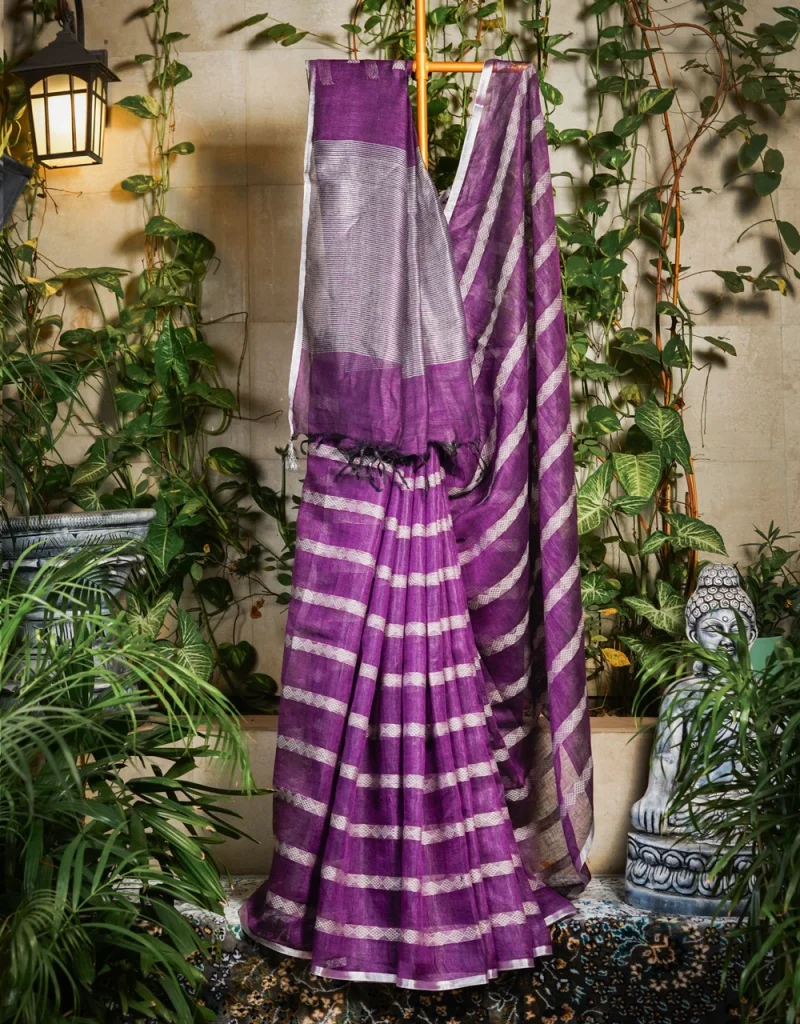
1. Deep Purple Handwoven Pure Silk Saree
Best for: Weddings and Festive OccasionsBhagalpuri Silk Saree Price Range: Premium
This jewel-toned deep purple Bhagalpuri pure silk saree is an instant statement. The geometric patterns woven into the pallu and blouse piece give it a contemporary graphic edge, while the pure Tussar silk base ensures flawless natural drape. Rich enough for a wedding reception, structured enough for an evening cultural event – this is a piece that earns its place at the front of your wardrobe every festive season. Also available in a refined blue-grey combination.
💄 Styling Tip: Pair with freshwater pearl jewellery – a layered pearl necklace and pearl drop earrings. The softness of pearls balances the depth of the purple beautifully.
Best for: Formal Events and Corporate CelebrationsBhagalpuri Silk Saree Price Range: Mid-Range
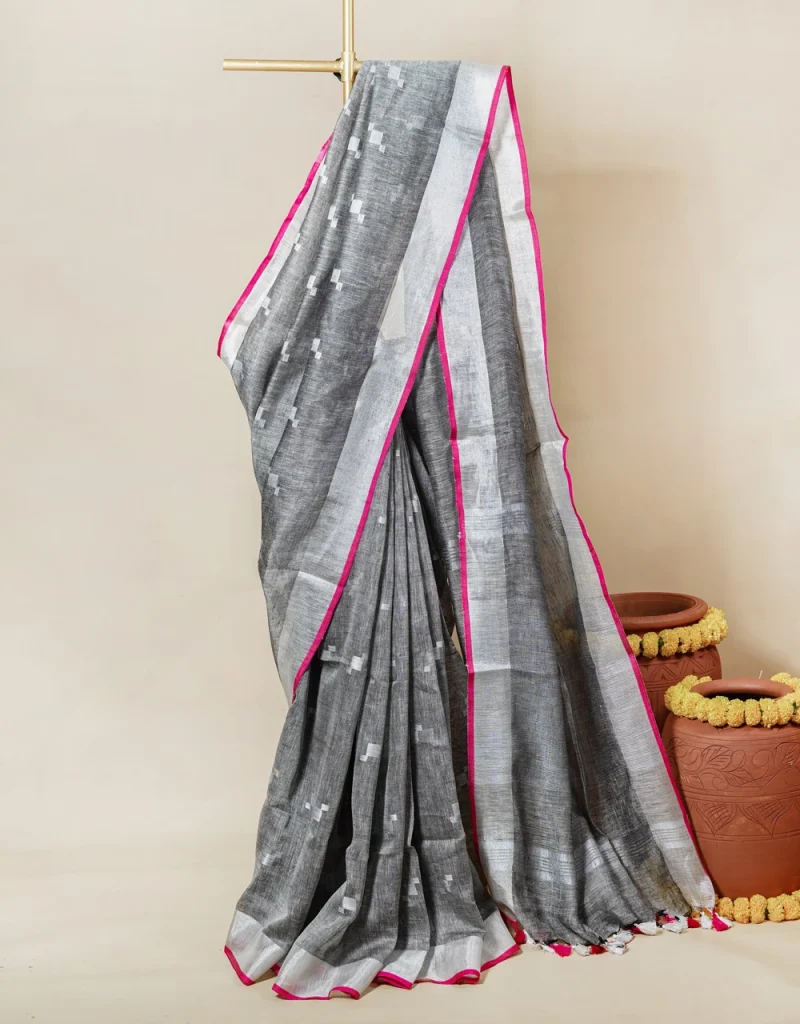
Tissue silk weaves ultra-fine metallic threads directly into the fabric, creating a subtle luminous shimmer across the surface. This grey piece layers grey and yellow thread embroidery with delicate zari detailing – the result is sophisticated, multi-textured, and genuinely stunning under evening lighting. The neutral grey base keeps it professional enough for corporate Diwali celebrations and formal dinners, sitting at a mid-range Bhagalpuri silk saree price point that represents excellent value. If the shimmer of tissue appeals to you, explore our full buy tussar silk saree collection for more options in this finish.
💄 Styling Tip: Choose silver or diamond jewellery – a slim pendant necklace and chandelier earrings that echo the metallic tones without overpowering the embroidery.
Best for: Evening Events and High-Profile OccasionsBhagalpuri Silk Saree Price Range: Premium
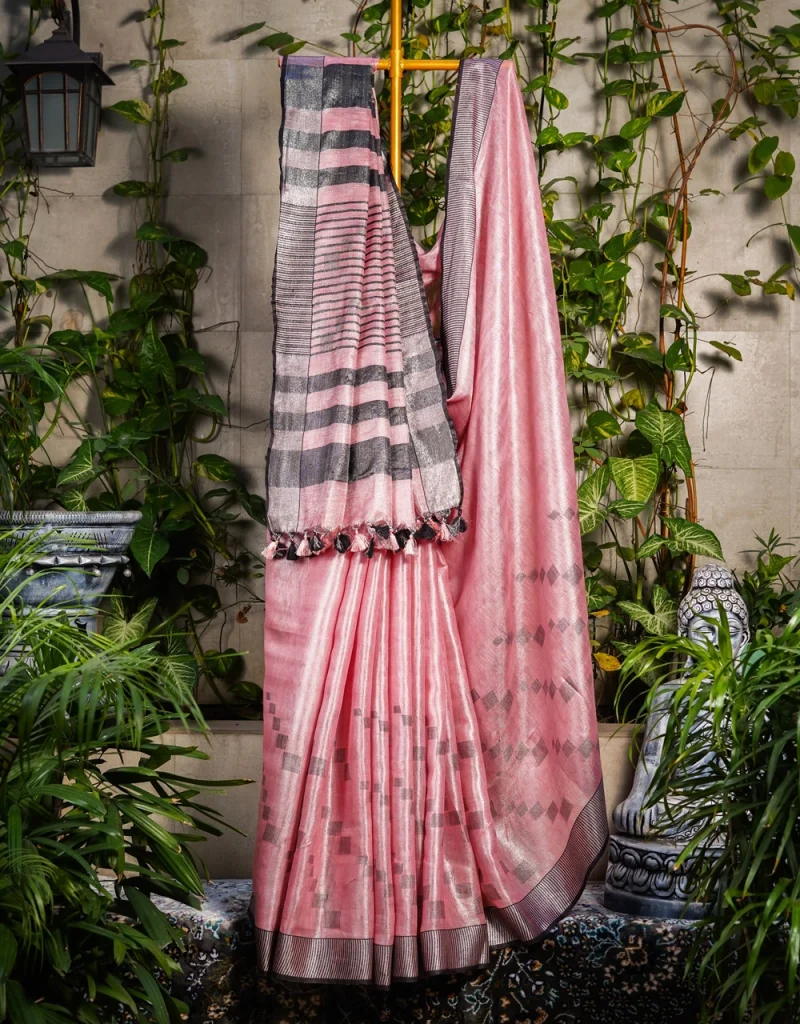
Few combinations in ethnic fashion are as powerful as pink And charcoal, and this Bhagalpuri silk saree handles the pairing flawlessly. charcoal zari stripes run the full length of the pink Tussar fabric, and the pallu features bold charcoal zari checks framed by a thin border. It photographs beautifully and commands a room in person. This is the saree you reach for when you want to make an entrance.
💄 Styling Tip: Go bold with heavy gold temple jewellery – a layered long necklace, large jhumkas, and stacked gold kadas complete the look with traditional grandeur.
4. Off-White Traditional Bhagalpuri Saree with Zari
Best for: Ceremonies and GiftingBhagalpuri Silk Saree Price Range: Mid-Range
There is an enduring, quiet elegance to this ivory traditional Bhagalpuri silk saree that makes it one of the most versatile pieces in the entire range. Golden zari detailing on the pallu and a delicate rust border add warmth without disrupting the saree’s sense of calm purity. Wear it to a pooja, a naming ceremony, or any auspicious occasion. It also ranks among the most thoughtful gifts you can give – meaningful, beautiful, and suitable for women of any age.
💄 Styling Tip: A rich red blouse makes a classic pairing. Complete the look with Kundan studs and a layered choker for a finish that feels ceremonial and complete.
Best for: Office WearBhagalpuri Silk Saree Price Range: Entry to Mid-Range
Designed for the woman who moves between professional and personal worlds without changing her standards, this Bhagalpuri saree in Silk Viscose blend solves the perennial challenge of looking distinctly Indian at work while staying genuinely comfortable. The blend breathes well, resists creasing through long days, and drapes cleanly. Minimal zari detailing on the pallu and a solid gold border add polish without making it feel festive.
💄 Styling Tip: Small gold stud earrings and a slim chain bracelet. Clean, intentional, and quietly confident – exactly the right tone for professional settings.
How to Care for Bhagalpuri Silk Sarees So They Last a Lifetime
Why Proper Care Protects Your Bhagalpuri Silk Saree Price Investment
A Bhagalpuri silk saree is an investment. With the right care, it will reward you for decades.
Washing Your Bhagalpuri Silk Saree
Always dry clean embroidered, zari-heavy, or tissue silk pieces. For plain Bhagalpuri Tussar silk sarees, gentle hand washing in cold water with a mild, pH-neutral detergent is safe. Never use a washing machine – agitation damages handwoven fibres.
Drying Bhagalpuri Silk Sarees Without Fading Natural Dyes
Press gently between two clean towels to remove excess water. Dry flat in shade – direct sunlight fades natural dyes over time.
Ironing Your Original Bhagalpuri Silk Saree Without Damage
Use a low to medium heat setting on the reverse side of the saree. Always place a thin cotton cloth between the iron and the fabric. Never iron directly over embroidery or zari work.
Storing Bhagalpuri Silk Sarees So They Only Get Better With Age
Wrap in muslin or soft cotton cloth – never plastic, which traps moisture and causes discolouration. Refold along different lines every few months to prevent permanent crease marks. Store with dried neem leaves or cedar chips to deter moths and silverfish naturally.
The Long-Term Promise of Every Bhagalpuri Silk Saree
With this level of care, your Bhagalpuri saree will only grow more beautiful with time – softer, more lustrous, and more deeply cherished.
Conclusion: Why Bhagalpuri Silk Sarees Deserve a Permanent Place in Your Wardrobe
The Enduring Case for Owning an Original Bhagalpuri Silk Saree
In a world of fast fashion and disposable choices, a Bhagalpuri silk saree is something profoundly different. It is an investment that grows more beautiful with age. It is a connection to a thousand-year craft tradition. It is a conscious choice to support artisan communities and sustainable production. And above everything else, it is simply a magnificent garment – versatile, comfortable, and genuinely one of a kind.
Your Next Step – Find Your Bhagalpur Silk Saree Online Today
Whether you are building your first serious saree collection or adding to a wardrobe that already spans decades, traditional Bhagalpuri silk sarees deserve their place at the centre of it. Begin with an original Bhagalpuri silk saree – explore what’s available from trusted sources like Siakari or check the Bhagalpur silk saree online market with the authentication checklist from this guide. And when you are ready to expand your collection further, you can buy sarees online India across every weave – silk, buy cotton silk and beyond. Choose wisely, care for it well, and it will become one of the most enduring things you own.
Bhagalpuri silk, produced in Bhagalpur, is primarily a variety of Tussar silk. It is known for its natural golden sheen, coarse texture, and durability. Unlike mulberry silk, it is made from wild silkworms, giving it a slightly irregular yet rich appearance. This silk is breathable and well-suited for warm climates. Bhagalpuri silk is widely used in sarees, stoles, and fabrics, and is valued for its eco-friendly and handcrafted production process.
What are the 4 types of silk?
The four main types of silk are Mulberry, Tussar, Eri, and Muga. Mulberry silk is the most common and smoothest, produced by domesticated silkworms. Tussar silk comes from wild silkworms and has a textured finish. Eri silk, also called peace silk, is soft and warm, as it is made without killing the silkworm. Muga silk, mainly from Assam, is rare and known for its natural golden color and exceptional durability, often improving with age.
Which type of saree is famous in Bihar?
The most famous saree from Bihar is the Bhagalpuri silk saree, crafted in Bhagalpur, often called the “Silk City.” These sarees are known for their lightweight feel, natural texture, and elegant sheen. Made mainly from Tussar silk, they often feature simple yet sophisticated designs. Bhagalpuri sarees are popular for both casual and formal wear due to their comfort and versatility, making them a significant part of Bihar’s textile heritage.
Which silk is the highest quality?
Mulberry silk is considered the highest quality silk due to its fine texture, uniform fibers, and smooth finish. It is produced from silkworms that feed exclusively on mulberry leaves, resulting in consistent and strong threads. Among premium varieties, Muga silk from Assam is also highly prized for its natural golden shine and durability. However, Mulberry silk remains the global standard for luxury fabrics because of its softness, sheen, and wide availability.
A South Indian wedding is not merely a ceremony it is a layered celebration of rituals, music, emotions, and generations of tradition. At the very heart of this celebration stands something truly iconic: the south indian wedding saree.
More than bridal wear, this timeless garment represents identity, cultural heritage, and emotional continuity that no modern trend has managed to replace. Even in 2026, when bridal fashion includes gowns, fusion silhouettes, and Indo-western experiments, the south indian wedding saree continues to hold its ground as the most meaningful choice a bride can make.
Whether planning a wedding look, attending a ceremony, or seeking to understand this enduring style, this guide covers everything from fabrics and weaving traditions to draping techniques, styling, and modern interpretations of the south indian wedding saree.
Why the South Indian Wedding Saree Is More Than Bridal Fashion
The south indian wedding saree has a cultural foundation that goes far deeper than aesthetics. In Tamil Nadu, Kerala, Karnataka, and Andhra Pradesh, brides traditionally wear sarees that reflect their regional identity, family customs, and ancestral pride.
What sets a south indian wedding saree apart is its remarkable balance between simplicity and richness. There is no need for excessive embellishment the weave, the border, and the drape itself carry all the visual impact and cultural weight.
Another defining quality of a south indian wedding saree is its emotional value. Many families treat it as a cherished heirloom, passing it from mother to daughter across generations, making it far more than an outfit for a single occasion.
Even as trends change rapidly in the bridal fashion industry, the south indian wedding saree remains a constant because it is rooted in tradition rather than in seasonal fashion cycles.
The Emotional Significance Behind a South Indian Wedding Saree
Every bride carries the memory of her wedding outfit throughout her life, and for South Indian brides, the south indian wedding saree becomes an inseparable part of that lifelong memory. It is often chosen through a meaningful process involving family, blessings from elders, and sometimes traditional rituals before the first wearing.
This deeply personal process of selection gives the south indian wedding saree a sacred quality that distinguishes it from any other garment. It is not chosen from a catalogue alone it is chosen with purpose, emotion, and generational wisdom.
Unlike fast fashion pieces that hold little meaning beyond the occasion, a south indian wedding saree represents prosperity, purity, and the beginning of a new chapter in a woman’s life.
Popular Fabrics Used in a South Indian Wedding Saree
Choosing the right fabric is the most foundational step in understanding the south indian wedding saree. The material determines not only how the saree looks but also how it drapes, how it photographs, and how comfortable it feels across long ceremonial hours.
Silk – The Soul of a South Indian Wedding Saree
Silk is the most iconic fabric associated with a south indian wedding saree, prized for its rich structure, natural sheen, and ability to hold pleats with precision. It creates a royal silhouette that defines the bridal look at traditional ceremonies. Women looking to buy silk saree styles for weddings will find silk to be the most enduring and prestigious choice available.
A cotton silk saree offers the perfect balance between comfort and elegance, making it a popular choice for pre-wedding rituals and daytime ceremonies where ease of movement matters. It is lighter than pure silk and considerably more manageable across several hours of wear.
Tissue silk carries a fine, semi-transparent quality with a metallic shimmer that makes it an exceptional choice for reception evenings and formal functions. Those who wish to buy tissue silk saree styles will appreciate how this fabric holds structure while delivering an unmistakable luminosity that photographs beautifully under event lighting.
Tussar silk brings a natural, raw texture with a muted sheen that suits brides who prefer a more grounded, organic aesthetic in their south indian wedding saree. Women who choose to buy tussar silk saree styles are drawn to its quiet richness and the dignified manner in which it drapes at traditional ceremonies.
Linen and linen blend saree options are increasingly being embraced by modern brides for pre-wedding events and outdoor functions where breathability and ease of movement are priorities. Women who wish to buy linen saree styles will find a growing range of elegantly woven options that pair well with minimalist jewellery and contemporary accessories.
Georgette – Lightweight Option for Casual Functions
Lightweight georgette is favoured by many brides for reception nights and post-wedding celebrations where a more relaxed version of the south indian wedding saree aesthetic is preferred. It moves gracefully and drapes effortlessly without requiring the same level of preparation as heavier silks.
Brands like Siakari curate an extensive collection of bridal sarees across all these fabric categories, making it straightforward to find the perfect south indian wedding saree for every function and personal style.
Iconic Weaving Traditions of the South Indian Wedding Saree
The true beauty of a south indian wedding saree lies not only in its fabric but in the weaving traditions that give it its identity. Each regional weave carries a distinct visual language, historical legacy, and cultural story.
Kanchipuram Silk – The Crown of Bridal Weaves
What Makes Kanchipuram the Most Iconic South Indian Wedding Saree
Kanchipuram silk is widely regarded as the most prestigious south indian wedding saree available, celebrated for its temple-inspired borders, peacock motifs, and intricate gold zari work. Its durability and structural richness make it the top choice for main wedding ceremonies across South India.
Key Characteristics of Kanchipuram Weave
The Kanchipuram south indian wedding saree is distinguished by its three-shuttle weaving technique, where the body and border are woven separately before being interlocked. This method gives the saree exceptional strength, weight, and a distinct visual contrast between the body and the border.
Mysore Silk – Understated Elegance
Mysore silk offers a softer, lighter interpretation of the south indian wedding saree, making it ideal for brides who prefer refined minimalism over heavy ornamentation. Its smooth texture and subtle sheen give it a quiet elegance that works beautifully for engagement functions and intimate ceremonies.
Kerala Kasavu – Pure Tradition in White and Gold
The white-and-gold Kerala Kasavu is one of the most culturally distinctive versions of the south indian wedding saree, worn predominantly in temple weddings and traditional Kerala ceremonies. Its simplicity is its greatest strength the contrast between natural cotton and gold zari borders creates an appearance of dignified purity.
Colour Symbolism in a South Indian Wedding Saree
Colour in a south indian wedding saree is never arbitrary it carries specific cultural meanings that have been observed and respected across generations of bridal tradition. Understanding this symbolism helps brides make choices that are both aesthetically and culturally informed.
Red is the most widely chosen colour for a south indian wedding saree, symbolising fertility, auspiciousness, and prosperity. Gold represents divine blessings and is woven into virtually every traditional bridal saree through zari borders and motifs. Green is associated with harmony and the promise of new beginnings in a south indian wedding saree worn at auspicious occasions.
In contemporary weddings, pastel shades of pink, peach, and ivory are being introduced into the south indian wedding saree palette particularly for engagement ceremonies and reception evenings. However, traditional shades remain the cultural heart of the south indian wedding saree at main wedding rituals.
How to Choose the Perfect South Indian Wedding Saree
Selecting the right south indian wedding saree is a thoughtful and multi-dimensional process that goes beyond simply choosing a colour or fabric. Several practical and cultural factors must be considered before making a final decision.
Key Factors to Consider
Occasion and Function Type
Different functions within a South Indian wedding call for different interpretations of the south indian wedding saree. Heavy silk is most appropriate for the main wedding ceremony, while lighter fabrics suit pre-wedding events, receptions, and outdoor functions.
Fabric Weight and Comfort
Since weddings involve long hours of rituals, movement, photography, and socialising, the comfort of a south indian wedding saree is as important as its appearance. Heavy silks are appropriate for shorter ceremonies, while lighter fabrics serve better for all-day events.
Jewellery Compatibility
The colour, border style, and overall tone of a south indian wedding saree must complement the bridal jewellery being worn. Temple jewellery pairs most naturally with traditional Kanchipuram and Mysore silk styles.
Cultural and Family Preferences
Many South Indian families have specific regional preferences and customs around the south indian wedding saree, including expectations around colour, weave, and draping style. These preferences should be honoured alongside personal taste.
Many brides today choose to buy sarees online India through curated platforms that allow detailed comparison of multiple weave styles, colour options, and fabric weights before making a final selection.
Traditional Draping Style for a South Indian Wedding Saree
Draping is what truly brings a south indian wedding saree to life. The traditional South Indian draping style is characterised by neat symmetry, structured pleating, and a controlled pallu placement that enhances the bridal silhouette without appearing excessive or informal.
The classic draping approach of a south indian wedding saree is designed to support good posture, allow graceful movement during rituals, and ensure the saree remains intact across several hours of continuous wear. Its restrained elegance is precisely why this draping tradition has endured without significant modification for centuries.
Step-by-Step Draping Guide for a South Indian Wedding Saree
Step 1 – Prepare the Foundation
The foundation of a well-draped south indian wedding saree begins with a properly fitted blouse and a firmly tied petticoat that sits at the natural waist. The petticoat length should reach the ankles to provide full support for the saree’s hemline throughout the ceremony.
Step 2 – Begin the First Tuck
Take the plain end of the south indian wedding saree and tuck it firmly into the petticoat at the navel, then wrap the fabric once fully around the body while maintaining an even hem throughout this initial wrap.
Step 3 – Set the Correct Hem Length
Before proceeding to the pleats, adjust the hem of the south indian wedding saree so it falls approximately half an inch above the floor enough to walk comfortably without the risk of stepping on the fabric during long ceremonial processions.
Step 4 – Create Even Pleats
Gather the front fabric into five to seven neat, equal pleats this is the most technically important step in draping a south indian wedding saree and the one that most directly determines the overall visual quality of the final result.
Step 5 – Secure the Pleats
Tuck the pleats firmly into the waistband slightly to the left of the navel, and pin them discreetly with a safety pin angled inward. For a south indian wedding saree worn across long ceremonies, this step is essential for maintaining pleat structure without any adjustment throughout the day.
Step 6 – Drape and Pin the Pallu
Bring the remaining fabric over the left shoulder and adjust the pallu length according to preference. For a traditional south indian wedding saree, the pallu is typically pinned at the shoulder to maintain a structured, formal appearance throughout the ceremony.
Modern Draping Variations for a South Indian Wedding Saree
While tradition remains the primary reference point, modern South Indian brides are increasingly experimenting with contemporary draping interpretations of their south indian wedding saree. These variations preserve cultural identity while incorporating personal style and current bridal fashion trends.
Popular Modern Draping Styles
Belted Draping: A structured belt at the waist adds a fashion-forward dimension to a south indian wedding saree while simultaneously keeping the pleats firmly in place throughout long events.
Layered Pleats for Volume: Additional pleating at the front creates a fuller, more dramatic silhouette for a south indian wedding saree worn at evening receptions and contemporary celebrations.
Relaxed Pallu Drape: A softly flowing pallu gives a more effortless, modern interpretation of a south indian wedding saree that suits brides who prefer a less structured aesthetic at post-wedding events.
Fusion Styling with Jackets: Pairing a traditional south indian wedding saree with an embroidered jacket or structured blazer has become a popular choice for reception evenings and cocktail functions.
Bridal Jewellery That Completes a South Indian Wedding Saree Look
No south indian wedding saree look is complete without the right jewellery, and in South Indian bridal tradition, temple jewellery is the most culturally authentic and visually harmonious choice. Gold necklaces, layered chokers, traditional bangles, maang tikkas, and waist chains collectively enhance the richness of the saree without competing with its craftsmanship.
Jewellery selection for a south indian wedding saree should be guided by the weight and colour of the saree fabric. Heavy Kanchipuram silk pairs best with elaborate multi-layered gold sets, while lighter fabrics such as Mysore silk or kasavu call for more restrained, elegant jewellery choices.
Hairstyling Traditions for a South Indian Wedding Saree
Hair is an integral component of the complete bridal presentation built around a south indian wedding saree, and no South Indian wedding look is considered truly finished without it. The most traditional and iconic choice is a neatly structured bun adorned with fresh jasmine flowers, which adds fragrance, cultural meaning, and visual contrast against the richness of the saree.
Contemporary brides wearing a south indian wedding saree are also exploring floral braids, embellished hairpins, and sleek chignons as alternatives that maintain cultural authenticity while reflecting individual personality.
Makeup Guidance for a South Indian Wedding Saree
Makeup for a south indian wedding saree should enhance natural features rather than overpower the traditional richness of the garment. Soft gold eyeshadow, precisely applied winged eyeliner, and warm-toned lipstick in shades of terracotta, rose, or deep burgundy create a polished bridal finish that complements the saree beautifully.
The overall makeup approach for a south indian wedding saree occasion should prioritise longevity and balance the saree itself carries significant visual presence, and makeup should harmonise with rather than dominate the overall bridal aesthetic.
Accessorising the South Indian Wedding Saree Look
The right accessories transform a beautifully draped south indian wedding saree into a complete, cohesive bridal statement. Each piece should be selected with the saree’s colour, weave, and overall tone in mind to ensure visual harmony across the entire look.
Essential Accessories for a South Indian Wedding Saree
Maang Tikka: Frames the forehead and adds a traditional focal point to the bridal look built around a south indian wedding saree.
Temple Necklaces: The most culturally appropriate necklace style for a traditional south indian wedding saree, available in elaborate multi-layered designs or more restrained single-strand styles.
Gold Bangles and Kadas: Wrist jewellery adds movement and sound to the bridal presentation, both of which are considered auspicious at South Indian wedding ceremonies.
Anklets and Waist Chains: These traditional accessories add cultural depth and completeness to the overall look of a south indian wedding saree without requiring excessive styling effort.
Photography Tips for a South Indian Wedding Saree
A south indian wedding saree photographs exceptionally well when the right styling, lighting, and posing choices are made by both the bride and the photographer. Natural lighting brings out the depth of silk weaves, the brilliance of gold zari borders, and the richness of traditional colours in a way that artificial light rarely replicates.
Key details such as the border pattern, jewellery placement, pallu drape, and pleat structure of a south indian wedding saree should be deliberately highlighted during close-up shots to capture the full cultural and aesthetic value of the garment. Candid expressions and traditional ritual moments often produce the most powerful images of a south indian wedding saree in wear.
Common Mistakes Brides Should Avoid with a South Indian Wedding Saree
Even the finest south indian wedding saree can lose its visual impact if styling and draping decisions are not carefully considered. Awareness of these common errors helps brides present themselves with the polished elegance their saree deserves.
Over-Accessorising: Excessive jewellery or accessories can overpower the craftsmanship of a south indian wedding saree rather than enhancing it. A curated, deliberate approach to accessorising always produces a more refined result.
Poor Blouse Fitting: A poorly fitted blouse undermines the structural balance of a south indian wedding saree and affects posture, silhouette, and overall comfort throughout the ceremony.
Uneven Pleat Structure: Inconsistent or loosely formed pleats compromise the symmetry and elegance that define a well-draped south indian wedding saree, and are among the most visually noticeable draping errors.
Ignoring Fabric Behaviour: Different fabrics drape, move, and hold structure differently, and treating every version of a south indian wedding saree with an identical draping approach often leads to a less-than-ideal result.
Prioritising Appearance Over Comfort: A beautiful south indian wedding saree that restricts movement or causes discomfort during long rituals will affect a bride’s confidence and enjoyment throughout the most important day of her life.
Recommended Tools and Resources for South Indian Wedding Saree Styling
For brides, families, and saree enthusiasts seeking deeper guidance on selecting and styling a south indian wedding saree, the following platforms offer reliable and visually rich references:
Taneira by Tata – A premium Indian saree brand backed by the Tata Group, offering authenticated silk weaves and regional handloom sarees including Kanchipuram and Mysore silk varieties ideal for a south indian wedding saree occasion.
The Loom – A curated online destination for handwoven Indian sarees, featuring detailed weave stories, regional craft documentation, and a wide selection of silk sarees suited for bridal and ceremonial wear.
Sundari Silks – One of Chennai’s most established saree retailers with decades of expertise in traditional Kanchipuram silk and South Indian bridal wear, serving as a reliable reference for weave authenticity and styling.
Bridal Asia – A leading Indian bridal lifestyle platform featuring editorial content, styling guides, and expert advice on bridal saree selection, jewellery pairing, and regional wedding fashion trends across South India.
How Siakari Supports Your South Indian Wedding Saree Journey
Siakari is a dedicated saree brand built around the values of authentic craftsmanship, regional heritage, and contemporary curation making it one of the most trusted destinations for brides seeking a south indian wedding saree that reflects both cultural integrity and personal style.
The Siakari collection spans Kanchipuram silk, Mysore silk, Kasavu weaves, tissue silk, and linen blends covering every fabric and function associated with the south indian wedding saree across different regions and family traditions. Each piece is carefully selected for quality, weave authenticity, and bridal suitability.
From grand wedding ceremonies requiring the finest Kanchipuram silk to reception evenings calling for lighter, contemporary fabrics, Siakari ensures that every bride finds her ideal south indian wedding saree from one trusted platform. The brand also provides styling guidance to support brides through the selection, draping, and accessorising process with confidence.
Why the South Indian Wedding Saree Remains Timeless
Fashion trends evolve continuously, but the cultural significance of a south indian wedding saree remains entirely unaffected by changing tastes or seasonal aesthetics. Its enduring relevance comes not from trend cycles but from the generational meaning woven into every thread.
Brides continue to choose a south indian wedding saree decade after decade because it connects them to their family lineage, regional identity, and ancestral traditions in a way that no contemporary garment can replicate. The saree is not just worn it is carried forward.
Even among younger generations who are exposed to global bridal fashion and international styling influences, the south indian wedding saree retains a special status because it represents something fashion alone cannot manufacture: belonging, continuity, and cultural pride.
Final Thoughts on the South Indian Wedding Saree
A south indian wedding saree is not simply clothing it is heritage woven into fabric, tradition expressed through colour, and identity preserved in every border and motif. Every pleat, border, weave, and drape carries meaning that extends far beyond the wedding day itself.
Whether a bride chooses a traditional Kanchipuram silk or a contemporary lighter interpretation, the essence of a south indian wedding saree remains consistent grace, cultural dignity, and the quiet confidence that comes from wearing something deeply meaningful. Brands like Siakari are committed to making that experience accessible, authentic, and memorable for every bride.
When a south indian wedding saree is worn with the right preparation, the right drape, and the right intention, it does not merely complete a bridal look it continues a tradition that has lived for generations and deserves to live for many more.
Why is the South Indian wedding saree so important in weddings?
The South Indian wedding saree is important because it represents tradition, culture, and family heritage. It is deeply rooted in rituals and symbolizes purity, prosperity, and new beginnings. Brides wear it as part of long-standing customs, often choosing it with family blessings. Its rich silk fabric and gold borders add a regal touch to the ceremony. Beyond fashion, the South Indian wedding saree carries emotional value, making it a timeless and meaningful choice for bridal celebrations.
Which fabric is best for a South Indian wedding saree?
Silk is the best fabric for a South Indian wedding saree because it offers structure, richness, and traditional elegance. Kanchipuram silk is especially popular for its durability and gold zari work. It drapes beautifully and enhances bridal appearance during ceremonies. Mysore silk is another lightweight yet elegant option. For pre-wedding functions, some brides choose lighter fabrics, but for the main wedding, silk remains the most preferred choice for a perfect South Indian wedding saree look.
How is a South Indian wedding saree traditionally draped?
A South Indian wedding saree is traditionally draped in a structured style with neatly arranged front pleats and a well-positioned pallu over the shoulder. The saree is first tucked at the waist, then pleats are made evenly and secured. The pallu is adjusted to fall gracefully, giving a balanced and elegant appearance. This classic draping style enhances posture and comfort, making the South Indian wedding saree look graceful, cultural, and perfect for long wedding rituals and ceremonies.
How can a South Indian wedding saree look more modern?
A South Indian wedding saree can look modern by experimenting with styling while keeping its traditional base. Brides can use belt draping, stylish blouses, or minimal jewellery for a contemporary touch. Soft makeup and different pallu placements also enhance the look. Lighter silk or fusion fabrics add freshness while maintaining tradition. Even though the South Indian wedding saree is traditional, modern styling helps brides personalize their look while still respecting cultural elegance and wedding customs beautifully.
Graduation day is one of those rare milestones that stays in your memory long after it’s over. It’s emotional in a quiet way you’re proud of how far you’ve come, a little nostalgic about the years behind you, and excited about everything ahead. And in the middle of all this, there’s one thing almost every student thinks about: what to wear.
For many, a saree for graduation day becomes the perfect choice. It’s graceful, meaningful, and timeless. But choosing the right saree for graduation day isn’t always easy. You want something elegant but not overdressed, comfortable but still special, simple but memorable.
So let’s go step by step and talk about everything you need to know in a natural, practical way like a friend helping you get ready for one of the most important days of your life.
Why a Saree for Graduation Day Feels Perfect
A saree for graduation day is not just a fashion choice it’s a symbolic one. It represents growth, transition, and the beginning of a new journey. Unlike casual outfits, a saree for graduation day carries emotional weight. It feels like a gentle shift from student life into a more mature phase of life.
What makes it even more special is how versatile a saree for graduation day can be. It can be soft and minimal or slightly festive depending on your personality. It adapts to you, not the other way around.
It also photographs beautifully. Graduation pictures are something you’ll look back on for years, and a saree for graduation day ensures those memories feel timeless.
Understanding the Mood of Graduation Day and Your Saree
Before choosing your saree for graduation day, it helps to understand the mood of the event.
What Graduation Feels Like and How Your Saree for Graduation Day Should Match It
Graduation is:
Formal but not rigid
Emotional but celebratory
Traditional yet modern
Your outfit should reflect this balance. That’s why a saree for graduation day works so well it sits perfectly between elegance and simplicity.
Step One: Choosing the Right Fabric for Your Saree for Graduation Day
Fabric is the foundation of your entire look. It affects comfort, movement, and how confident you feel throughout the day. Choosing the right fabric is the first real decision when picking a saree for graduation day.
Cotton Silk Saree for Graduation Day: Simple, Comfortable, Reliable
If you want something easy and fuss-free, a cotton silk saree is a great starting point for a saree for graduation day. It’s breathable, soft, and perfect for long ceremonies.
A cotton-based saree for graduation day works especially well if your event is during the day or in a warm climate. It gives a clean, grounded look without feeling heavy.
Many students prefer cotton blends because they don’t require constant adjustment, which makes the day more enjoyable.
Buy Silk Saree for Graduation Day: Light and Photogenic
Silk is one of the most popular choices when selecting a saree for graduation day. It drapes beautifully and moves gracefully, which makes it ideal for pictures.
If you plan to buy silk sarees, you’ll notice they come in soft shades and elegant prints perfect for formal occasions. Brands like Nalli Silk Sarees offer a wide silk range in graduation-friendly colours. A silk saree for graduation day gives a soft, feminine look without feeling overdone.
It’s especially good if you want something flowy and slightly dressy but still comfortable.
Linen Saree for Graduation Day: Minimal and Modern
Linen sarees are perfect for students who prefer understated elegance in their saree for graduation day. A linen blend saree has a structured feel that looks polished and contemporary.
If you’re thinking to buy a linen saree, choose soft tones like ivory, beige, or pastel blue. FabIndia has an excellent collection of handwoven linen sarees that work beautifully for occasions like graduation. A linen saree for graduation day gives a confident, effortless vibe perfect for someone who likes clean aesthetics.
It’s simple, but that simplicity is exactly what makes it powerful.
Tissue Silk Saree for Graduation Day: Subtle Celebration Look
Graduation is a celebration too, and a little shimmer can enhance your presence when picking a saree for graduation day.
A tissue silk saree option is perfect if you want a slightly festive touch. Many students choose to buy tissue silk saree for important events like this because it adds a soft glow without being too heavy. Explore the curated range at Kalki Fashion for tissue silk options that are graduation-ready.
A tissue silk saree for graduation day works beautifully for evening ceremonies or stage appearances where lighting enhances the fabric’s natural shine.
Hairstyle and Makeup Tips for a Saree for Graduation Day
Your hairstyle and makeup should enhance your natural look alongside your saree for graduation day.
Hairstyle Options That Work with a Saree for Graduation Day
For a balanced saree for graduation day look:
Loose curls for a soft feminine vibe
Straight hair for a modern feel
Neat bun for a traditional touch
Makeup That Complements Your Saree for Graduation Day
Makeup should stay natural when pairing with your saree for graduation day:
Soft foundation
Nude or pink lips
Light eyeliner or mascara
Keep everything fresh and simple so your saree for graduation day remains the star of the look.
Footwear That Works All Day with Your Saree for Graduation Day
Graduation involves walking, standing, and posing for photos, so comfort matters when styling a saree for graduation day.
Best Footwear Options for a Saree for Graduation Day
Best options for a saree for graduation day:
Low heels
Wedges
Comfortable flats
Make sure your footwear doesn’t distract you from enjoying your day in your saree for graduation day.
Budget-Friendly Saree for Graduation Day Options
Looking good doesn’t mean spending a lot when choosing a saree for graduation day. Many affordable sarees look stunning when styled well.
Where to Shop for an Affordable Saree for Graduation Day
A simple saree for graduation day in silk or cotton blend can look just as beautiful as expensive designer pieces.
Many students explore options when they buy sarees online India, where budget-friendly yet stylish sarees are widely available. You can also browse Myntra’s saree collection for a great range of affordable yet stylish options that work well as a saree for graduation day.
Styling Tips That Make a Difference for Your Saree for Graduation Day
Small adjustments can completely change your final look when wearing a saree for graduation day.
Final Styling Checklist for Your Saree for Graduation Day
Keep these tips in mind to perfect your saree for graduation day:
Keep pleats crisp and aligned
Match blouse tone thoughtfully
Avoid over-accessorizing
Maintain good posture
These details make your saree for graduation day look refined and confident.
Common Mistakes to Avoid with a Saree for Graduation Day
To ensure your saree for graduation day looks perfect, avoid these common pitfalls:
What Not to Do When Wearing a Saree for Graduation Day
Heavy makeup that feels too mature
Ill-fitted blouse or petticoat
Overly complicated draping styles
Too many accessories
Simplicity always photographs better and a saree for graduation day is no exception to this rule.
How to Feel Confident in Your Saree for Graduation Day
Confidence is the most important part of your look when wearing a saree for graduation day.
Owning the Moment in Your Saree for Graduation Day
A saree for graduation day feels truly complete when you feel comfortable in it. Don’t overthink perfection. Walk naturally, smile freely, and enjoy the moment.
Your confidence will always stand out more than your outfit but a beautiful saree for graduation day certainly helps.
Why Simplicity Works Best for a Saree for Graduation Day
Graduation is not about dressing to impress others it’s about celebrating yourself. And the right saree for graduation day understands that.
The Power of a Simple Saree for Graduation Day
A simple saree for graduation day allows your personality to shine. It doesn’t overpower the moment; it complements it.
Final Thoughts on Finding the Perfect Saree for Graduation Day
Choosing the perfect saree for graduation day is less about strict fashion rules and more about emotional connection. It’s about choosing something that feels right for you in one of the most meaningful moments of your life.
Whether you go for a soft silk, a breathable cotton blend, a structured linen, or a subtle tissue silk, your saree for graduation day should reflect who you are and how far you’ve come.
Take your time, try different styles, and trust your instincts. Because in the end, your saree for graduation day is not just clothing it’s a memory woven into fabric, captured in photographs, and carried in your heart long after the ceremony ends.
Ready to Find Your Perfect Saree for Graduation Day?
The best saree for graduation day depends on comfort, style, and the event setting. Lightweight fabrics like georgette, cotton blend, or linen are ideal because they are easy to carry for long hours. Soft pastel or neutral shades work beautifully for a graceful look. A well-chosen saree for graduation day should feel comfortable, photograph well, and reflect your personality while keeping the overall appearance elegant, simple, and suitable for a formal academic ceremony.
Which fabric is most suitable for a saree for graduation day?
Fabrics like georgette, cotton blend, linen, and tissue silk are most suitable for a saree for graduation day. Cotton blends offer comfort, georgette gives a flowy look, and linen provides a modern, structured style. Tissue silk adds a subtle festive shine. Choosing the right fabric ensures you stay comfortable throughout the ceremony while maintaining elegance. A good saree for graduation day balances ease of movement, neat drape, and a polished appearance.
How should I style a saree for graduation day?
To style a saree for graduation day, keep everything minimal and elegant. Choose a well-fitted blouse with simple necklines, light jewelry like studs or a bracelet, and soft makeup with natural tones. Hairstyles like loose curls, straight hair, or a neat bun work best. Focus on neat draping with even pleats and a smooth pallu. A balanced styling approach ensures your saree for graduation day looks graceful, confident, and appropriate for a formal celebration.
Can I wear a budget-friendly saree for graduation day?
Yes, a budget-friendly saree for graduation day can look just as elegant as expensive ones if styled well. Fabrics like georgette and cotton blends offer affordable yet stylish options. The key lies in proper draping, color choice, and minimal accessories. Many students explore options when they buy sarees online india, where stylish and budget-friendly designs are widely available. A simple saree for graduation day can look stunning with confidence and the right presentation.
A school farewell is one of those rare moments that feels emotional, exciting, and slightly surreal all at once. It’s the day you laugh with your friends a little louder, click a hundred photos, and secretly realize that a chapter of your life is quietly coming to an end. And in the middle of all this emotion, there’s one thing every girl thinks about at some point what to wear.
For many students, nothing feels more graceful and memorable than a saree for farewell party in school. It brings together elegance, tradition, and a sense of maturity that perfectly matches the occasion. But choosing the right saree for farewell party in school can feel confusing when you’re surrounded by so many styles, colors, fabrics, and opinions.
So instead of overcomplicating it, let’s go step by step and make this process simple, practical, and actually enjoyable.
Why a Saree for Farewell Party in School Feels So Special
A saree for farewell party in school is not just another outfit it’s a moment of transformation. For many girls, it’s the first time they wear a saree for farewell party in school for a big occasion like this. That alone makes it memorable.
Unlike western outfits that may come and go with trends, a saree for farewell party in school has a timeless charm. It instantly adds grace without trying too hard. That’s why so many students choose a saree for farewell party in school when they want something elegant yet meaningful.
It also reflects emotion. Farewell is about memories, and a saree for farewell party in school fits that mood beautifully it feels nostalgic, traditional, and personal at the same time.
Understanding What Kind of Look You Want for Your Saree for Farewell Party in School
Before you even start browsing, it helps to ask yourself one simple question: What kind of look do I want for my farewell?
Finding Your Vibe: What Your Saree for Farewell Party in School Should Reflect
Your saree for farewell party in school can reflect different moods:
Soft and simple
Elegant and graceful
Bold and confident
Light and festive
Once you know your vibe, choosing a saree for farewell party in school becomes much easier.
Choosing the Right Fabric for Your Saree for Farewell Party in School
Fabric is the foundation of your entire look. A good fabric ensures comfort, movement, and a flattering drape especially important when selecting a saree for farewell party in school.
Cotton Silk Sarees for Farewell Party in School: Simple and Comfortable
If comfort is your top priority, a cotton silk saree is one of the safest choices for a saree for farewell party in school. It’s breathable, easy to manage, and perfect for long hours.
A cotton-based saree for farewell party in school works well if your farewell is during the day or in a casual setting. It gives a soft, grounded look without feeling heavy or overdone.
Many students prefer cotton silk when they are experimenting for the first time because it feels familiar and easy to carry. You can explore a wide range when you buy sarees online India and filter specifically for cotton silk that suit your style and budget.
Silk Sarees for Farewell Party in School: Light and Elegant
Silk is one of the most popular choices among students because it drapes beautifully and feels light on the saree for farewell party in school look.
If you plan to buy silk sarees, you’ll find plenty of soft pastel shades and subtle prints that are perfect for farewell looks. A georgette saree for farewell party in school gives a smooth, flowy appearance that photographs really well.
It’s especially great if you want something feminine and effortless without too much structure. Nalli Silk Sarees carries a beautiful georgette range that works perfectly as a saree for farewell party in school.
Linen Sarees for Farewell Party in School: Minimal and Modern
Linen sarees are perfect for students who like clean, understated fashion when choosing a saree for farewell party in school. A linen blend saree has a natural texture that feels both modern and traditional at the same time.
A linen saree for farewell party in school works well if you want a calm, confident look rather than something flashy. It’s subtle, elegant, and very easy to style.
If you’re exploring options to buy linen saree, you’ll notice how versatile it is for both casual and semi-formal occasions. FabIndia offers a curated range of handwoven linen sarees that make for a stunning saree for farewell party in school.
Tissue Silk Sarees for Farewell Party in School: Soft Festive Shine
If your farewell feels more like a celebration, tissue silk can be a beautiful choice for your saree for farewell party in school. It has a soft shine that adds just the right amount of glamour without going overboard.
Many students prefer to buy tissue silk saree for special occasions because it instantly elevates the overall appearance of a saree for farewell party in school.
It’s perfect for evening events, stage photos, and final group pictures where you want to stand out a little more. Kalki Fashion has an excellent tissue silk edit that is ideal as a saree for farewell party in school.
A Note on Silk Options for Your Saree for Farewell Party in School
If you’re drawn to silk varieties, it’s also worth exploring options to buy silk saree and buy tussar silk saree both carry an earthy, rich texture that looks stunning for farewell events. A cotton silk saree is another wonderful middle-ground option that combines the comfort of cotton with the gentle sheen of silk, making it a practical yet beautiful choice as a saree for farewell party in school.
Choosing the Right Color for Your Saree for Farewell Party in School
Color plays a huge role in how your saree for farewell party in school looks both in real life and in photos.
Color Guide for the Perfect Saree for Farewell Party in School
Here are some safe and beautiful choices for your saree for farewell party in school:
Soft pastels like lavender, peach, baby pink, sky blue
Neutral tones like ivory, beige, and cream
Deep shades like maroon, emerald, or navy for a bold statement
A well-chosen color ensures your saree for farewell party in school complements your skin tone and stands out naturally without feeling too loud.
Keep the Design Simple Yet Stylish for Your Saree for Farewell Party in School
Farewell is not a wedding, so heavy embroidery or overly flashy designs are usually not necessary when picking a saree for farewell party in school.
What Design Details Work Best on a Saree for Farewell Party in School
A well-balanced saree for farewell party in school should have:
Light prints or minimal embroidery
Soft borders instead of heavy embellishments
Clean, elegant patterns
The goal is to look graceful and youthful, not overly dressed, in your saree for farewell party in school.
Draping Style Makes a Big Difference for Your Saree for Farewell Party in School
Even the most beautiful saree for farewell party in school can look average if not draped properly. That’s why draping is one of the most important parts of styling a saree for farewell party in school.
How to Drape Your Saree for Farewell Party in School Perfectly
Here’s what to focus on when draping your saree for farewell party in school:
Keep pleats even and neat
Make sure the saree is not too loose or too tight
Let the pallu fall smoothly over the shoulder
Use pins for support if needed
A clean drape instantly upgrades your entire saree for farewell party in school look.
Blouse Styling for Your Saree for Farewell Party in School: Small Detail, Big Impact
The blouse can completely change your appearance when wearing a saree for farewell party in school.
Blouse Tips That Complement Your Saree for Farewell Party in School
For a balanced saree for farewell party in school, choose:
Simple necklines like round, boat, or square
Well-fitted structure
Minimal or no heavy embellishments
A clean blouse helps your saree for farewell party in school stand out more naturally.
Accessories: Less is Always Better with a Saree for Farewell Party in School
One common mistake students make is over-accessorizing. For farewell, subtle elegance works best with a saree for farewell party in school.
The Right Accessories for a Saree for Farewell Party in School
To complement your saree for farewell party in school, go for:
Small earrings or studs
Light bangles or bracelets
A simple chain or no necklace at all
Let your saree for farewell party in school be the highlight, not the accessories.
Hair and Makeup Tips for Your Saree for Farewell Party in School
Your hairstyle and makeup should match the softness of your saree for farewell party in school.
Hairstyle Ideas That Work with a Saree for Farewell Party in School
For a perfect saree for farewell party in school look:
Loose curls or straight hair for a natural vibe
Neat bun for a traditional touch
Soft makeup with nude or pastel tones
Avoid heavy makeup because it can overpower the simplicity of your saree for farewell party in school.
Footwear for Your Saree for Farewell Party in School: Comfort Comes First
Farewell involves a lot of walking, standing, and posing for pictures. So your footwear matters more than you think when wearing a saree for farewell party in school.
Best Footwear Options for a Saree for Farewell Party in School
Best options for your saree for farewell party in school:
Low heels
Wedges
Comfortable flats
Choose something stable so you can enjoy your day without discomfort in your saree for farewell party in school.
Budget-Friendly Saree for Farewell Party in School Choices for Students
Not every beautiful saree for farewell party in school needs to be expensive. In fact, some of the best-looking options are quite affordable.
Where to Find an Affordable Saree for Farewell Party in School
A simple saree for farewell party in school in georgette or cotton blend can look stunning when styled well.
Many students explore options when they buy sarees online India, where there are plenty of budget-friendly yet stylish choices available for a saree for farewell party in school.
Shopping Tips to Avoid Mistakes When Buying a Saree for Farewell Party in School
When choosing your saree for farewell party in school, keep these points in mind:
How to Shop Smart for Your Saree for Farewell Party in School
Always check fabric description
Look at real customer images
Avoid overly edited product photos
Read reviews before buying
A little attention during shopping can save a lot of disappointment later when selecting a saree for farewell party in school.
Building Confidence in Your Saree for Farewell Party in School Look
No matter what saree you choose, confidence is what completes the look of a saree for farewell party in school.
How to Own Your Saree for Farewell Party in School
Your saree for farewell party in school becomes truly beautiful when you feel comfortable in it. Walk naturally, smile freely, and enjoy your moment.
Confidence reflects in every photo, every step, and every memory you make in your saree for farewell party in school.
Common Mistakes to Avoid with a Saree for Farewell Party in School
To make sure your saree for farewell party in school looks perfect, avoid:
What Can Go Wrong with a Saree for Farewell Party in School
Overly heavy makeup
Too many accessories
Ill-fitted blouse or petticoat
Uncomfortable fabric choices
Keeping things simple almost always works better for a saree for farewell party in school.
Final Thoughts on Choosing the Perfect Saree for Farewell Party in School
Choosing the perfect saree for farewell party in school is not about following strict fashion rules it’s about finding something that feels right for you.
Whether you choose a soft georgette, a breathable cotton blend, or a slightly shiny tissue silk, your saree for farewell party in school should reflect your personality, comfort, and mood for the day.
Take your time, try different styles, and don’t stress too much about perfection. Because at the end of the day, your saree for farewell party in school is not just an outfit it’s part of a memory you’ll carry with you forever, long after school is over.
What is the best saree for farewell party in school?
The best saree for farewell party in school depends on comfort and personal style. Lightweight fabrics like georgette, cotton blend, or linen work well because they are easy to carry for long hours. Soft pastel colors or subtle prints are ideal for a graceful look. A well-chosen saree for farewell party in school should balance elegance and comfort so you can enjoy the event, click pictures, and move freely without feeling restricted or overdressed.
Which fabric is most comfortable for a saree for farewell party in school?
Comfortable fabrics like georgette, cotton blend, and linen are best for a saree for farewell party in school. A cotton blend saree is breathable and simple, while georgette offers a soft, flowy drape. Linen gives a modern and neat appearance. These fabrics ensure you stay comfortable during long farewell celebrations while still looking stylish. Choosing the right material is key to carrying a saree for farewell party in school with ease and confidence.
How can I style a saree for farewell party in school?
To style a saree for farewell party in school, keep everything simple and elegant. Choose a well-fitted blouse with a clean neckline, minimal jewelry like studs or light bangles, and soft makeup. Hairstyles like loose curls or a neat bun work beautifully. Focus on neat draping with even pleats. A balanced styling approach ensures your saree for farewell party in school looks graceful without being too heavy or overdone for a school event.
Can I wear a saree for farewell party in school on a budget?
Yes, you can easily find a stylish saree for farewell party in school on a budget. Many affordable options in georgette, cotton blend, or linen look elegant when styled properly. You don’t need expensive designer wear to stand out. Simple designs, soft colors, and good draping can make even budget-friendly sarees look beautiful. A well-chosen saree for farewell party in school is more about presentation and confidence than price or brand value.
There is something undeniably graceful about a saree. It is one of those outfits that never feels outdated, no matter how trends shift. Whether it is a wedding, a festival, a religious ceremony, or even a special family dinner, the charm of a saree lies in how effortlessly it blends elegance with tradition. And when done right, a traditional saree look does not just make you look good it makes you feel connected to something deeper.
But let us be honest. Getting that perfect traditional saree look can sometimes feel intimidating. The draping, the styling, the accessories it can all seem like a lot, especially if you are not used to wearing sarees regularly.
The good news is that it is much simpler than it looks. Once you understand the basics and find your comfort zone, achieving a beautiful traditional saree look becomes second nature. This guide walks through everything you need to know, step by step, in a way that feels practical and easy to follow.
What Defines a Perfect Traditional Saree Look?
Before diving into styling tips, it helps to understand what really makes a traditional saree look stand out. A traditional saree look is not about wearing the most expensive saree or the heaviest jewelry it is built on simplicity, cultural essence, and thoughtful styling.
Core Elements That Make a Traditional Saree Look Authentic
A traditional saree look typically includes classic or regional draping styles, timeless fabrics like cotton, silk, or khadi, subtle yet meaningful accessories, and a balanced overall appearance. These elements work together to create a look that feels rooted and graceful rather than overdone.
Why Simplicity Is the Foundation of a Traditional Saree Look
The beauty of a traditional saree look lies in its authenticity. It does not try too hard and that is exactly why it works. A restrained, well-considered approach to styling always produces a more compelling traditional saree look than one layered with excess.
Choosing the Right Saree for a Traditional Saree Look on Every Occasion
One of the biggest mistakes people make is wearing the same type of saree for every occasion. The key to a flawless traditional saree look is choosing something that fits the moment. Occasion-appropriate choices make the traditional saree look feel effortless rather than forced.
Traditional Saree Look for Everyday and Religious Functions
For simple gatherings or temple visits, lightweight fabrics work best for a traditional saree look. A cotton blend saree is a great option here breathable, comfortable, and easy to carry for long hours. It helps maintain a soft and elegant traditional saree look without feeling overdressed.
Why Cotton Works So Well for an Everyday Traditional Saree Look
Cotton sarees strike the perfect balance between comfort and elegance. For a traditional saree look that needs to last through a full day of activity, cotton remains one of the most reliable choices across generations and regions.
Traditional Saree Look for Weddings and Grand Celebrations
Weddings call for richer fabrics and deeper colors to create a traditional saree look that matches the occasion’s grandeur. Silk sarees, especially those with traditional motifs, instantly elevate your traditional saree look. If you are looking to buy tissue silk saree, choose one with a refined sheen rather than excessive shine this ensures your traditional saree look feels elegant and not overwhelming.
How Silk Elevates the Traditional Saree Look at Celebrations
Silk has long been associated with ceremony and celebration in Indian culture. A well-chosen silk saree creates a traditional saree look that feels rich and considered without crossing into excess. The weight and drape of silk naturally lend structure and presence to the overall appearance.
Traditional Saree Look for Festive Occasions
Festivals are the perfect time to experiment slightly while staying rooted in tradition. Bright colors, light embellishments, and comfortable fabrics can help create a vibrant yet balanced traditional saree look that celebrates the spirit of the occasion.
Balancing Color and Comfort in a Festive Traditional Saree Look
For festivals, the traditional saree look works best when color leads the styling. Bold hues like yellow, orange, and red naturally align with festive energy while keeping the overall appearance grounded in tradition. The key is to let the saree do the talking and keep accessories restrained.
Traditional Saree Look for Casual Family Gatherings
For smaller events, keeping things simple is the most effective approach to a traditional saree look. A linen or georgette saree can help achieve a relaxed yet polished traditional saree look that feels appropriate without being overly formal.
Why Georgette and Linen Work for a Relaxed Traditional Saree Look
Both georgette and linen offer a natural ease of movement that suits informal occasions. If you are looking to buy georgette sarees, opt for subtle prints or bordered designs that enhance the traditional saree look without being too loud. The result is a quietly elegant appearance that suits most casual settings.
How Fabric Choice Shapes Your Traditional Saree Look
Fabric plays a huge role in how a traditional saree look comes together. The same drape can look completely different depending on the material, which is why fabric selection deserves as much attention as color or styling.
Cotton and Linen for a Grounded Traditional Saree Look
Cotton sarees are timeless and perfect for achieving a clean, grounded traditional saree look. They are especially suitable for daytime events and warmer climates. A linen blend saree offers a structured yet comfortable feel ideal for those who prefer a modern touch while maintaining a traditional saree look.
Choosing the Right Weave for a Cotton or Linen Traditional Saree Look
If you are planning to buy linen saree, choosing neutral or earthy tones creates a more refined traditional saree look. These tones complement the natural texture of linen beautifully and give the overall appearance a quiet sophistication that is hard to achieve with heavier fabrics.
Silk and Khadi for a Rich and Rooted Traditional Saree Look
Silk sarees are synonymous with tradition and instantly add richness to a traditional saree look, making them perfect for weddings and festive occasions. Khadi sarees carry a unique charm when you buy khadi saree online, you are embracing a fabric that represents heritage and sustainability, perfect for a meaningful and authentic traditional saree look.
Why Tussar Silk Deserves Attention for a Traditional Saree Look
If you are planning to buy tussar silk saree, you are choosing a fabric known for its natural texture, earthy tones, and quiet elegance. Tussar silk produces a traditional saree look that feels organic and refined particularly well-suited for cultural events and daytime ceremonies where understated grace is the goal.
The Role of a Cotton Silk Saree in a Traditional Saree Look
A cotton silk saree offers the best of both fabrics the breathability of cotton combined with the sheen of silk. This makes it a versatile choice for creating a traditional saree look that works across multiple occasions without committing to the heaviness of pure silk.
When to Reach for a Cotton Silk Saree for Your Traditional Saree Look
Cotton silk sarees work particularly well for semi-formal events and religious gatherings where a traditional saree look is expected but full silk might feel excessive. The subtle lustre adds polish while the cotton base ensures comfort throughout the day.
Color Selection for the Perfect Traditional Saree Look
Color can completely transform your traditional saree look. It influences how the saree is perceived and how confident you feel wearing it. Choosing the right color ensures the traditional saree look feels appropriate and visually cohesive.
Color Guidelines for Every Occasion and Traditional Saree Look
For a balanced traditional saree look, red and maroon work beautifully for weddings and rituals, yellow and orange suit festive occasions, pastels are ideal for daytime events, and earthy tones create subtle elegance for everyday wear.
How Color Harmony Elevates the Traditional Saree Look
The most enduring traditional saree looks are built on color harmony where the saree, blouse, and accessories complement rather than compete with each other. Choosing a palette and sticking to it consistently is one of the simplest ways to elevate any traditional saree look.
Draping Techniques That Define the Traditional Saree Look
No matter how beautiful a saree is, the drape is what brings the traditional saree look together. A neat and well-structured drape is essential for a polished traditional saree look that holds up throughout the day.
Key Draping Principles for a Polished Traditional Saree Look
For a traditional saree look that looks intentional and graceful, keep pleats even and properly aligned, secure them with pins for a clean finish, and let the pallu fall naturally rather than forcing a specific shape.
Regional Draping Styles That Enhance the Traditional Saree Look
If you are comfortable experimenting, regional draping styles add a unique and culturally rich dimension to the traditional saree look. The Nivi drape from Andhra Pradesh, the Nauvari from Maharashtra, and the Bengali style each produce a distinctly different traditional saree look while remaining deeply rooted in heritage. Brands like Ekaya Banaras offer beautifully crafted sarees designed specifically to complement traditional regional draping styles.
Blouse Styling for a Complete Traditional Saree Look
The blouse is often underestimated, but it plays a significant role in the overall traditional saree look. A well-chosen blouse brings structure and intention to the entire appearance.
Blouse Choices That Strengthen the Traditional Saree Look
For a classic traditional saree look, choose well-fitted blouses, opt for traditional sleeve lengths like elbow-length, and stick to simple necklines. Avoiding overly trendy blouse designs keeps the traditional saree look timeless rather than trend-dependent.
Matching the Blouse to the Fabric for a Cohesive Traditional Saree Look
The blouse fabric should ideally complement or match the saree fabric. A silk saree paired with a silk blouse creates a seamless traditional saree look, while a contrast blouse in a coordinating tone adds visual interest without disrupting the overall harmony of the traditional saree look.
Accessories That Complete the Traditional Saree Look
Accessories should complement the saree, not compete with it. The right accessories enhance the traditional saree look by adding layers of meaning and elegance without overwhelming the overall appearance.
Jewelry Choices for an Elegant Traditional Saree Look
To enhance the traditional saree look, statement earrings like jhumkas work beautifully, bangles or a simple bracelet add a traditional touch, and a bindi brings the entire look together with cultural authenticity. The idea is balance every element should feel like it belongs.
How Minimalism Strengthens the Traditional Saree Look
In the context of a traditional saree look, less is consistently more. Choosing one or two statement pieces rather than layering multiple accessories ensures the saree remains the focal point of the traditional saree look. Designers like Sabyasachi offer traditional jewelry collections that are specifically designed to complement rather than overpower a classic saree look.
Hair and Makeup for a Harmonious Traditional Saree Look
Hair and makeup are the finishing touches that bring the entire traditional saree look together. These details may seem small, but they significantly enhance the overall appearance and ensure the traditional saree look feels complete.
Hairstyles That Complement a Traditional Saree Look
For a traditional saree look, a neat bun, braid, or soft curls all work beautifully. Adding flowers like gajra for festive occasions brings a distinctly regional and celebratory quality to the traditional saree look that no accessory can replicate.
Makeup Principles for a Balanced Traditional Saree Look
Makeup for a traditional saree look should enhance natural features rather than transform them. A balanced application defined eyes, a complementary lip color, and clean skin ensures the face harmonises with the saree rather than drawing attention away from it.
Footwear often gets overlooked in the pursuit of the perfect traditional saree look, but the wrong choice can affect both comfort and visual harmony. The right footwear grounds the traditional saree look and completes the appearance from head to toe.
Classic Footwear Options for Every Traditional Saree Look
Classic heels or wedges work well for formal occasions, while traditional footwear like juttis or kolhapuris bring an authentically regional quality to the traditional saree look. Comfort is especially important for long events where the traditional saree look needs to hold up for several hours.
Matching Footwear to the Occasion for the Right Traditional Saree Look
For a wedding traditional saree look, heels with embellishment add polish. For a festival traditional saree look, embroidered juttis or flats complement the lighter, more relaxed energy of the occasion. Matching the footwear choice to the specific context ensures the traditional saree look remains coherent from start to finish.
Building a Versatile Wardrobe Around the Traditional Saree Look
You do not need a huge collection to achieve different traditional saree looks. A few well-chosen sarees can cover multiple occasions while consistently delivering the elegance the traditional saree look is known for.
Starting a Saree Wardrobe for Multiple Traditional Saree Looks
Start with a cotton or linen saree for daily wear, a silk saree for weddings, and a georgette saree for easy styling across casual and semi-formal events. This core collection provides the foundation for a traditional saree look on virtually any occasion.
How to Buy Sarees Online for the Best Traditional Saree Look
As you explore and buy sarees online India, look for brands that offer detailed fabric descriptions, real product images, and verified customer reviews. Siakari, our dedicated saree brand, offers a thoughtfully curated collection of traditional sarees from cotton and linen to silk and khadi designed to help every woman achieve an authentic and elegant traditional saree look for any occasion. Gradually expanding your collection through trusted sources ensures each addition genuinely strengthens the traditional saree look you are building.
Shopping Tips for the Perfect Traditional Saree Look
Online shopping has made it easier than ever to find the perfect saree, but choosing wisely is what ensures the traditional saree look translates from screen to reality. Being informed at the shopping stage directly affects the quality of the traditional saree look you eventually achieve.
What to Check When Shopping for a Traditional Saree Look Online
Read fabric descriptions carefully, check customer reviews, and look for real product images rather than heavily edited ones. Whether you are planning to buy a linen saree, a tissue silk saree, or exploring a tussar silk option, being mindful of these details helps you achieve a better traditional saree look with every purchase.
Trusted Designers to Explore for an Elevated Traditional Saree Look
For those seeking a more elevated traditional saree look, exploring curated collections from designers like Ritu Kumar can be a rewarding experience. Their collections blend traditional weaving techniques with contemporary presentation, making them a useful reference point for understanding what a refined traditional saree look can look like in practice.
Common Mistakes That Undermine the Traditional Saree Look
Even small mistakes can affect the overall traditional saree look in ways that are immediately noticeable. Being aware of these pitfalls is one of the most practical steps toward a consistently polished traditional saree look.
Styling Mistakes That Disrupt the Traditional Saree Look
The most common mistakes that affect the traditional saree look include over-accessorising, choosing uncomfortable fabrics, ignoring proper draping technique, and wearing mismatched blouses. Each of these errors pulls attention away from the saree itself and undermines the elegance the traditional saree look is meant to project.
How Simplicity Protects the Traditional Saree Look
Keeping styling choices simple is the most reliable insurance against these mistakes. When each element of the traditional saree look fabric, color, drape, blouse, and accessories is chosen with restraint and intention, the overall result is consistently more elegant than one built on excess.
Confidence as the Final Element of the Traditional Saree Look
At the end of the day, the most important part of any outfit is how you feel wearing it. A traditional saree look is not just about the saree it is about confidence, posture, and comfort working together.
Why Confidence Transforms the Traditional Saree Look
When you feel good in a traditional saree look, it shows in the way you carry yourself. Straight posture, easy movement, and genuine comfort with the drape all communicate a quiet confidence that no amount of styling can substitute. The traditional saree look is ultimately worn best by someone who feels at home in it.
Building Confidence Through Familiarity with the Traditional Saree Look
Confidence in a traditional saree look grows with practice. Wearing sarees on smaller occasions first, experimenting with different draping styles at home, and gradually building familiarity with the fabric all contribute to a traditional saree look that eventually feels completely natural rather than effortful.
Final Thoughts on Achieving the Perfect Traditional Saree Look
Achieving the perfect traditional saree look is not about following strict rules it is about understanding what works for you and embracing it with confidence. From choosing the right fabric and color to styling it thoughtfully, every step contributes to the overall traditional saree look.
Start simple, experiment when comfortable, and enjoy the process. Over time, creating a beautiful traditional saree look becomes effortless and once it does, it is something you will keep coming back to no matter the occasion.
What are the key elements of a perfect traditional saree look?
A perfect traditional saree look comes down to a few essential elements fabric, draping, blouse, and accessories. Choosing the right fabric for the occasion sets the base, while neat draping ensures a polished appearance. A well-fitted blouse enhances the structure, and minimal yet meaningful accessories complete the look. It’s not about being overly dressed but about maintaining balance. When everything comes together naturally, your traditional saree look feels elegant, effortless, and appropriate for any occasion.
Which fabrics are best to achieve a traditional saree look?
Fabrics like cotton, silk, khadi, and linen are ideal for creating a graceful traditional saree look. Cotton works well for daytime and casual events, while silk adds richness for weddings and festivals. Khadi offers a rooted, cultural feel, and linen provides a subtle modern touch while staying traditional. The key is to match the fabric with the occasion and your comfort. A thoughtfully chosen fabric enhances the overall traditional saree look without making it feel heavy or difficult to carry.
How can I style my saree for a traditional look without overdoing it?
To achieve a balanced traditional saree look, keep your styling simple and intentional. Choose classic blouse designs, avoid heavy embellishments, and stick to elegant accessories like jhumkas or bangles. A neat hairstyle, such as a bun or braid, adds to the traditional appeal. Makeup should complement your outfit rather than overpower it. The goal is to enhance your natural look while keeping everything cohesive. This way, your traditional saree look appears refined and graceful, not excessive.
Can a traditional saree look work for all occasions?
Yes, a traditional saree look is incredibly versatile and can be adapted for almost any occasion. For weddings, opt for rich fabrics and bold colors, while for festivals, choose bright yet balanced designs. For smaller gatherings or daytime events, lighter fabrics and softer tones work best. The flexibility of a traditional saree look lies in how you style it. With the right adjustments in fabric, color, and accessories, you can make it suitable for both grand and simple occasions.
A saree is one of the most timeless garments in Indian fashion, and a formal saree for women remains at the heart of every significant occasion. Regardless of how trends evolve, the elegance of this six-yard wonder continues to captivate generations across the country.
Yet, the most common challenge women face is not finding the right saree it is knowing how to drape a formal saree for women correctly. A perfectly chosen saree can lose its impact entirely if the draping technique is flawed.
On the other hand, even a simple formal saree for women can look extraordinarily polished when draped with precision and confidence. This guide offers a comprehensive, step-by-step breakdown covering fabric selection, draping techniques, styling tips, and expert resources.
Why Draping Technique Matters for a Formal Saree for Women
Unlike stitched garments, a formal saree for women is an unstitched fabric that takes shape entirely based on how it is worn. The same saree can look dramatically different depending on the draping technique, pleat structure, and pallu placement.
A neat, structured drape enhances posture, improves movement, and elevates the overall look of a formal saree for women at any event. When the draping is done correctly, confidence follows naturally.
Key Benefits of Mastering the Drape
For weddings and parties where first impressions matter, understanding the draping of a formal saree for women is not optional it is essential. The benefits are visible immediately:
Improved silhouette and body posture
Greater ease of movement throughout the event
A polished, camera-ready appearance
Pallu that stays in place without constant adjustment
A reflection of cultural sophistication and elegance
Choosing the Right Fabric for a Formal Saree for Women
Before mastering the draping technique, selecting the right fabric is the most critical first step for any formal saree for women. The material directly impacts how the saree drapes, how it holds pleats, and how comfortable it feels across several hours of wear.
Silk – The Classic Choice
Silk remains the most popular fabric for a formal saree for women, particularly at weddings. It holds structure beautifully and carries a natural sheen that no other material replicates. Women looking to buy silk saree styles will find silk varieties to be the most versatile and enduring choice across all formal occasions.
Tissue silk is a fine, semi-transparent fabric with a metallic shimmer that adds luminosity to a formal saree for women at high-end events. Those who wish to buy tissue silk saree styles will appreciate how firmly this fabric holds pleats while delivering an unmistakable radiance at bridal functions and traditional ceremonies.
Tussar silk offers a natural, raw texture with a muted sheen that makes it an excellent fabric for a formal saree for women at traditional gatherings. Women who prefer to buy tussar silk saree styles gravitate towards its organic character and the dignified simplicity with which it drapes.
For semi-formal occasions or daytime events, a cotton silk saree strikes the perfect balance between comfort and elegance. It is lighter than pure silk, far easier to manage, and an ideal starting point for women still building their draping skills.
Linen sarees are gaining considerable popularity among women who prefer understated contemporary styling in a formal saree for women. A linen blend saree drapes effortlessly and suits semi-formal gatherings, outdoor functions, and office events with equal ease. Women who wish to buy linen saree styles will find them available across a range of elegant weaves and natural tones.
Brands like Siakari offer an extensive collection across all these fabric categories, making it easy to find the right formal saree for women for every occasion.
Understanding the Structure of a Formal Saree for Women
Before beginning the draping process, understanding the basic components of a formal saree for women makes the entire technique far more intuitive. Each section of the saree plays a specific role in the final silhouette.
Key Parts Every Woman Should Know
The Plain End: This is the starting edge of a formal saree for women, tucked into the petticoat first to anchor the entire drape securely at the waist.
The Main Body: The primary expanse of fabric that wraps around the waist forms the base silhouette of a formal saree for women and determines how the pleats fall.
The Pallu: The decorative end draped over the shoulder is often the most ornate section of a formal saree for women, designed to be displayed prominently.
The Blouse Piece: The fabric used to stitch the accompanying blouse plays a critical role in the overall balance and finish of a formal saree for women.
Step-by-Step Guide: How to Drape a Formal Saree for Women
Step 1 – Prepare the Right Base
The foundation of a well-draped formal saree for women begins with a well-fitted blouse and a properly tied petticoat. The petticoat should sit snugly at the natural waist, and its length should reach the ankles to support the hemline of the saree throughout the event.
Step 2 – Begin the First Tuck
Take the plain end of the formal saree for women and begin tucking it into the petticoat at the navel, moving from right to left. Wrap the fabric once fully around the body, ensuring the hem remains even throughout this initial wrap.
Step 3 – Set the Correct Length
Before securing the drape, adjust the hem of the formal saree for women so it falls approximately half an inch above the floor. This ensures ease of movement while maintaining the polished, floor-grazing appearance expected at formal events.
Step 4 – Create the Pleats
Gathering neat, even pleats is the most important technical step when draping a formal saree for women. Fold the front fabric into five to seven equal pleats, ensuring each fold is of consistent width and falls perfectly straight downward without fanning out.
Step 5 – Tuck and Secure the Pleats
Tuck the gathered pleats into the waistband slightly to the left of the navel, then pin them discreetly with a safety pin angled inward. For a formal saree for women worn at long events, this step is what keeps the front drape intact without requiring any adjustment throughout the day.
Step 6 – Drape the Pallu
Bring the remaining fabric across the front of the body and over the left shoulder to complete the drape of a formal saree for women. The pallu can be left free to flow, pinned at the shoulder for security, or styled in a structured manner depending on the occasion and fabric weight.
Popular Draping Styles for a Formal Saree for Women
The Nivi Style – Timeless and Universal
The Nivi drape is the most widely used and universally flattering choice for a formal saree for women across all regions of India. It suits every body type and pairs beautifully with both heavy silk and lightweight fabrics.
The Seedha Pallu Style – Royal and Traditional
In this variation, the pallu is draped straight across the front body rather than over the shoulder, giving a formal saree for women a regal, structured appearance. It works exceptionally well with heavily embroidered or embellished pallus that deserve full display at wedding ceremonies.
The Belted Drape – Modern and Fashion-Forward
A statement belt at the waist adds a contemporary edge to a formal saree for women and simultaneously prevents the pleats from loosening during long events. This style is especially popular at cocktail parties, receptions, and modern fusion occasions.
The Pre-Stitched Drape – Effortless Elegance
Pre-stitched or pre-pleated sarees are increasingly favoured by busy professionals and beginners who still want to wear a formal saree for women with confidence. They deliver the elegance of a traditionally draped saree with significantly less preparation time.
Common Draping Mistakes to Avoid with a Formal Saree for Women
Even experienced saree wearers make recurring mistakes that can diminish the visual impact of a formal saree for women. Identifying and correcting these errors makes a significant difference to the final presentation.
Uneven Pleats: Inconsistent pleat widths disrupt the symmetry of the front drape. Always fold each pleat to an equal width before tucking it into the waistband.
Loose Waist Tucking: A loosely anchored formal saree for women will shift during movement, causing the drape to lose shape within the first hour of wear.
Incorrect Petticoat Fit: A petticoat that is too loose or too tight undermines the structural foundation of the entire drape. It must sit firmly at the natural waist to serve as a reliable anchor.
Ignoring Fabric Behavior: Silk holds its shape, while georgette flows freely, and each requires a different approach when draping a formal saree for women. Adapting the technique to the fabric is essential for a clean finish.
Poor Pallu Placement: A pallu that is too short or hangs unevenly affects the overall balance and elegance of a formal saree for women. Always adjust the pallu length before completing the final drape.
Weddings demand the highest standard of draping precision, and a formal saree for women worn at such occasions must look impeccable from arrival through the final farewell. Structure, stability, and careful preparation are the three pillars of a perfect wedding drape.
Prioritize Stability Throughout the Event
Heavy embroidered sarees in silk or tissue silk require extra pins to maintain their structure, and securing a formal saree for women with at least three to four discreet safety pins across the pallu, waist fold, and pleat section is strongly recommended for long ceremonial events.
Select the Most Appropriate Draping Style
For traditional wedding ceremonies, the Nivi or Seedha Pallu draping style is most appropriate when presenting a formal saree for women with cultural authenticity. For cocktail receptions and modern functions, a belted or fusion drape delivers the right balance of tradition and contemporary style.
Accessories That Elevate the Final Look
The overall impact of a formal saree for women at a wedding is elevated significantly through the right accessories statement earrings, a classic necklace, embellished heels, and a structured clutch bring the entire look together without competing with the saree itself.
Party Draping Ideas for a Formal Saree for Women
Parties offer considerably more creative flexibility when interpreting a formal saree for women, with the focus shifting from traditional structure toward contemporary flair and personal expression. Lightweight georgette and linen styles move gracefully under event lighting and drape effortlessly without excessive pinning.
Minimal pleating combined with a dramatic, floor-length pallu creates a chic editorial look in a formal saree for women that photographs exceptionally well. This approach works particularly well with solid colours and subtle embellishments that catch the light without appearing overdressed.
Fusion accessories such as contemporary metallic belts, layered necklaces, and strappy heels bring a refreshing perspective to a formal saree for women at a party setting, blending Indian tradition with modern styling sensibility.
Recommended Tools and Resources for Styling a Formal Saree for Women
For women seeking additional guidance on draping and styling a formal saree for women, the following platforms offer reliable, detailed, and visually rich references:
Craftsvilla – A comprehensive platform for traditional Indian ethnic wear, offering a wide selection of sarees with styling guides and regional draping references for every type of occasion.
Utsavfashion – Provides detailed product descriptions and draping style references across silk, georgette, and embroidered categories suited to every formal saree for women occasion.
Vogue India – Features editorial content and expert tips on presenting a formal saree for women with modern sensibility at high-profile events, weddings, and contemporary fashion occasions.
Craftmaster India on YouTube – Offers step-by-step video tutorials on draping techniques for a formal saree for women, making it one of the most accessible visual learning resources for beginners and experienced wearers alike.
How Siakari Elevates the Formal Saree for Women Experience
Siakari is a dedicated saree brand that brings together traditional craftsmanship and contemporary design in a single, thoughtfully curated platform built around the formal saree for women. The brand offers an extensive range spanning silk, linen, tissue silk, tussar, and more catering to every occasion and personal aesthetic.
Women who wish to buy sarees online India will find Siakari’s collection organised by fabric, occasion, and regional weave, making it straightforward to identify the right saree for every event. Each piece is selected with both aesthetic quality and wearability in mind.
From handwoven silk sarees for grand wedding ceremonies to understated linen blends for semi-formal occasions, Siakari ensures that finding the perfect formal saree for women is a seamless and enjoyable experience. The brand also provides styling guidance to assist customers through the draping process with confidence.
Caring for a Formal Saree for Women After Wearing
Post-event care is as important as the draping itself when it comes to preserving the quality and longevity of a formal saree for women. With the right maintenance practices, a saree can be worn across multiple occasions without losing its original character.
Dry Cleaning: Silk, tissue silk, and heavily embellished styles should always be dry cleaned after wear to protect the fabric structure and embellishment quality of a formal saree for women.
Proper Folding and Storage: Always fold the formal saree for women along its original crease lines and wrap it in a muslin cloth before storing, which prevents dust accumulation and protects delicate fabric from friction damage.
Airing Before Storage: Allow the formal saree for women to air out fully for several hours before folding, particularly after extended indoor wear where the fabric may have absorbed moisture or fragrance.
Protection from Direct Sunlight: Storing a formal saree for women away from direct light prevents colour fading over time and preserves the vibrancy of embroidery, zari weaving, and printed motifs for years of continued use.
Final Thoughts on Draping a Formal Saree for Women
Mastering the drape is a skill that develops gradually, and every woman who commits to learning will find that a formal saree for women becomes easier and more intuitive to wear with each occasion. Every pleat, tuck, and pallu fold contributes to the final presentation in ways that make the effort entirely worthwhile.
Whether it is a traditional silk saree for a wedding ceremony or a contemporary linen drape for an evening party, the core principles of draping a formal saree for women remain consistent: the right fabric, a firm base, even pleats, and a well-placed pallu define the beauty of every drape.
Brands like Siakari make the entire journey easier from selecting the right fabric to finding the perfect formal saree for women for any occasion all from one trusted destination. With the right guidance and consistent practice, every woman can wear her saree with the confidence and poise it truly deserves.lity.
FAQs
What makes a formal saree for women suitable for office wear?
A formal saree for women is defined by its simplicity, subtle colors, and minimal design. It avoids heavy embroidery or flashy elements and focuses on clean patterns and structured drapes. Fabrics like cotton, linen, or georgette are preferred because they are comfortable and easy to manage. The overall look should feel polished and professional, helping you maintain a confident presence in meetings, presentations, and everyday office interactions without appearing overdressed.
Which fabrics are best for a formal saree for women in daily office use?
For daily wear, breathable and lightweight fabrics work best. Cotton and cotton blends keep you comfortable throughout long work hours, while linen offers a crisp and sophisticated look. Georgette is great for easy draping and movement, especially on busy days. Choosing the right fabric ensures your formal saree for women not only looks elegant but also feels practical, making it easier to wear regularly without discomfort or constant adjustments.
How can I style a formal saree for women for a corporate look?
To style a formal saree for women, focus on neatness and minimalism. Pair it with a well-fitted blouse in classic cuts like boat neck or high neck. Keep accessories simple stud earrings, a watch, or a delicate chain work well. Make sure your saree is neatly draped with properly pinned pleats. Choose neutral footwear like closed-toe heels or flats. The goal is to create a clean, balanced look that feels professional and effortless.
Can a formal saree for women be worn in all types of workplaces?
Yes, a formal saree for women can fit into most workplaces when styled appropriately. In corporate offices, stick to neutral colors and structured fabrics. In creative environments, you can experiment with soft prints and lighter materials. For client-facing roles, choose sarees that reflect confidence and elegance, like khadi or silk blends. The versatility of a formal saree for women allows it to adapt to different work settings while maintaining a professional appearance.