
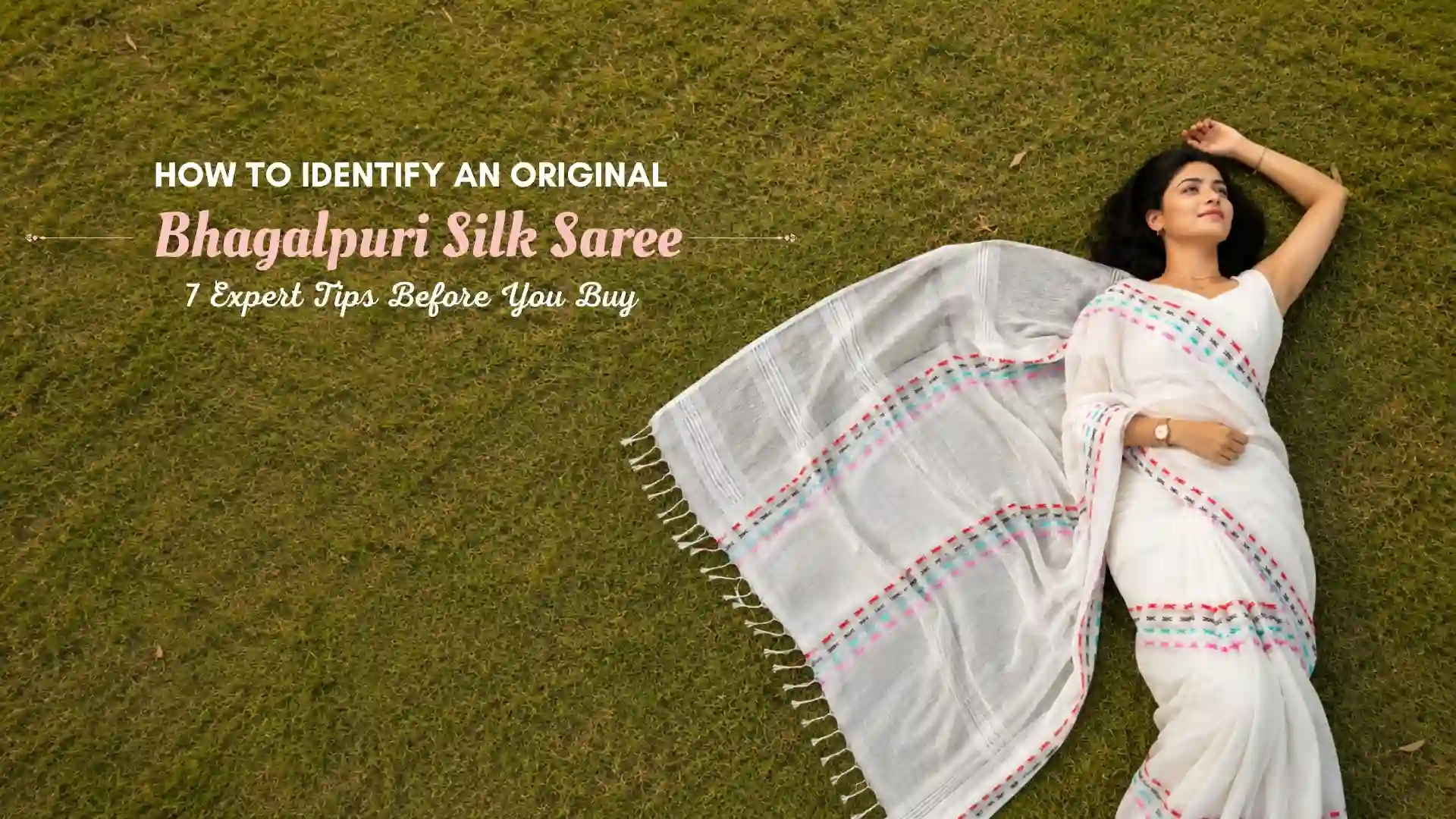
Here’s the short answer. To identify an original Bhagalpuri silk saree, check the GI tag, feel for natural slubs in the weave, run a burn test on a loose thread, and look for a soft matte gold sheen rather than a bright synthetic shine. None of these checks take more than a minute, and together they tell you almost everything.
The tricky part is that Bhagalpur’s fame has made it an easy name to fake. Mills across the country print “Bhagalpuri” on machine woven polyester and sell it at half the price of the real thing, which is exactly why so many buyers who buy sarees online in India search for how to identify an original Bhagalpuri silk saree before they hand over their money. This guide walks you through seven checks that actually work, straight from how weavers themselves judge a genuine piece.
Tip 1: Look For The GI Tag First
Bhagalpur’s silk carries a Geographical Indication tag, which means only silk woven in this specific region of Bihar can legally be called Bhagalpuri. If you want to identify an original Bhagalpuri silk saree without touching the fabric at all, this is the fastest starting point.
Why The GI Tag Matters So Much Here
The tag was granted after Bhagalpur’s silk industry proved its centuries old, region specific weaving tradition, so it isn’t just a marketing label, and it’s the single fastest way to identify an original Bhagalpuri silk saree before you look at anything else. A seller who genuinely stocks Bhagalpuri weaves should be able to show you this tag or at least name the weaving cluster the saree came from.
Where Sellers Usually Display It
Reputable online stores mention the GI status directly on the product page, and physical sarees sometimes carry a woven or printed tag near the selvedge, a small detail that makes it much easier to identify an original Bhagalpuri silk saree while browsing. If a listing calls a saree “Bhagalpuri style” instead of simply “Bhagalpuri,” that wording is often a quiet admission it wasn’t woven there. Shoppers looking to buy silk saree options from a genuine cluster should treat this labelling difference as a non-negotiable filter.
Tip 2: Check The Texture For Natural Slubs
Genuine handloom fabric is never perfectly smooth, and that’s actually the point. To identify an original Bhagalpuri silk saree by touch, run your fingers slowly along the body and pallu.
What Handloom Texture Actually Feels Like
Tussar yarn, the base of most Bhagalpuri weaves, is hand reeled from wild silkworm cocoons, so the thread thickness varies slightly along its length, which is precisely what you’re feeling for when you try to identify an original Bhagalpuri silk saree by touch. This creates tiny raised bumps called slubs, scattered irregularly rather than in a repeating pattern, and they’re the clearest sign of an actual handloom.
What A Copy Feels Like Instead
Machine woven polyester mimicking Bhagalpuri silk feels uniformly smooth from end to end, almost slippery under the palm, and this uniformity is one of the fastest ways to identify an original Bhagalpuri silk saree from a copy without any tools. If a saree marketed as Bhagalpuri has zero texture variation anywhere on its six or nine yards, that consistency is the giveaway, not a good sign.
Tip 3: Do The Burn Test On A Loose Thread
This is the single most reliable test weavers themselves use, and it takes fewer than thirty seconds once you know how to identify an original Bhagalpuri silk saree using it.
How To Do It Without Damaging The Saree
Pull a tiny thread from an inconspicuous spot like the inner hem or a loose selvedge end, hold it with tweezers, and touch a flame to it briefly, since this simple step is how most weavers themselves identify an original Bhagalpuri silk saree in seconds. Real silk is a natural protein fiber and responds very differently to heat than any synthetic ever will.
Reading The Ash And The Smell
Genuine silk burns slowly, self-extinguishes once you pull the flame away, smells like burnt hair, and leaves behind a fine black ash you can crumble between your fingers, which is often enough on its own to identify an original Bhagalpuri silk saree with confidence. Synthetic fabric melts instead of burning, smells like burning plastic, and leaves a hard bead of residue that won’t crumble at all, so this one test alone can settle most doubts.
Tip 4: Feel The Fabric And Listen For The Scroop
Touch and sound together give you a second, independent way to identify an original Bhagalpuri silk saree, especially useful if you can’t do a burn test in a shop.
The Touch Test
Rub a small section of the fabric between your thumb and fingers, a habit worth building if you regularly try to identify an original Bhagalpuri silk saree while shopping in person. Authentic Bhagalpuri tussar feels dry, slightly coarse, and warm rather than cold and glassy, which is the opposite of how synthetic silk typically feels.
The Sound Test, Also Called Scroop
Gently scrunch a handful of the saree near your ear and listen closely, one more low effort way to identify an original Bhagalpuri silk saree before you commit to buying it. Real silk produces a soft rustling or crunching sound from the natural friction between fibers, while synthetic blends stay almost silent when scrunched the same way.
Tip 5: Look For Silk Mark Certification
A hologram tag can save you the trouble of running your own tests, and checking for one is a shortcut worth knowing before you try to identify an original Bhagalpuri silk saree on your own.
What The Silk Mark Hologram Actually Confirms
Silk Mark is a government backed certification managed by the Central Silk Board, and a saree carrying this coded hologram has been lab tested for pure natural silk content, which makes it a useful shortcut whenever you need to identify an original Bhagalpuri silk saree quickly. It won’t tell you whether a saree is specifically Bhagalpuri, but it rules out synthetic blends immediately.
Why This Alone Isn’t Always Enough
Not every genuine handloom saree carries a Silk Mark tag, especially smaller weaver cooperatives that skip formal certification, so its absence doesn’t automatically mean a fake when you try to identify an original Bhagalpuri silk saree this way. This is true whether you’re evaluating a Bhagalpuri tussar piece or something as different as a breathable buy linen saree for summer, since certification habits vary widely by weaver cluster. Treat it as one strong signal among several rather than the final word.
Tip 6: Check The Sheen And Color In Natural Light
Lighting reveals things touch can’t, which makes this one of the easiest ways to identify an original Bhagalpuri silk saree from across a room.
The Matte Gold Glow To Look For
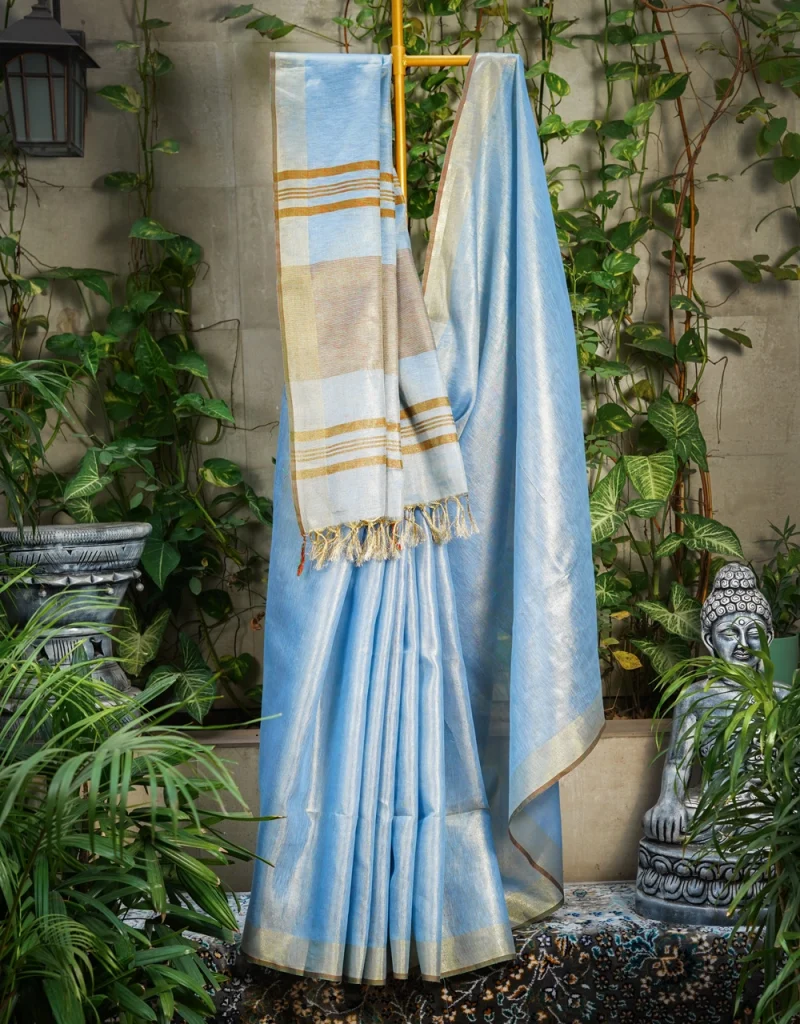
Hold the saree up under daylight and tilt it slightly, since natural light is far more revealing than any showroom bulb when you try to identify an original Bhagalpuri silk saree this way. Genuine Bhagalpuri tussar has a soft, warm, matte gold undertone that shifts gently as the fabric moves, a natural result of the wild silk’s untreated fiber.
Signs You’re Looking At A Synthetic Imitation
Synthetic imitations tend to look flat and uniformly bright, almost metallic under indoor lighting, without that gentle tonal shift, and this alone can help you identify an original Bhagalpuri silk saree even from a photo online. The same logic works when you’re eyeing a linen blend saree instead, since natural fibers of any kind tend to shift tone gently under changing light. If the shine looks the same from every angle, that flatness is usually artificial rather than natural.
Tip 7: Compare The Price To What Handloom Weaving Actually Costs
Price is the last check, but it’s often the first clue that something is off, and understanding it helps you identify an original Bhagalpuri silk saree before you even touch the fabric.
Why Genuine Bhagalpuri Silk Isn’t Cheap
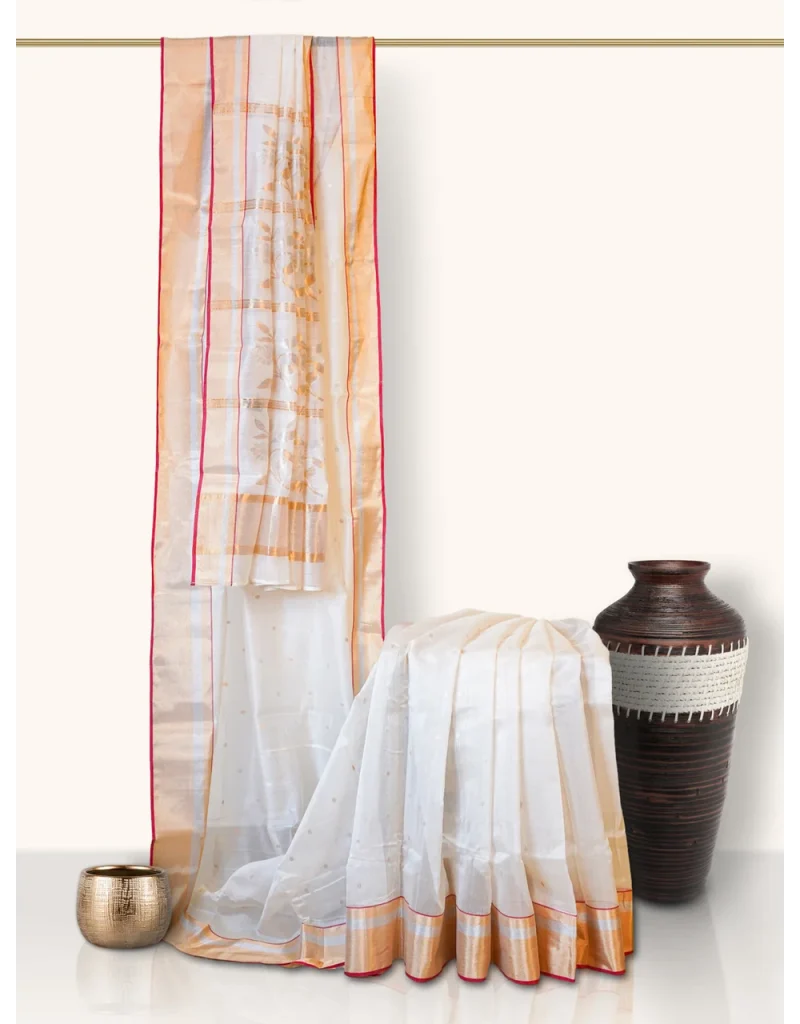
A real Bhagalpuri silk saree involves weeks of cocoon harvesting, hand reeling, dyeing, and weaving pick by pick on a handloom, work that simply cannot be rushed or automated, which is exactly why price matters so much when you identify an original Bhagalpuri silk saree. That labor is reflected in the price, and a heavily discounted “silk” saree at a fraction of typical market rates is rarely the genuine article.
Red Flags Worth Watching For
Be cautious of listings that use “Bhagalpuri” loosely alongside vague terms like “silk finish” or “art silk,” since these phrases usually signal a blend rather than pure tussar and make it harder to identify an original Bhagalpuri silk saree from the description alone. A trustworthy seller like Siakari will state the fiber content and weaving origin clearly instead of relying on ambiguous language, whether you’re comparing it against a buy tussar silk saree listing or any other weave.
Final Thoughts On How To Identify An Original Bhagalpuri Silk Saree
Between the GI tag, the natural slubs, the burn test, and the matte gold sheen, you now have enough tools to identify an original Bhagalpuri silk saree with real confidence, whether you’re shopping online or holding one in your hands. No single test is foolproof alone, but two or three of them agreeing is as close to certainty as you’ll get outside a lab.
If you’d rather skip the guesswork entirely, Siakari sources its Bhagalpuri and other handloom weaves directly from certified artisans, so the work of learning to identify an original Bhagalpuri silk saree is already done for you before it reaches your doorstep. Whether you’re drawn to a rustic tussar drape or a lighter cotton silk saree for daily wear, buying from a transparent source is still the surest way to bring home the real thing.
Your Bhagalpuri silk saree is waiting
FAQs
Is Bhagalpuri silk the same as Tussar silk?
Yes, largely. Bhagalpuri silk is a regional style of Tussar silk woven specifically in and around Bhagalpur, Bihar, which is why people trying to identify an original Bhagalpuri silk saree often see both names used together, much like how a buy tissue silk saree search can mean several different weaving styles depending on the seller.
Can a Bhagalpuri saree be machine woven and still be genuine?
No. Authentic Bhagalpuri silk is defined by its handloom weaving process, and if you’re trying to identify an original Bhagalpuri silk saree, a machine woven version, even using real silk yarn, doesn’t carry the same GI protected identity.
Does a lower price always mean a fake?
Not always, but it’s a strong warning sign. Genuine handloom weaving has a real labor cost, so if your goal is to identify an original Bhagalpuri silk saree, an unusually cheap listing deserves extra scrutiny before you buy.
What’s the quickest single test if I only have a minute?
The burn test on a loose thread is the fastest and most reliable way to identify an original Bhagalpuri silk saree at home, giving you a clear answer through smell and ash within seconds.
Leave a Reply